

More news on this day
Hundreds of travellers across Australia and New Zealand are experiencing extended delays and cancellations as a wave of operational disruptions affects at least 586 flights and leads to 44 cancellations across major hubs including Melbourne, Sydney, Auckland and Christchurch.
Get the latest news straight to your inbox!
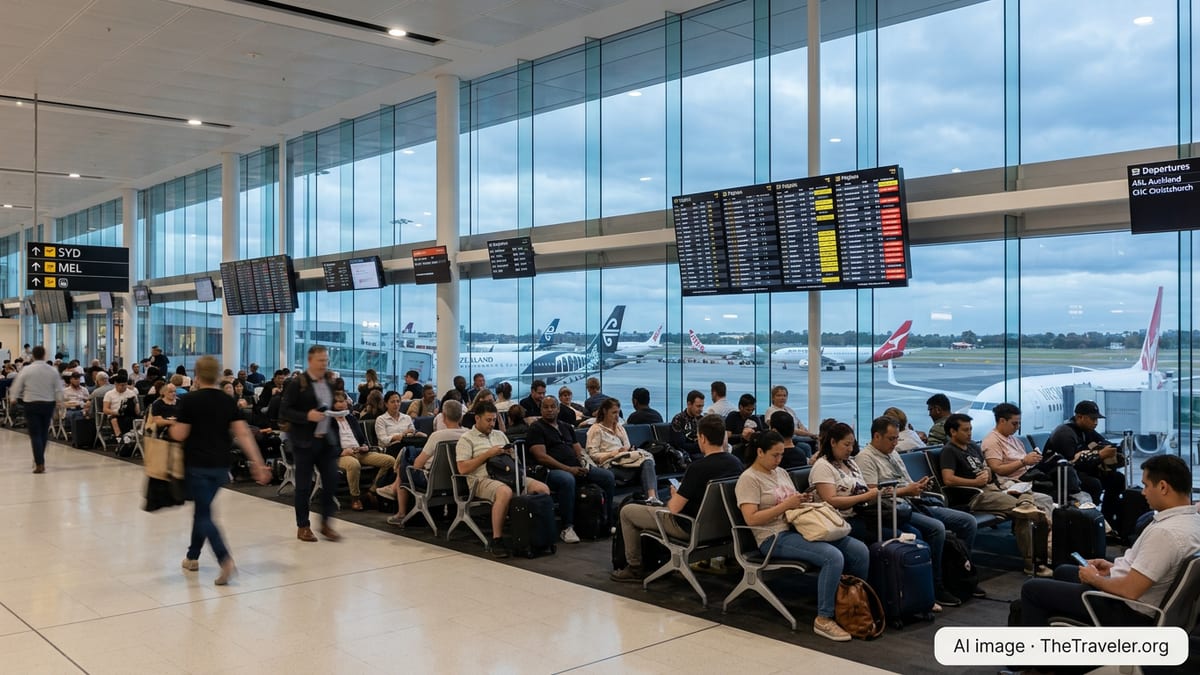
Major Hubs Across the Tasman Disrupted
Air travel across the trans-Tasman corridor has been heavily affected, with delays and cancellations concentrated at the busy gateways of Melbourne, Sydney, Auckland and Christchurch. Reports indicate that regional airports feeding into these hubs are also experiencing knock-on disruption as aircraft and crews fall out of position.
The latest data points to 586 delayed services and 44 outright cancellations across multiple carriers, including Jetstar, Virgin Australia and Air New Zealand. These impacts are being felt on both domestic and international routes, with trans-Tasman services particularly exposed due to the tight scheduling that typically links New Zealand and Australian networks.
Publicly available flight tracking information shows clusters of late departures and arrivals across the day rather than a single isolated window, suggesting a broad operational strain rather than one-off localised weather. The result for travellers is a mix of long waits at departure gates, missed onward connections and rebooked itineraries stretching into the following day.
Weekend and school-holiday travel demand has amplified the pressure, leaving many services already close to capacity and reducing the options available for rapid reaccommodation of disrupted passengers.
Jetstar, Virgin Australia and Air New Zealand Among Affected Carriers
Low-cost and full-service airlines are both heavily represented in the disruption figures. Jetstar and Virgin Australia are among the most affected Australian-based carriers, while Air New Zealand is seeing similar operational challenges on the New Zealand side of the Tasman and on connecting domestic routes.
Published coverage of recent performance trends for these airlines highlights that punctuality across the region has been under strain for several months, with operational buffers frequently narrowed by strong demand and tight fleet utilisation. The current spike in delays and cancellations appears to have brought those underlying pressures into clear focus for travellers.
While individual carriers have been updating disruption information through their own channels, passengers at airports in Melbourne, Sydney, Auckland and Christchurch are largely relying on departure boards and mobile alerts to track shifting departure times. In many cases, rolling delays have turned what began as minor schedule changes into multi-hour waits.
Some flights have been cancelled after extended postponements, requiring travellers to seek alternative services or overnight accommodation, particularly where the last departures of the day have been affected.
Causes Range from Weather to Operational Constraints
Publicly available information points to a combination of contributing factors behind the current wave of disruption. Localised weather systems have intermittently reduced capacity at key airports, briefly slowing arrivals and departures and creating initial backlogs in already busy schedules.
Operational constraints are also playing a significant role. Tight turnaround times, aircraft availability and crew rostering have all come under pressure once delays begin to cascade through the network. Once morning services depart late, subsequent rotations can remain behind schedule well into the evening, particularly on multi-sector domestic and trans-Tasman routes.
Industry data released in recent months has shown that on-time performance for several airlines in both Australia and New Zealand has been trending below pre-pandemic benchmarks. The scale of the current disruption, with hundreds of delayed flights across a single operating period, reflects how quickly networks can become congested when a mix of weather, technical checks and staffing constraints intersect.
At some airports, runway and air traffic management restrictions have further limited the ability to recover timetables quickly, forcing carriers to consolidate flights or cancel select services to rebalance aircraft and crew.
Travellers Face Long Queues, Missed Connections and Rebookings
The immediate impact on travellers has been visible in lengthy check-in queues, crowded departure lounges and busy customer service desks as passengers seek new options. Reports from airports across Melbourne, Sydney, Auckland and Christchurch describe families, business travellers and international tourists all contending with extended waits and uncertainty over revised departure times.
Those with onward connections, particularly on long-haul itineraries to North America, Asia and Europe, are among the hardest hit. Missed connections can require complete rebooking of complex journeys, with some passengers facing unplanned overnight stays as the final departures of the day from key hubs depart without them.
Many travellers are turning to airline apps and third-party flight tracking tools for the most current information, while others are attempting to rebook via online channels to avoid airport queues. However, high loads on alternative flights are limiting availability, and some passengers are finding that only next-day services can accommodate them.
Travel insurers are expected to receive an uptick in claims relating to delay expenses, additional accommodation and missed pre-paid arrangements, as disrupted passengers seek to recover some of the financial impact of the widespread schedule changes.
What Passengers Can Do as Disruption Continues
With delays and cancellations still working their way through airline schedules, travellers due to fly in or out of Melbourne, Sydney, Auckland, Christchurch and other affected airports are being advised by publicly available guidance to monitor their flights closely before heading to the airport. Checking the status of services on airline channels shortly before departure remains one of the most practical steps passengers can take.
Travel experts routinely recommend allowing extra time at the airport during periods of operational strain. Earlier arrival can help mitigate the impact of longer check-in and security queues and provide more options if last-minute changes occur. For those with same-day connections, longer layovers may offer a buffer against rolling delays.
Where flights are cancelled, publicly accessible airline policies generally outline options that can include rebooking on the next available service, credit vouchers or refunds, depending on the fare type and circumstances of the disruption. Travellers are encouraged in consumer guidance materials to retain receipts for additional accommodation, meals and ground transport in case these are needed for later claims.
With the current round of disruption highlighting how quickly networks in Australia and New Zealand can be affected, regular passengers across the Tasman are likely to continue building greater flexibility into their plans, especially during busy travel periods or when severe weather and operational pressures are in the forecast.