

More news on this day
Hundreds of passengers travelling between Australia and New Zealand faced extensive disruption today, as Qantas, Network Aviation, Sounds Air and several other carriers reported a surge of 395 delayed flights and 13 cancellations across key airports including Melbourne, Sydney, Wellington and Picton.
Get the latest news straight to your inbox!
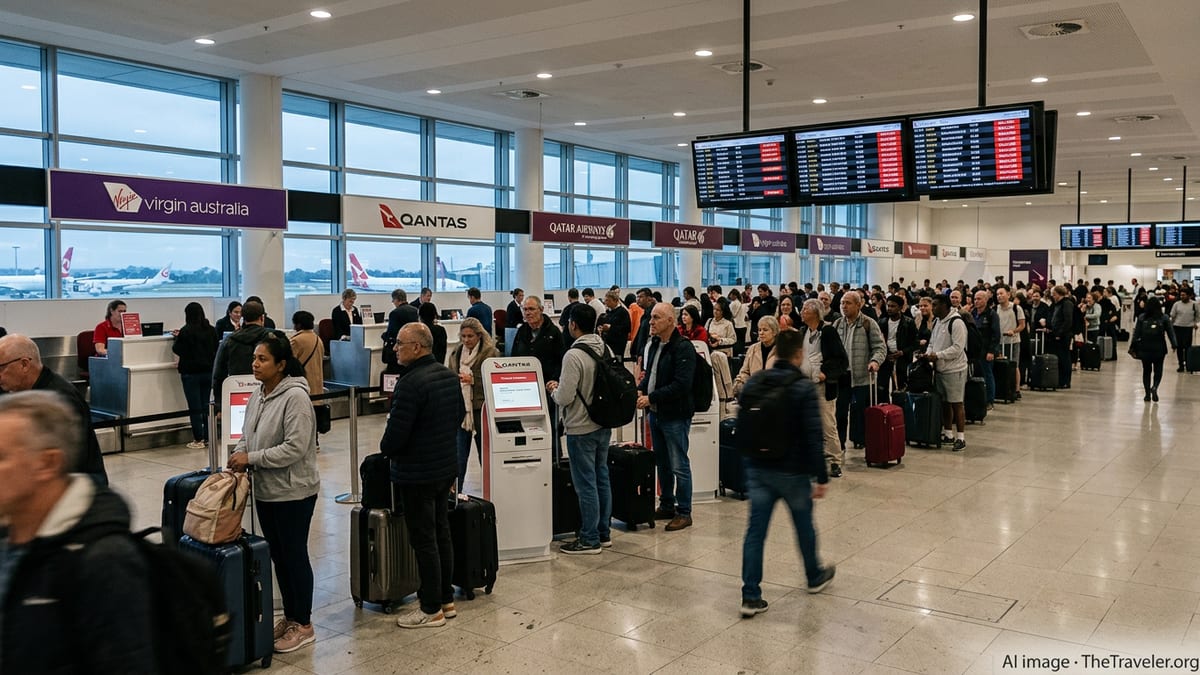
Delays Ripple Across Major Trans-Tasman Gateways
The latest disruption has unfolded across some of the region’s busiest aviation hubs, with Melbourne and Sydney in Australia and Wellington in New Zealand among the most affected. Publicly available operational data for the day indicate mounting schedule pressure on short-haul domestic and trans-Tasman routes, resulting in crowded terminals and extended wait times for passengers.
Melbourne Tullamarine and Sydney Kingsford Smith continue to anchor much of the traffic between Australia’s eastern states and New Zealand, and both airports have a history of weather-related and traffic-management delays during peak periods. Recent on-time performance statistics published for these hubs show that services between Melbourne and Sydney regularly experience elevated delay and cancellation rates compared with longer-haul routes, leaving little slack in the system when disruption strikes.
On the New Zealand side, Wellington and smaller regional gateways such as Picton have seen growing reliance on regional carriers for connectivity to larger hubs. Industry reporting has previously highlighted how smaller airports can be particularly vulnerable when a single aircraft or crew rotation is disrupted, with a single cancellation or extended delay cascading through several subsequent services.
Today’s pattern of 395 delays and 13 cancellations across the wider Australia–New Zealand corridor reflects those structural pressures, with the impact felt not only at primary hubs but also across regional spokes feeding into them.
Qantas and Network Aviation Under Operational Strain
Qantas and its regional subsidiary Network Aviation are among the carriers most visible in today’s disruption pattern. While recent performance analyses have noted that many individual Qantas services post competitive on-time records, broader data and past reporting have pointed to elevated cancellation rates on some domestic Australian routes, particularly where aircraft utilisation is high and spare capacity is limited.
Industry commentary in recent years has drawn attention to the challenge of operating older aircraft and dense schedules across Australia’s vast domestic network. Network Aviation, which operates charter and regional services primarily in Western Australia under the QantasLink banner, has been in the spotlight over fleet renewal and maintenance cycles. Aviation community discussions have noted the gradual retirement of older Fokker aircraft, a process that can temporarily tighten fleet availability and increase the risk that any technical or staffing issue will translate quickly into disruption.
Operational reports and traveller accounts suggest that once delays begin to accumulate in the Qantas and QantasLink systems, they can propagate quickly, especially through key hubs such as Sydney and Melbourne. A late-arriving aircraft on a morning sector may lead to knock-on delays across several subsequent flights, affecting passengers far from the original source of the problem.
Today’s figures for delays and cancellations indicate that this kind of cascading effect is again playing out, with rotation-sensitive regional and charter services particularly exposed when schedule buffers are thin.
Sounds Air and Regional Routes Feel the Pressure
Across the Tasman, regional operator Sounds Air is among the smaller carriers contending with today’s volatility. The airline plays a crucial role in connecting communities across the upper South Island and lower North Island, with routes that link smaller centres to Wellington and other hubs. Previous coverage in New Zealand media has documented how the airline has already scaled back certain routes in recent years, citing high operating costs and a challenging regional aviation environment.
Those earlier changes underscored how fragile regional connectivity can be when margins are tight and demand is uneven. In that context, the latest day of extensive delays and cancellations highlights how quickly regional services can be disrupted when weather, operational constraints or air traffic management measures affect already slim schedules.
Picton, a key gateway for ferry and tourism traffic in the Marlborough region, relies on small regional aircraft and a limited number of daily services. Any cancellation there can have an outsized effect on passengers trying to connect with ferries, road journeys and onward flights. Today’s disruption has again illustrated how travellers in smaller centres often have fewer alternative options when flights are delayed or cancelled at short notice.
Regional aviation analysts in New Zealand have regularly pointed to a long-term need for more resilient scheduling, stronger financial support mechanisms and infrastructure upgrades at smaller airports to reduce the vulnerability of communities to single-day shocks of the kind now being recorded.
Weather, Congestion and Operational Complexity Drive Disruption
While a single root cause is rarely identified for a day of disruptions of this scale, recent patterns in the region point to a familiar combination of factors: changeable weather, congested airspace and increasingly complex airline operations. In Australia, published accounts from pilots, air traffic sources and travellers alike have described how strong winds, low visibility and runway constraints at Sydney can trigger “ground delay” programs in which flights are held or metered, often for extended periods.
When such restrictions coincide with busy holiday or business periods, airlines may respond by consolidating lightly booked services or rearranging aircraft assignments, which can in turn result in same-day cancellations or longer delays on secondary routes. Reports in Australia and New Zealand have also emphasised how tight crew scheduling and high aircraft utilisation leave little flexibility to recover from unexpected technical or weather-related issues.
Across the wider Asia-Pacific region, recent travel-industry monitoring has recorded several days of elevated disruption at major hubs, with thousands of delays and hundreds of cancellations across multiple carriers. Today’s events in the Australia–New Zealand market fit that broader pattern, suggesting that capacity constraints and ongoing operational headwinds continue to challenge airlines as they attempt to meet robust post-pandemic travel demand.
The mix of full-service and regional operators involved in the current disruption highlights that no single business model is immune when network complexity is high and infrastructure capacity is stretched.
Travellers Confront Missed Connections and Uncertain Plans
For passengers, the operational story translates into missed connections, rebooked itineraries and unplanned overnight stays. With 395 flights delayed and 13 cancelled today across affected airports, many travellers have found themselves facing long queues at service desks, changing departure boards and complex rerouting through alternative hubs.
Consumer advocacy groups in both Australia and New Zealand have previously called attention to the limited compensation frameworks available to travellers affected by delays and cancellations, particularly when disruptions are attributed to weather or air traffic control rather than airline decisions. That context informs how today’s events are likely to be experienced, with many passengers relying on standard rebooking policies, travel insurance and personal resources to manage the fallout.
Travel information services continue to advise passengers in the region to monitor airline apps and airport departure boards closely, arrive early for departures and build additional time into itineraries involving connections across multiple carriers or smaller regional airports. Given the recurring nature of recent disruptions, some analysts also suggest that travellers consider scheduling critical journeys earlier in the day, when operational buffers can be slightly larger and recovery options more plentiful.
As airlines across Australia and New Zealand work through today’s backlog, attention is already turning to how the disruptions will affect early-morning departures and trans-Tasman services tomorrow, with the potential for residual delays to linger even after weather and traffic conditions improve.