

More news on this day
Thousands of travelers across China are facing extensive flight disruptions after more than 1,700 delays and over 100 cancellations were recorded at major hubs including Beijing, Shanghai and Shenzhen, affecting operations at carriers such as Air China, China Eastern and Hainan Airlines.
Get the latest news straight to your inbox!
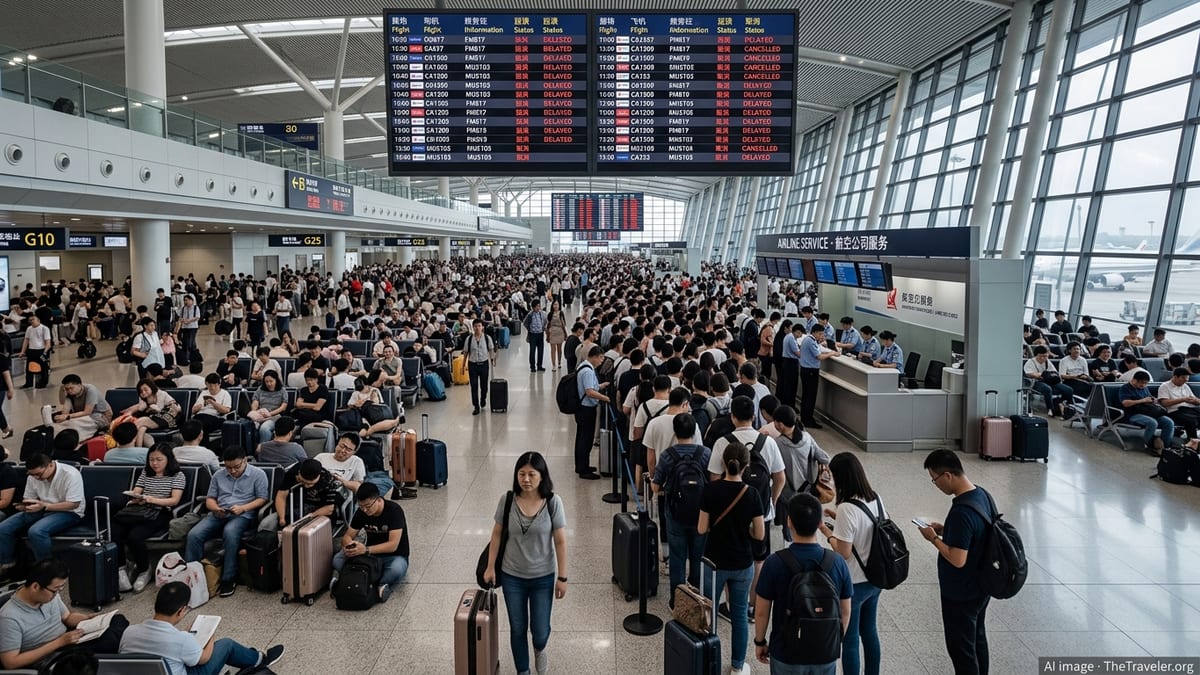
Widespread Disruptions Across China’s Busiest Airports
Publicly available flight-tracking data and media coverage indicate that a total of 1,714 flights were delayed and 115 services were cancelled in a single day across multiple Chinese cities, with the heaviest disruption concentrated at large hubs such as Beijing, Shanghai, Guangzhou and Shenzhen. The figures point to one of the more severe single-day operational snarls seen in China’s rapidly recovering aviation market this year.
Major state and privately owned airlines, including Air China, China Eastern and Hainan Airlines, feature prominently in the delay and cancellation tallies. The disruptions span both domestic and international routes, affecting passengers connecting through China on long-haul itineraries as well as those traveling on short sectors between coastal and inland cities.
While the exact breakdown of delays by carrier and airport continues to evolve as data is updated, the scale of the disruption underscores how sensitive China’s dense aviation network remains to periods of sudden strain. Even small scheduling shocks at a few key hubs can ripple quickly through the system, leading to missed connections, forced overnight stays and significant rebooking challenges for travelers.
The disruption has coincided with a period of elevated demand, as China’s outbound tourism continues to rebuild and business travel remains strong in several economic centers. This combination of high load factors and congested airport operations has made it harder for airlines to absorb irregular operations without knock-on effects.
Impact on Travelers: Missed Connections and Extended Layovers
For passengers, the consequences of 1,714 delayed flights and more than a hundred cancellations are being felt in longer queues, missed onward connections and extended layovers at some of China’s busiest terminals. Reports shared on airline forums and travel platforms describe travelers stuck in Beijing Capital and Beijing Daxing, Shanghai Pudong and Hongqiao, and Shenzhen Bao’an as they wait for updated departure times or alternative routings.
Many of the affected itineraries involve multi-leg journeys, where a delay on an initial domestic leg quickly cascades into missed long-haul flights to Europe, the Middle East or Southeast Asia. In practice, this has meant complicated rebookings for passengers flying, for example, from inland Chinese cities to Shanghai or Beijing and then on to international destinations on Air China, China Eastern or Hainan Airlines.
Travelers stranded overnight have reported being offered hotel accommodation in some cases, while others have faced long hours in crowded departure halls when suitable onward flights were not immediately available. For those on tight schedules, including business travelers and passengers with onward rail or tour arrangements, these unplanned delays can translate into additional accommodation costs, rearranged itineraries and lost time.
The disruptions are also complicating the experience for first-time visitors to China, many of whom are navigating language barriers, unfamiliar airport layouts and differing airline policies around compensation and support. In such an environment, access to accurate, real-time information about flight status and rebooking options becomes especially critical.
Airlines Respond With Schedule Adjustments and Waivers
In response to the disruption, publicly available notices and customer updates show that airlines including Air China, China Eastern and Hainan Airlines have been adjusting schedules, consolidating lightly booked flights and opening additional customer service channels to handle increased volumes of change requests. In several cases, carriers have promoted flexible change policies that allow passengers on affected routes to modify travel dates or reroute without extra charges.
These measures build on a broader trend in China’s aviation sector, where major airlines have increasingly turned to ticket change waivers during episodes of large-scale disruption, whether caused by weather, regional airspace constraints or operational bottlenecks. Such policies can ease immediate pressure at airport counters, but they do not always resolve the underlying congestion if alternative seats remain limited.
Operationally, airlines have been prioritizing aircraft and crew for routes with the highest passenger volumes and strategic importance, particularly flights connecting Beijing, Shanghai and other tier-one cities. However, this can leave smaller markets more vulnerable to sudden cancellations if spare capacity is needed elsewhere in the network.
Industry observers note that the disruptions are occurring amid a complex operating environment that includes tight aircraft utilization, ongoing fleet transitions and adjustments to international schedules. These factors can reduce the spare capacity available to absorb irregular operations, making a single day of elevated delays and cancellations more disruptive than similar events might have been before the pandemic.
Factors Behind the Spike in Delays
Available operational data and recent research on aviation performance in the region suggest that a combination of factors is likely contributing to the spike in delays. Weather remains a perennial challenge for Chinese hubs, particularly when low visibility or thunderstorms affect large swaths of airspace around Beijing, Shanghai and the Pearl River Delta, forcing ground stops or reduced traffic flow rates.
Airspace congestion and route restrictions can further compound these issues. China’s air corridors remain among the busiest in the world, and rerouting around temporarily closed sectors can lengthen flight times and strain carefully planned schedules. When multiple carriers attempt to recover at once, taxiway and runway bottlenecks at hub airports can quickly appear.
On the ground, staffing and resource allocation also play a role. As airlines and airports continue to ramp up operations to meet resurgent demand, any mismatch between staffing levels, aircraft availability and flight schedules can translate into slower turnaround times and missed slot windows. Even minor technical checks or crew timing constraints may then trigger wider knock-on delays.
Analysts studying post-pandemic aviation trends have highlighted how delay propagation can be more severe in highly connected networks, where a significant share of flights are tightly banked around peak departure and arrival waves. With carriers such as Air China, China Eastern and Hainan Airlines operating extensive domestic and international networks from shared hubs, recovery from one disrupted wave can easily spill into the next.
What Travelers Can Do if Their Flight Is Affected
For travelers currently in China or planning imminent trips, aviation and consumer guides recommend monitoring flight status directly through airline channels and reputable flight-tracking services, and checking regularly rather than waiting for a single notification. With so many flights delayed, departure times can shift more than once in a short period as airlines reshuffle schedules.
Passengers whose flights are significantly delayed or cancelled are generally advised to contact their airline or booking agent as soon as possible to explore rebooking options, including alternative routings via other hubs. In periods of widespread disruption, seats on popular routes may be snapped up quickly, so acting early can improve the odds of securing an acceptable alternative.
Travel insurance policies that include trip interruption or delay coverage can offer an additional layer of protection, potentially reimbursing costs such as extra accommodation, meals or missed prepaid arrangements, subject to policy terms. Travelers are often encouraged to keep receipts, note times of disruption and retain any documentation provided by airlines to support later claims.
For those with flexibility, postponing nonessential trips or shifting travel away from peak times can help avoid the worst of the congestion. As airlines work through the backlog created by 1,714 delays and 115 cancellations, conditions at key hubs such as Beijing, Shanghai, Guangzhou and Shenzhen are expected to gradually stabilize, but further knock-on effects remain possible in the short term.