

More news on this day
Hundreds of travelers transiting Egypt have been left stranded after widespread schedule disruptions involving 227 delayed flights and 29 cancellations by Gulf Air, Saudia, Emirates, ITA Airways, and Air Cairo on routes linking Egyptian airports with Dubai, Doha, Sharjah, Hurghada, and Baghdad.
Get the latest news straight to your inbox!
Airspace Restrictions Trigger Widespread Operational Cuts
Publicly available flight data and industry tracking in March 2026 indicate that continuing airspace restrictions across parts of the Middle East have forced multiple carriers to trim or suspend services, with Egypt emerging as one of the most heavily affected transit points. Gulf Air, Saudia, Emirates, ITA Airways, and Air Cairo have all reduced or reshaped schedules on key corridors connecting Cairo and other Egyptian airports to Gulf hubs such as Dubai, Doha, and Sharjah, as well as regional destinations including Hurghada and Baghdad.
Schedule snapshots and airline notices show that many of the 29 outright cancellations involve services that would typically carry passengers onward to or from the wider Gulf region, amplifying the impact on travelers who rely on Egypt as a connecting gateway. The 227 delays recorded across recent days span both inbound and outbound operations, with knock-on effects for crews, aircraft rotations, and connecting itineraries.
Analysts note that Egypt’s geographic position between Europe, Africa, and the Gulf means any disruption to Middle East airspace is quickly felt in Cairo and other major airports. Reduced routings and longer flight paths around restricted zones have increased travel times and tightened aircraft utilization, leaving less margin to absorb operational hiccups and weather or technical issues.
Passengers Face Overnight Stays, Missed Connections, and Uncertainty
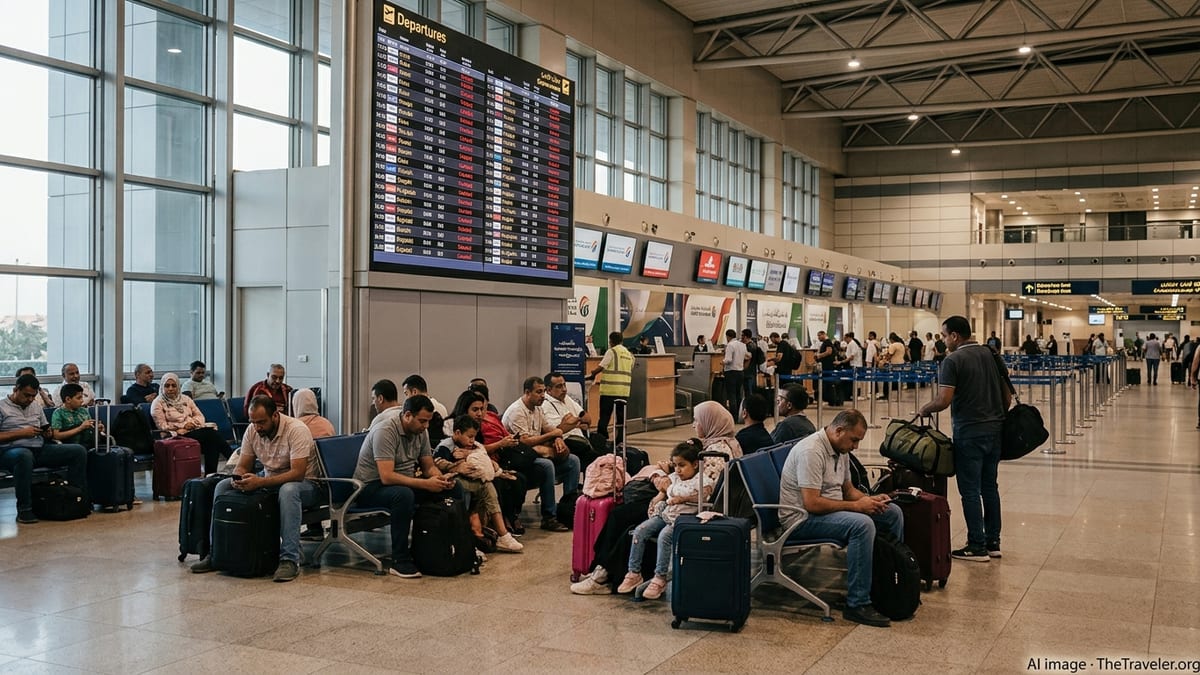
Reports from affected travelers describe crowded terminals, ad hoc overnight stays, and long waits for rebooking as the disruptions ripple through Egypt’s main airports. Many passengers connecting from European or African cities via Cairo and Hurghada to Gulf or regional destinations have found themselves stuck mid-journey when onward flights to Dubai, Doha, Sharjah, or Baghdad are delayed or removed from the schedule.
Some itineraries built around tight transfer windows have collapsed under the strain of rolling delays, forcing travelers to spend unexpected nights in Egypt while waiting for the next available departure. In several cases, passengers who had already endured lengthy reroutings to avoid restricted airspace have then faced further delays on short-haul segments within the region, compounding fatigue and out-of-pocket expenses.
Travel forums and social media posts reference uncertainty at departure boards, with flights shifting from on time to delayed, then to canceled as operational constraints evolve. While airlines have been providing vouchers or hotel accommodation in some situations, passengers report uneven experiences depending on the carrier involved, the type of ticket purchased, and whether the disruption is classified as within the airline’s control or attributable to wider airspace issues.
Carriers Adjust Egypt–Gulf and Regional Networks
According to published coverage and timetable data, Emirates has been operating a reduced schedule across selected Middle East routes, which has in turn affected some services touching Cairo and other Egyptian gateways. This more limited pattern of operations has led to fewer available connection options through Dubai for passengers originating in Egypt, making it harder to rebook travelers from canceled flights without substantial delays.
Gulf Air has faced extended suspensions of services involving Bahrain, which has disrupted a traditional connecting link between Egypt and Gulf destinations. As these flights feed traffic onward to cities such as Doha and Dubai via regional interline arrangements, their removal from the network has contributed to the tally of delays and cancellations affecting Egypt-based passengers.
Italian flag carrier ITA Airways has curtailed use of several Middle Eastern airspace corridors and temporarily halted services to and from Dubai, reducing an important alternative for travelers routing between Europe and the Gulf via Egypt. Saudia and Air Cairo, both with dense schedules within the region, have also made adjustments that reduced capacity on routes linking Cairo, Hurghada, and other Egyptian cities with Gulf hubs and Baghdad, reinforcing the bottlenecks.
Knock-On Impact at Cairo, Hurghada, and Regional Airports
Cairo International Airport, already one of the busiest hubs in Africa and the Middle East, has experienced surges of stranded transit passengers when outbound flights toward Dubai, Doha, or Sharjah are delayed or scrubbed. With many travelers booked on through-tickets, a single cancellation can disrupt multiple onward connections, including links to South and Southeast Asia that rely on Gulf hubs as intermediaries.
Hurghada, better known as a Red Sea leisure destination, has also played a role in the disruption, particularly for holidaymakers and seasonal workers using point-to-point flights or indirect routings via Gulf cities. When aircraft scheduled to connect Hurghada with Dubai or Doha are delayed or repositioned, local hotels and transport providers must accommodate unexpected surges in overnight stays and last-minute changes.
Services to Baghdad and other Iraqi destinations have been especially sensitive to evolving airspace restrictions, which can trigger sudden cancellations or reroutings. Passengers traveling between Iraq and Egypt, or using Baghdad as part of a wider itinerary involving the Gulf, face an added layer of uncertainty as carriers weigh safety considerations, overflight permissions, and the availability of alternative routings.
What Travelers Can Do Amid Continuing Disruptions
Travel rights advocates suggest that passengers affected by the 227 delays and 29 cancellations document all communication with airlines and retain receipts for hotels, meals, and ground transport incurred during unexpected stays in Egypt. Depending on the origin and destination of each leg, as well as the operating carrier, some travelers may be eligible for reimbursement of expenses or fixed-sum compensation under regional and international passenger protection frameworks.
Consumer guidance circulating in travel forums emphasizes the importance of checking flight status repeatedly in the 24 hours before departure, particularly for itineraries involving the Middle East. Travelers are being encouraged to allow longer connection times in Cairo and other Egyptian airports, and to consider flexible or changeable fares when routing through regions where airspace conditions are fluid.
With airspace restrictions and adjusted schedules expected to continue in the near term, industry observers anticipate that Egypt’s role as a transit and leisure hub will remain under pressure. For now, travelers planning routes that rely on Gulf Air, Saudia, Emirates, ITA Airways, or Air Cairo on sectors between Egypt and destinations such as Dubai, Doha, Sharjah, Hurghada, and Baghdad are being advised to prepare for possible last-minute changes and to build additional time into their journeys.