

More news on this day
Australia’s east coast aviation network has been thrown into disarray, with at least 55 flight cancellations and more than 400 delays reported across Melbourne, Sydney and Brisbane as major international and domestic airlines struggle to keep services running on schedule.
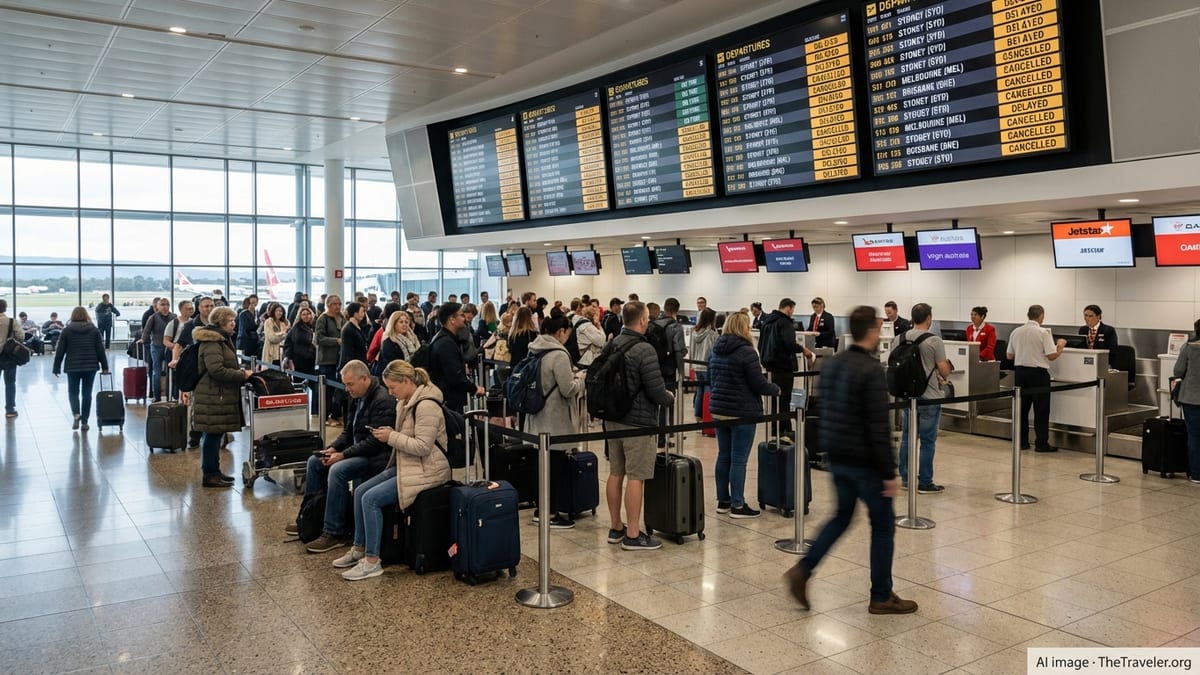
Airports Struggle as Cancellations and Delays Mount
Melbourne, Sydney and Brisbane airports reported heavy operational strain as rolling delays built across morning and afternoon peaks, rapidly turning routine schedule slippage into a full-blown disruption event. Real-time tracking data showed a sharp spike in late departures and arrivals, with knock-on effects rippling through domestic and long-haul networks serving the east coast gateway cities.
Across the three hubs, at least 55 services were cancelled outright while about 412 flights were recorded as delayed, according to aggregated flight-monitoring feeds and airport operational updates. The disruption affected both domestic shuttles between the major capitals and international links to key transit hubs in the Middle East, Asia and North America.
Airport staff reported swelling queues at check-in and security, as well as congestion at boarding gates where rolling last-minute time changes left passengers uncertain about when – or even if – they would depart. Terminal display boards at all three airports showed pages of departures and arrivals tagged as delayed, with some pushed back by more than two hours.
Ground handling crews and air traffic managers worked to resequence departures and squeeze in late-running arrivals between already congested slots, but industry sources said the high utilisation of aircraft across Australian fleets left limited room to recover once early delays began compounding.
Major Carriers Hit Across Domestic and International Networks
Virgin Australia, Qantas and Jetstar bore much of the domestic brunt, with repeated delays on trunk routes linking Melbourne, Sydney and Brisbane, and additional turbulence on services to Adelaide, Perth and the Gold Coast. On-time performance for some carriers dipped well below recent monthly averages, underscoring how quickly schedule reliability can be undermined when several problem flights stack up on the same day.
International operations were also affected, with Emirates, Qatar Airways, Etihad Airways and United Airlines among the global carriers forced to hold or retime services. Long-haul departures to and from Dubai, Doha, Abu Dhabi and major US gateways were pushed back as aircraft awaited connecting passengers, ground slots or inbound aircraft arriving late from previous sectors.
Airline representatives said a mix of contributing factors was at play, including aircraft rotation challenges, crew availability, congestion on approach and departure paths, and weather-related spacing requirements that reduced runway throughput during peak times. While each airline stressed that safety was not compromised, they acknowledged that the operational complexity of modern networks leaves limited margin for error once delays begin to accumulate.
Some carriers activated contingency measures such as swapping equipment to larger aircraft on heavily affected routes, extending crew duty periods within regulatory limits, and capping last-minute bookings to avoid oversaturating already strained services. However, aviation analysts noted that with aircraft fleets running close to full utilisation, options for rapid recovery remained constrained.
Passengers Face Long Queues, Missed Connections and Extra Costs
For travellers, the disruption translated into lengthy queues, anxious waits at departure gates and a scramble to salvage onward journeys. Families beginning holidays, business travellers on tight schedules and international visitors connecting through the east coast hubs all faced the risk of missed meetings, forfeited hotel bookings and rearranged ground transport.
Airport concourses in Melbourne, Sydney and Brisbane saw clusters of passengers gathered around information screens and airline service desks as they sought clarity on revised departure times or alternative routings. Many turned to airline apps and social media channels to obtain faster updates than those available over crowded service counters.
Travel insurers and consumer advocates advised affected passengers to keep detailed records of disruption-related expenses, such as hotel stays, meals and alternative transport costs, as they navigated reimbursement policies that vary between carriers and insurance providers. While airlines typically provide assistance when delays or cancellations are within their control, support can be more limited where disruptions intersect with weather or broader airspace constraints.
Seasoned travellers reported relying on carry-on-only packing, flexible itineraries and generous buffer times around critical connections to help manage the uncertainty. However, for many leisure travellers and families with children, the sheer volume of delayed flights meant hours spent in crowded terminals with limited seating and stretched food and beverage facilities.
Operational Pressures Expose Fragility in the Flight Network
The scale of cancellations and delays across Australia’s busiest corridors highlighted the ongoing fragility of the post-pandemic aviation system, even as passenger numbers return to or surpass pre-2020 levels. Airlines are operating intense schedules to meet strong demand, but this leaves networks vulnerable when several small disruptions coincide on the same day.
Aviation observers noted that east coast hubs are especially sensitive to rolling delays because of their dense banked schedules and reliance on short-haul shuttle flights that turn around quickly. When an early-morning rotation departs late from one city, the same aircraft often remains behind schedule for the rest of the day, multiplying the impact for passengers booked on later legs.
Industry data from recent months shows that on-time performance across Australian domestic routes has hovered below long-term averages, reflecting the combined pressure of high utilisation, infrastructure constraints and weather volatility. While airlines and airports have invested in new technology to improve forecasting and gate management, systemic improvements have lagged the rapid rebound in demand.
Analysts warned that without additional resilience measures, including more flexible fleet deployment, improved crew rostering and infrastructure upgrades to increase runway and terminal capacity, similar large-scale disruption events are likely to recur, particularly during peak holiday and long-weekend periods.
What Travellers Can Do on High-Disruption Days
With disruption now a recurring feature of busy travel days, passenger behaviour has become an important factor in minimising individual stress. Travel planners recommend booking earlier flights where possible, as morning departures are statistically more likely to leave on time than services later in the day that depend on multiple earlier rotations.
Passengers are also urged to monitor flight status closely from 24 hours before departure, using both airline apps and airport information feeds. Early awareness of creeping delay times can give travellers more options, including rebooking to alternative services before they fill, adjusting transfer plans or requesting assistance for vulnerable passengers such as children and older travellers.
Experts further suggest allowing wider connection windows between domestic and international legs, especially when travelling through Sydney, Melbourne or Brisbane. While tight connections can seem attractive when booking, they offer little buffer when system-wide disruption hits and can quickly turn a short connection into an overnight stay and re-ticketing exercise.
Despite the day’s turbulence, industry insiders maintain that Australia’s aviation sector remains fundamentally safe and resilient, but acknowledge that passengers will increasingly need to build flexibility into their plans. For those queued in crowded terminals watching departure boards flicker from “on time” to “delayed,” the message is clear: on high-pressure days, patience and preparation are as essential as a boarding pass.