

More news on this day
Passengers transiting Cairo International Airport on Tuesday faced extensive disruption as regional carriers Egypt Air, Qatar Airways, Gulf Air, and Flynas collectively recorded 138 delayed flights and 28 cancellations on routes connecting major hubs including Doha, London, and Abu Dhabi, according to emerging operational data and regional aviation coverage.
Get the latest news straight to your inbox!
Ripple Effects of Regional Airspace Disruptions
The concentration of delays and cancellations at Cairo International appears closely tied to broader instability in Middle East airspace. Publicly available airline schedule updates and aviation forums indicate that carriers have been repeatedly adjusting routings and frequencies in recent weeks in response to changing overflight permissions and security assessments across parts of the region. These adjustments have translated into rolling operational challenges at key connecting hubs such as Cairo.
Reports tracking airline schedule changes show that Qatar Airways, in particular, has been operating on an interim schedule, repeatedly revising services across the March 18 to March 28 window. Routes between Doha and Cairo have been singled out in publicly shared timetable changes, with previously planned operations withdrawn or consolidated. This has forced passengers to rely on a shrinking number of available flights, magnifying the impact of any delay or aircraft rotation issue when it occurs.
Although Egypt Air and Gulf-based carriers are continuing to operate many services, the rerouting of long-haul flights away from restricted corridors has extended block times, tightened crew hours, and complicated aircraft positioning. When multiple flights arrive late into Cairo, subsequent departures are pushed back in sequence, which can quickly compound into dozens of delays across a single operating day.
In this environment, even relatively minor disruptions such as routine maintenance checks or short notice crew reassignments have had outsized consequences. With limited slack built into schedules and strong demand for remaining seats, passenger loads remain high, making it harder for airlines to absorb disrupted travelers on later departures.
Carriers Most Affected at Cairo
Egypt Air, Qatar Airways, Gulf Air, and Flynas have emerged as the most visibly affected operators in Cairo’s current wave of disruption, according to flight-tracking snapshots and traveler accounts. These airlines collectively serve an extensive network linking Cairo with Gulf capitals, European gateways, and secondary regional cities, which helps explain the breadth of the impact when their operations are interrupted.
Qatar Airways’ Doha to Cairo services have been under particular strain as the airline reshapes its wider network around temporary restrictions, with some previously scheduled flights removed from sale and others consolidated. Travelers report that limited remaining services on the route are often heavily booked, leaving few options for same-day rebooking when a flight is delayed or cancelled, and contributing to crowded departure areas at Cairo when irregular operations occur.
Egypt Air, as the national carrier and the airport’s dominant operator, has also faced knock-on effects from inbound disruptions on shared regional corridors. Airline policy documents outline standard responses to “schedule irregularities,” including the use of meal vouchers after long delays and hotel accommodation for overnight disruptions where available. However, the sheer volume of delayed aircraft in a compressed timeframe can stretch these arrangements, leaving some passengers navigating long waits at the terminal while options are processed.
Gulf Air and Saudi low-cost carrier Flynas, both of which maintain links between Cairo and Gulf hubs such as Manama and Riyadh, have seen their operations affected as well when connecting banks in the region are reshuffled. Travelers connecting onward to cities across the Gulf and South Asia from Cairo are particularly exposed, as disrupted feeder flights can cause missed onward departures on already constrained networks.
Key Origin and Destination Markets Disrupted
The disruption has been felt most sharply on routes connecting Cairo to major regional and intercontinental hubs. Flight status records and traveler reports highlight Doha, London, and Abu Dhabi among the most significantly affected origin and destination points, as airlines juggle limited slots, altered routings, and high demand across those city pairs.
In the Gulf, Doha and Abu Dhabi serve as vital connection points for travelers moving between Africa, Europe, and Asia. When services between these hubs and Cairo operate on reduced or irregular schedules, passengers bound for onward long-haul flights face heightened risk of misconnection. Some travelers have reported being rebooked days later rather than hours, particularly on routes where aircraft capacity is constrained or where carriers are operating with temporary schedule cuts.
On the European side, London remains a crucial market for Egypt-bound traffic, including both point-to-point travelers and those connecting onward to Africa and the Middle East via Cairo. Publicly available disruption summaries note that flights between the Middle East and major European hubs have been subject to rerouting and extended flight times, raising the likelihood of missed connections when Cairo is used as an intermediate stop. The resulting delays have added pressure on airport facilities as passengers wait for new itineraries to be confirmed.
Beyond these flagship city pairs, travelers on services linking Cairo with secondary cities across the Gulf, Levant, and North Africa have also encountered disruption, though the data suggests that impact has been more uneven. On some routes, airlines appear to be protecting core frequencies at the expense of marginal flights, resulting in outright cancellations on lower-volume services while attempting to preserve connectivity on trunk routes.
Strain on Airport Operations and Passenger Experience
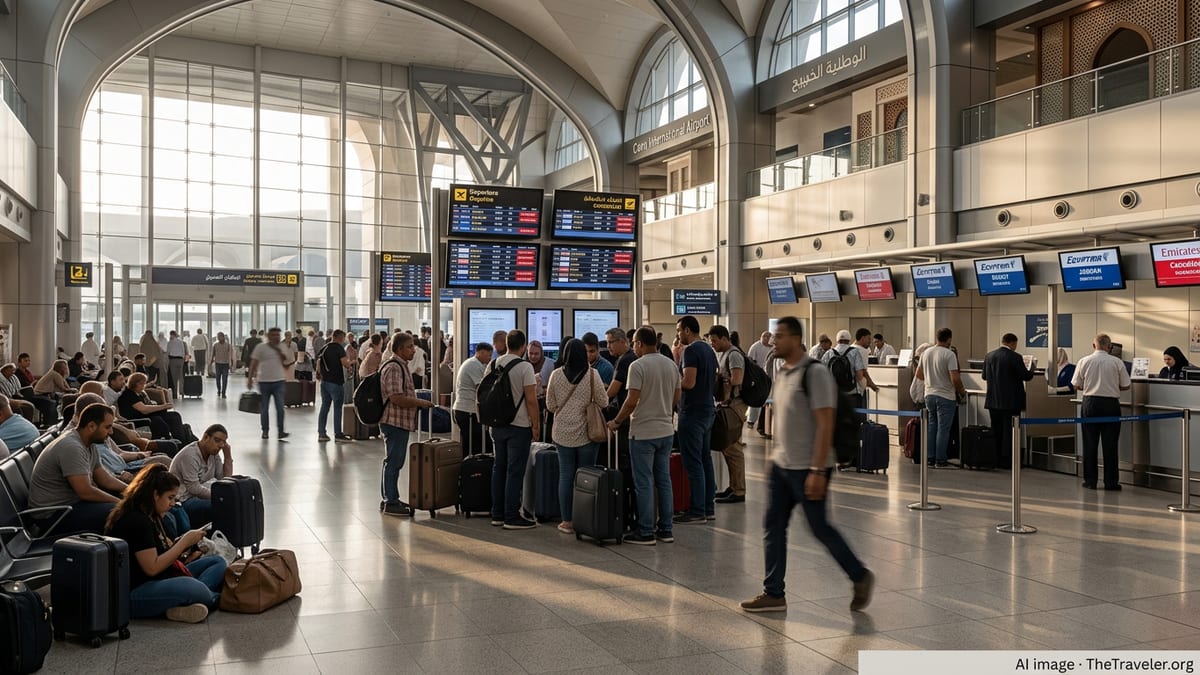
The knock-on impact of 138 delays and 28 cancellations in a short span has placed noticeable strain on Cairo International’s terminal operations. Observations shared by travelers describe crowded check-in halls and transfer areas as large numbers of disrupted passengers seek new arrangements. With multiple heavily booked flights departing within compressed windows, security checkpoints and boarding gates have at times experienced surges that outstrip typical traffic patterns for this time of year.
Ground handling and baggage operations are also under pressure when inbound flights arrive late and are turned around quickly to maintain modified schedules. In such conditions, baggage transfer between tight connections becomes more vulnerable to error, increasing the risk of mishandled or delayed luggage for passengers forced onto hurried rebookings. The resulting customer service queues add further congestion to terminal spaces already coping with irregular operations.
Airport infrastructure at Cairo is designed to accommodate high seasonal peaks, but the current wave of disruptions differs from predictable holiday surges. Instead of steady, forecast demand, operational peaks are being created by clusters of delayed flights arriving and departing within narrow windows. This pattern can outpace staffing and resource plans calibrated for more even flows, challenging both airport managers and airline station teams.
Despite these pressures, publicly available guidance from carriers continues to emphasize the importance of monitoring flight status up to the last minute and avoiding unnecessary early trips to the airport when services are not yet confirmed. Travelers who do arrive well in advance of disrupted departures often face extended stays in the terminal, making access to seating, food, and information particularly important to their experience.
What Travelers Can Do Right Now
For passengers scheduled to travel through Cairo with Egypt Air, Qatar Airways, Gulf Air, or Flynas in the coming days, publicly available travel advisories and airline disruption policies offer several practical steps. The most consistent recommendation is to check flight status repeatedly in the 24 hours before departure and again before leaving for the airport, using official airline channels and airport information screens rather than relying solely on earlier confirmations.
When flights are significantly delayed or cancelled, airlines operating from Cairo generally provide options such as rebooking on the next available service or, in some cases, refunds or travel credits, depending on the ticket type and jurisdictional rules that apply. Airline tariff documents and passenger rights guidance indicate that travelers facing long delays may be eligible for basic assistance such as meals, refreshments, and in some cases hotel accommodation, particularly when disruptions are within the carrier’s control and an overnight stay becomes unavoidable.
Given the constrained capacity on many regional routes, travelers affected by cancellations are encouraged by publicly shared guidance to consider flexible routing, including departures from or arrivals into alternative hubs in the region when feasible. However, with many carriers adjusting their networks simultaneously, availability on such alternatives can be limited, and some travelers may find that accepting a refund and rebooking a completely new itinerary is the most practical solution.
As airlines and regulators continue to navigate evolving airspace conditions around the Middle East, Cairo International’s role as a major connecting node ensures that it will remain sensitive to regional volatility. For now, travelers moving through the airport in the midst of 138 delays and 28 cancellations are being reminded by widely circulated travel advice to prioritize up-to-date information, preserve flexibility where possible, and prepare for the possibility of extended journeys.