

More news on this day
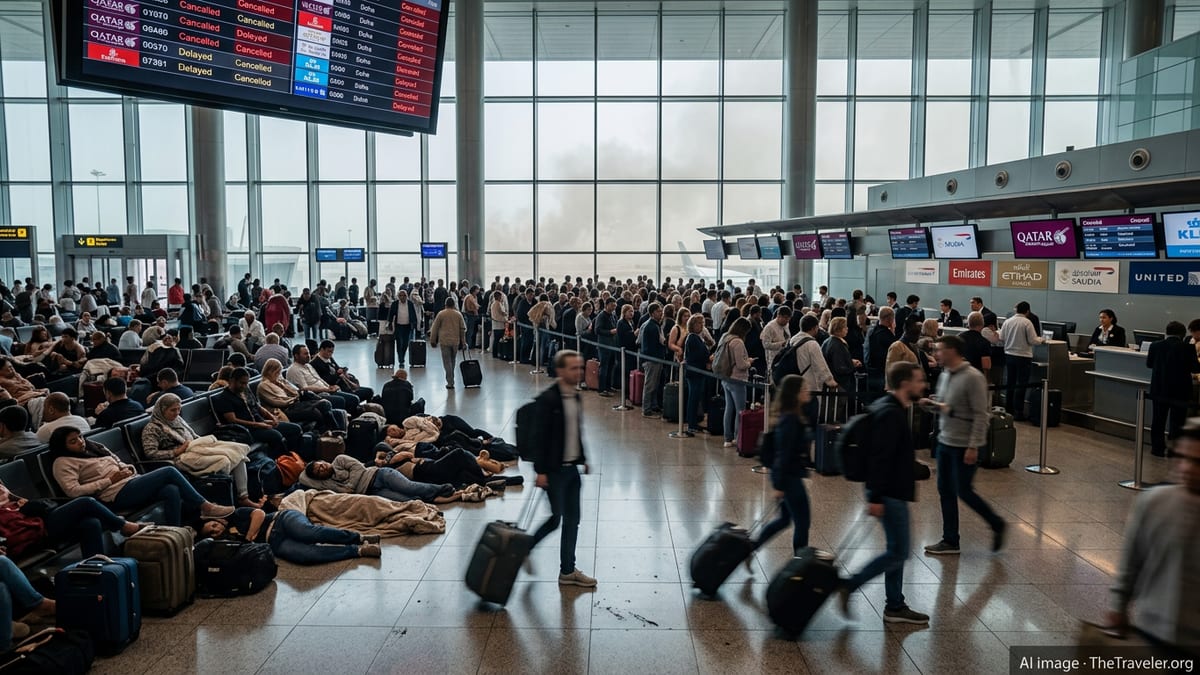
Hundreds of air travelers across Israel, Qatar and Bahrain faced long queues, crowded terminals and mounting frustration on Tuesday after a fresh wave of security-related disruptions led multiple airlines to cancel 163 flights and delay at least 24 more, intensifying an already severe spell of travel chaos in the Middle East.
Get the latest news straight to your inbox!
Regional Tensions Spill Into Airport Operations
The latest disruption comes amid heightened regional tensions that have repeatedly affected civil aviation since late February. Publicly available information shows that airspace closures, restrictions on commercial traffic and precautionary schedule cuts have combined to reduce capacity at several major hubs, including Ben Gurion Airport near Tel Aviv, Hamad International Airport in Doha and Bahrain International Airport.
In Israel, recent missile activity connected to the broader conflict with Iran has already led to tighter limits on outbound passenger loads at Ben Gurion. Reports from aviation trackers indicate that some airlines have trimmed frequencies or consolidated services, leaving fewer options for passengers trying to depart or connect through the country’s main international gateway.
Across the Gulf, Qatar and Bahrain continue to manage the fallout from repeated drone and missile incidents that have at times forced partial shutdowns of airspace and curbs on civilian traffic. Flight-status data and airport advisories show that carriers have been operating reduced or irregular schedules, with rolling cancellations announced in short windows as security assessments evolve.
The cumulative effect on Tuesday was a sharp spike in cancellations and delays across multiple airlines, adding 163 scrubbed departures and arrivals and at least 24 significantly delayed flights to an already long list of disrupted services since the start of March.
Scenes of Crowded Terminals and Uncertain Itineraries
At Ben Gurion, travelers described by local media were seen queuing in snaking lines at airline counters, with many passengers attempting to rebook itineraries that involved onward connections through European hubs or other Gulf states. Departure boards displayed clusters of red "cancelled" and "delayed" notices beside popular routes to Europe and North America, a visual summary of the day’s disorder.
In Doha, where Hamad International Airport has periodically limited standard commercial operations and prioritized evacuation and cargo movements, the latest schedule changes produced another surge of stranded passengers. Published coverage from the Qatari press has highlighted repeated advisories urging travelers not to proceed to the airport unless their flight is explicitly confirmed, reflecting the fluid status of flight operations.
Bahrain International Airport has experienced similar turbulence. The grounding of Gulf Air’s regular schedule and the closure or severe restriction of national airspace earlier in March have left many travelers relying on last-minute rerouting via neighboring hubs when possible. Social media posts and passenger accounts compiled in regional outlets depict crowded waiting areas and frequent gate changes as airlines adjust to shifting constraints.
For many travelers, the immediate concern has been basic certainty: whether they will be able to depart at all, and if so, when. With airlines often updating schedules only a few hours ahead, passengers have repeatedly reported showing up to the airport only to discover last-minute cancellations or lengthy delays.
Airlines Slash Schedules and Reroute Around Hotspots
Carriers operating in and out of the region have responded by aggressively trimming schedules, rerouting flights around affected airspace and, in some cases, suspending certain routes entirely. Flight timetable databases and airline advisories show that services linking Doha and Manama with several major Asian and European destinations have been particularly affected, with frequencies cut or aircraft types downgraded to smaller jets.
Some long-haul flights that would normally pass over the Gulf have been rerouted along longer pathways to avoid sensitive corridors, increasing flight times and adding pressure to already tight crew and fleet rosters. Aviation analysts quoted in international coverage note that these longer routings can quickly cascade into wider schedule disruption when aircraft and crews are out of position for subsequent legs.
In Israel’s case, limits on passenger numbers per flight have had a similar knock-on effect. Even when individual departures operate, caps on capacity have meant that some travelers are being left behind and rebooked days later, effectively functioning as de facto cancellations for those whose plans cannot accommodate the delay.
Low-cost and regional carriers are also feeling the strain. With leaner fleets and fewer spare aircraft, a single security hold or unscheduled diversion can wipe out the rest of a day’s rotations, contributing to the tally of 163 cancellations and 24 delays attributed to Tuesday’s disruption across the three countries.
Guidance for Stranded and Prospective Travelers
Airport and airline statements reviewed by regional and international media consistently urge passengers to verify the status of their flights before leaving for the airport, and to monitor official channels closely for rapid updates. Many carriers have introduced temporary flexible booking policies, allowing free date changes or fee waivers for itineraries touching Israel, Qatar or Bahrain during the current period of instability.
Travel trade publications report that some travelers have opted to rebook via alternate hubs outside the immediate region, using connections in Europe, Turkey or South Asia to avoid the most heavily affected airspace. However, higher demand on these alternative routes has already pushed up fares and limited seat availability on short notice.
Travel insurance companies and consumer advocates quoted in recent coverage recommend that passengers keep documentation of cancellations, delays and additional expenses, as compensation and reimbursement rules vary by airline, jurisdiction and ticket type. For those still planning trips into or through the region, observers suggest allowing extra buffer days and avoiding tight connections where possible.
With no clear timeline for a full normalization of schedules, the disruption is likely to continue shaping itineraries and travel decisions well beyond Tuesday’s spike in cancellations. Airlines and airports across Israel, Qatar and Bahrain remain in a delicate balance between maintaining essential connectivity and responding to evolving security risks that can disrupt operations with little warning.
Broader Impact on Middle East Connectivity
The concentration of cancellations and delays in Israel, Qatar and Bahrain carries outsized implications for global air travel given the region’s role as a crossroads between Europe, Asia and Africa. Major hubs in Doha and the Gulf have built their networks on serving as transfer points for long-haul journeys, so any sustained disruption has ripple effects far beyond the immediate geography.
Industry data referenced by aviation analysts suggest that the combined hubs of Doha, Bahrain and Tel Aviv handle millions of transfer passengers each year. Even a temporary reduction in capacity or closure of key airspace corridors can force airlines worldwide to rethink routings, adjust schedules and, in some cases, pause expansion plans.
Freight operations are also affected. Cargo carriers and belly-hold freight on passenger jets form a crucial link in supply chains for electronics, pharmaceuticals and perishable goods moving between Asia, Europe and North America. Prolonged or repeated interruptions at regional hubs can lead to delays in deliveries and higher logistics costs, which may ultimately be passed on to consumers.
For now, the hundreds of passengers left standing in queues across Israel, Qatar and Bahrain represent the most visible face of a wider aviation shock. Behind the scenes, airlines, airports and regulators are continuing to juggle safety considerations and operational demands in a fast-moving environment, where each new development has the potential to trigger another wave of cancellations and delays.