

More news on this day
Air travel across mainland China faced significant disruption as dozens of flights were cancelled and hundreds more delayed at key hubs including Beijing, Shanghai, Guangzhou, Chengdu and Wuhan, leaving large numbers of passengers stranded and highlighting persistent strain on the country’s aviation network.
Get the latest news straight to your inbox!
Wide Ripple Effects Across Major Chinese Hubs
Publicly available tracking data and media coverage indicate that a total of 31 flights operated by Chinese carriers, including Air China, China Express and China Eastern, were cancelled, while around 771 flights experienced delays across the country’s busiest airports. The disruption was concentrated at major hubs such as Beijing Capital, Beijing Daxing, Shanghai Pudong, Shanghai Hongqiao, Guangzhou Baiyun, Chengdu Tianfu and Wuhan Tianhe, amplifying the knock-on effects as passengers missed connections and schedules unraveled.
These airports function as the primary domestic and international gateways for China’s vast internal travel market. When operations slow at multiple hubs simultaneously, aircraft rotations, crew schedules and slot allocations at secondary airports are quickly affected, creating a cascading pattern of late departures and arrivals that can take many hours to unwind.
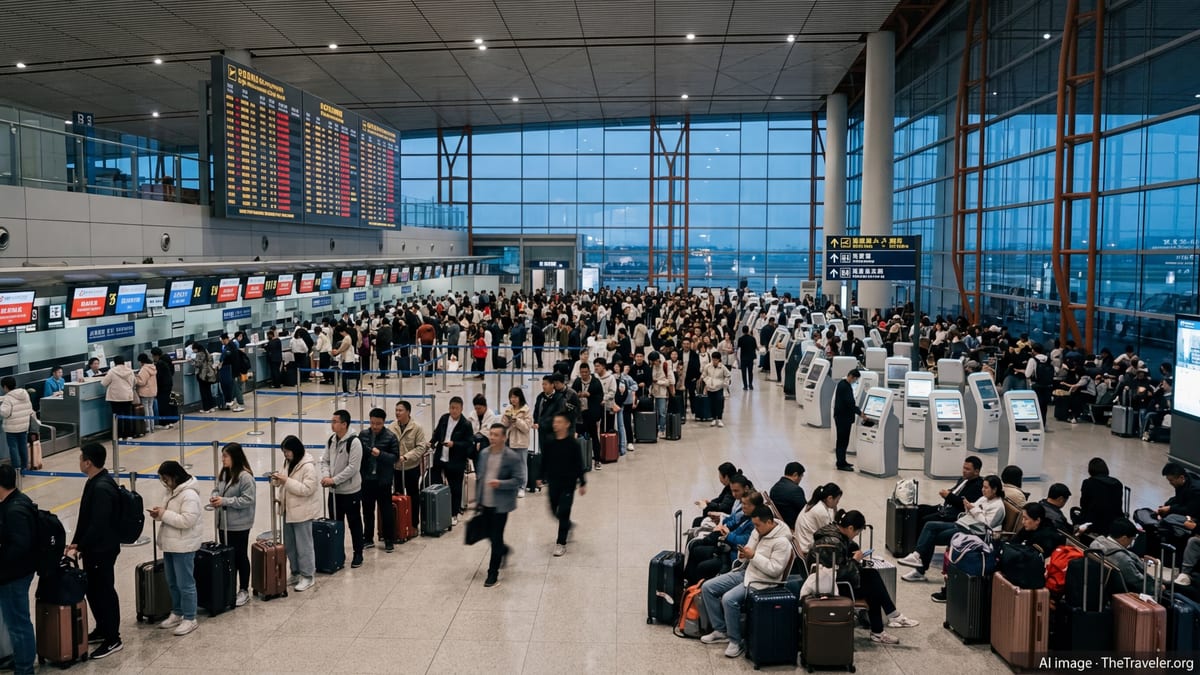
Images and accounts shared on Chinese social media platforms described crowded departure halls, long queues at airline service counters and departure boards dominated by “delayed” markers. Although such scenes are familiar during typhoon seasons and holiday peaks, the breadth of the disruption across several regions at once stands out even against a backdrop of generally high air traffic volumes.
Possible Triggers: Weather, Congestion and Airspace Constraints
Early reports did not point to a single, clearly defined trigger for the disruption, and no major safety incident was cited in publicly available information. Instead, analysts following the Chinese aviation market note that a combination of factors often interacts to produce sudden spikes in delays, including adverse weather conditions, localized thunderstorms, reduced visibility and airspace flow restrictions.
China’s skies remain among the most heavily controlled in the world, with sizable portions reserved for non-civil use. Industry statistics have repeatedly shown that congestion and airspace management are recurring contributors to delays affecting carriers such as Air China and China Eastern on trunk routes linking Beijing, Shanghai, Guangzhou and Chengdu. When traffic levels are high, even short-lived restrictions or weather deviations can push already tight schedules beyond their limits.
Operational challenges within airports can also play a role. Ground handling bottlenecks, staff shortages in peak waves, and the complex choreography of boarding, baggage loading and aircraft pushback can magnify the impact of any upstream delay. Once rotations fall out of sync, carriers often must choose between cancelling specific flights or allowing rolling delays to spill into the rest of the day’s program.
Passenger Experience: Missed Connections and Overnight Disruptions
For travelers, the immediate impact of 31 cancellations and hundreds of delayed flights was felt in missed meetings, interrupted holidays and unexpected overnight stays in transit cities. Passengers connecting through Beijing, Shanghai and Guangzhou on multi-leg itineraries were particularly vulnerable, as even a modest delay on an inbound sector could make onward flights impossible to catch in the tightly timed transfer windows typical of large hubs.
According to publicly accessible traveler accounts, some domestic passengers were offered rebookings on later same-day or next-day departures, while others had to accept detours through alternative cities or extended layovers. International travelers facing disrupted itineraries encountered additional complications related to visas, hotel costs and reissuing of onward tickets, especially where separate reservations or different airlines were involved.
Consumer advocates frequently point out that in China, as in many other markets, passenger protections vary depending on whether a journey is purely domestic or includes international legs governed by additional treaties or foreign regulations. While carriers often provide options such as free rebooking or refunds in the event of cancellations, compensation for delays is more limited and typically subject to specific airline policies and the assessed cause of the disruption.
Airlines Under Scrutiny as Punctuality Pressures Mount
The latest wave of cancellations and delays has drawn renewed attention to on-time performance at major Chinese carriers. Industry punctuality statistics from recent reporting periods show that Air China and China Eastern, both heavily reliant on busy hubs like Beijing and Shanghai, regularly grapple with congestion-related delays on domestic and international routes. Regional operator China Express, which links smaller cities into the trunk network, can also be affected when aircraft depend on timely arrivals from overburdened hubs.
Aviation analysts note that the post-pandemic rebound in domestic demand has restored, and in some corridors exceeded, pre-crisis traffic levels, putting infrastructure and scheduling models back under pressure. Airlines have sought to optimize aircraft utilization and maintain dense wave structures at hub airports, strategies that improve connectivity in principle but leave little slack when weather or airspace issues arise.
Observers say that, while some degree of delay is inherent in any large aviation system, clusters of disruptions on the scale of hundreds of flights in a single day risk eroding traveler confidence, particularly among business passengers and international visitors with limited time and complex itineraries. Carriers that experience repeated high-profile disruptions may face tougher questions about scheduling resiliency and contingency planning.
What Disrupted Operations Mean for Future Travel in China
The latest operational turbulence underscores the challenges China faces in maintaining reliable air service as demand continues to grow. Large infrastructure projects, including the relatively new Beijing Daxing and Chengdu Tianfu airports, were designed to relieve some of the pressure on older hubs. However, their integration into airspace patterns, route structures and airline networks remains a gradual process, and saturation can still occur when traffic surges align with weather or operational constraints.
For travelers planning journeys within or through China, recent events serve as a reminder to build additional time into connections, especially when transiting through Beijing, Shanghai or Guangzhou, and to monitor flight status closely in the days and hours before departure. Flexible booking options, travel insurance and awareness of airline policies on rebooking and refunds can help mitigate the impact when schedules change suddenly.
In the longer term, aviation specialists argue that improvements in air traffic management, investments in ground handling capacity and more resilient scheduling strategies will be essential to reducing the frequency and severity of nationwide disruption days. As Chinese carriers continue to expand their international reach, maintaining a reputation for reliability across a sprawling domestic backbone will remain a central test for the country’s aviation sector.