

More news on this day
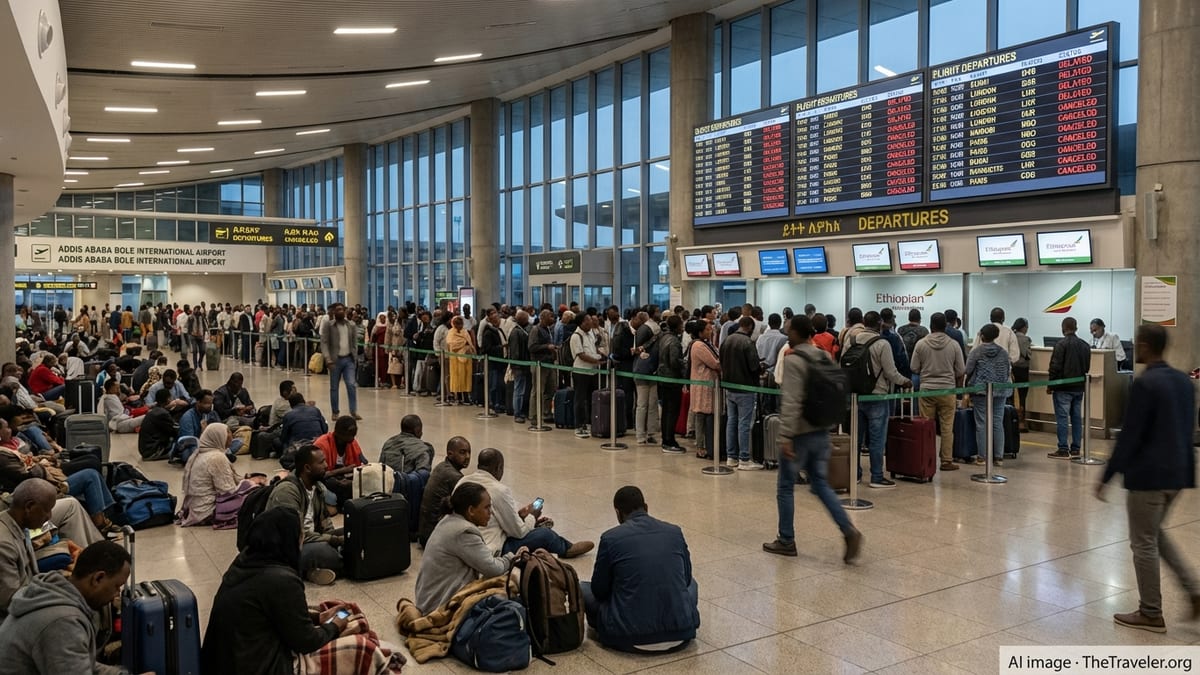
Hundreds of passengers were left sleeping on terminal floors and queuing for hours at Addis Ababa Bole International Airport on March 1 as a wave of knock-on delays and cancellations rippled through Ethiopia’s main aviation hub, disrupting at least 80 flights and grounding services to cities including Dubai, London, Nairobi and Paris.
Regional Turmoil Spills Over Into Addis Ababa Hub
The disruption at Bole International Airport comes as air travel across the wider Middle East and surrounding regions reels from sudden airspace closures and route suspensions following a major escalation in regional conflict. With key Gulf hubs temporarily shut or heavily curtailed, airlines have scrambled to reroute traffic, placing unexpected strain on alternative connectors such as Addis Ababa.
According to live airport performance data for Addis Ababa on March 1, more than three quarters of departing flights were experiencing delays and a small but significant share had been canceled outright. For passengers transiting through the Ethiopian capital from Africa to Europe, Asia and the Gulf, even relatively short hold-ups rapidly cascaded into missed onward connections and lengthy waits for rebooking.
Travel industry trackers say the amplification effect is particularly pronounced at large hub airports like Bole, where Ethiopian Airlines has built one of Africa’s busiest connecting networks. When a few key routes are disrupted, aircraft and crew are knocked out of position, intensifying delays on subsequent rotations and stranding travelers who rely on tight connection windows.
Flights to Dubai, London, Nairobi and Paris Hit Hard
By early afternoon in Addis Ababa, departure boards showed a patchwork of delays and cancellations affecting both regional and long-haul services. Ethiopian Airlines’ own network was heavily impacted, with late-running departures toward Nairobi and other African capitals, as well as Europe-bound flights forced into rolling delays while operations teams worked to reset aircraft rotations.
Services operated by partner and competitor carriers were also affected. Flights marketed or operated by FlyDubai and Turkish Airlines felt the squeeze as altered routings, crew duty-time limits and congestion at alternative hubs made it difficult to maintain published schedules. Connections from Addis Ababa to Dubai in particular saw extended delays as Gulf-bound flights contended with crowded detour corridors and evolving airspace restrictions.
Passengers booked on services to London and Paris reported being held at the gate or on board aircraft awaiting revised departure slots, while those connecting onward from Addis Ababa to Nairobi faced uncertainty about whether they would make it onto already full recovery flights. Airline staff could be seen moving through crowded waiting areas calling for volunteers to accept later departures in exchange for vouchers, underscoring the pressure on available seats.
Scenes of Frustration Inside Bole International Airport
Inside the terminals at Bole, the operational strain translated into long lines at check-in counters, transfer desks and customer service kiosks. Travelers described scenes of families stretched out on blankets near departure gates, while others clustered around power outlets to charge phones and monitor constantly shifting flight information screens.
Security queues and immigration lines also lengthened as waves of delayed passengers converged at similar times, compressing what would normally be staggered flows throughout the day. Airport staff worked to manage the crowds and provide updates, but many travelers said they struggled to obtain clear information on revised departure times or guaranteed connections.
Local hotels near the airport, including large properties that frequently accommodate disrupted passengers, began filling up as airlines issued overnight vouchers for those whose connections had completely fallen apart. Others, seeking to avoid additional expense or fearing they might miss last-minute recovery flights, chose to remain in the terminal area despite the congestion and limited seating.
Airlines Race to Restore Schedules and Rebook Passengers
Ethiopian Airlines, which owns and operates Bole International Airport, deployed additional ground staff to rebook stranded travelers, arrange hotel accommodation where possible and manage baggage for passengers whose journeys would now stretch into an extra day or more. Agents prioritized those with imminent long-haul departures and families traveling with young children or elderly relatives.
Operational planners across multiple airlines spent the day working on revised flight plans that could navigate around closed or restricted airspace while still safely connecting Addis Ababa to key markets. In some cases, aircraft were reassigned from lower-demand routes to bolster congested corridors such as Addis Ababa to Dubai and Addis Ababa to major European gateways, in an effort to clear backlogs.
Industry analysts noted that while the number of outright cancellations at Bole remained limited compared with some airports closer to the epicenter of regional tensions, the concentration of delays across such a high volume of flights had a disproportionate impact on connecting passengers. With hundreds of travelers now relying on a shrinking pool of open routes and available seats, the recovery process is expected to continue into the coming days.
Travelers Advised to Monitor Flights and Prepare for Disruptions
Airline and airport officials urged passengers with upcoming itineraries through Addis Ababa to closely monitor their flight status, use airline apps where possible and avoid heading to the airport too early unless their departure was confirmed. They also recommended allowing for longer than usual connection times and being prepared for sudden schedule changes as carriers adjust to evolving regional conditions.
Travel agents and tour operators serving East Africa reported a surge in calls from concerned clients, particularly those scheduled to transit through Bole on their way to Dubai, London, Nairobi or Paris in the coming days. Many are exploring options to reroute via alternative hubs that remain fully operational, though capacity on those routes is tightening quickly.
For the hundreds already stranded at Bole International Airport, the priority on March 1 was simply finding a way to continue their journeys. As airlines gradually restore more regular operations and reposition aircraft, most are expected to depart within the next 24 to 48 hours, but the episode has underscored how rapidly a regional shock can disrupt air travel far beyond the immediate conflict zone.