

More news on this day
Hundreds of travelers found themselves stranded across the Middle East today as a fresh wave of flight delays and cancellations hit major hubs in Saudi Arabia, Egypt, Türkiye, the United Arab Emirates, Kuwait, and Israel, disrupting operations for carriers including Emirates, Pegasus Airlines, Saudia, and EgyptAir in cities such as Dubai, Cairo, Riyadh, and Istanbul.
Get the latest news straight to your inbox!
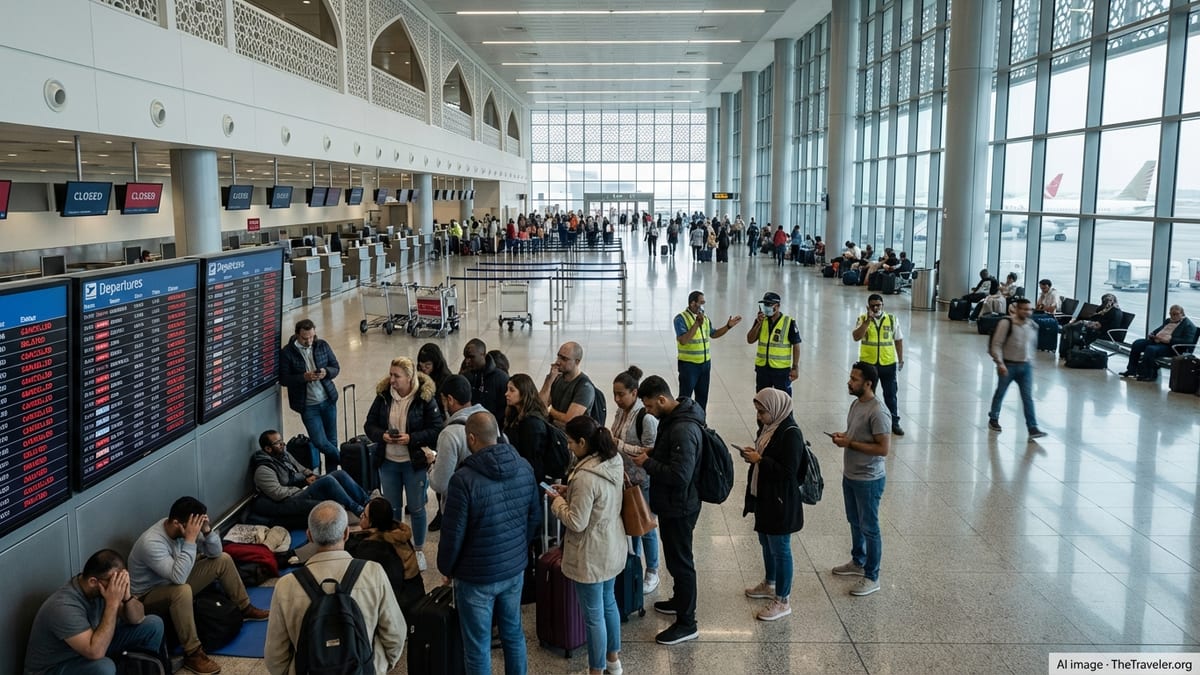
586 Delays and 23 Cancellations Hit Key Regional Hubs
Publicly available operational data for Middle East airports today indicate 586 flight delays and 23 cancellations across airports in Saudi Arabia, Egypt, Türkiye, the UAE, Kuwait, and Israel. The disruptions are concentrated at major international gateways including Dubai, Cairo, Riyadh, and Istanbul, where dense banks of connecting flights mean even a small number of cancellations can cascade into widespread missed connections.
The pattern mirrors a series of severe disruptions that have hit the region in recent weeks, with similar tallies of several hundred delayed flights and a few dozen cancellations repeatedly reported across Gulf and Levant hubs. Recent coverage has highlighted that even when formal cancellation rates remain relatively low, elevated delays can leave passengers waiting many hours in terminals or overnight in nearby hotels while airlines work through backlogs.
Today’s figures add to that mounting disruption, with many passengers reporting long queues at rebooking counters, difficulty reaching airline call centers, and limited information on when normal schedules might resume. The cumulative effect for travelers is uncertainty not only about onward connections through the Middle East but also about itineraries linking Europe, Asia, Africa, and North America.
Airport monitoring services and aviation-focused outlets have described these rolling disruption days as part of a broader regional pattern, rather than isolated events at a single airport. This dynamic has turned what might otherwise be a local operational problem into a multi-country challenge for airlines and passengers alike.
Emirates, Pegasus Airlines, Saudia, EgyptAir and Others Affected
Among the carriers most visibly affected are Emirates, Pegasus Airlines, Saudia, and EgyptAir, alongside a range of regional and international airlines that depend on Middle East hubs for long-haul connectivity. In earlier disruption waves this year, data compiled by industry trackers showed Emirates operating with a very low proportion of outright cancellations but a high share of delayed departures, reflecting efforts to preserve core connections even as schedules slipped.
Saudi Arabia’s Saudia has faced a different type of strain, with previous reports detailing extended suspensions or reductions on selected Gulf routes, leaving aircraft and crew out of position and contributing to bottlenecks when services resume. EgyptAir, meanwhile, has had to navigate Cairo’s growing role as a diversion and transit point as airlines reroute away from the most affected airspace, increasing pressure on ground handling and scheduling.
In Türkiye, Pegasus Airlines has appeared frequently in recent disruption tallies, reflecting Istanbul’s importance as both an origin and transfer hub. Aviation reports in recent days have described widespread delays affecting both regional low-cost operations and full-service long-haul networks, as carriers juggle altered routings, longer flight times, and tighter crew duty limits.
While today’s delay and cancellation counts are distributed across many airlines, the concentration among major regional carriers means knock-on effects for international travelers who may not have started or ended their journeys in the Middle East but rely on these hubs for connections.
Dubai, Cairo, Riyadh, Istanbul Bear the Brunt
Dubai once again features prominently in disruption data, with its role as a global super-hub amplifying the impact of every delayed or cancelled departure. Recent advisories highlighted by travel industry coverage have urged passengers not to travel to Dubai International Airport unless they have verified that their flight is operating, citing long queues and stretched customer service counters during earlier peaks in disruption.
Cairo is also under sustained pressure. In recent weeks, Egyptian outlets have underscored the country’s growing role as an alternative aviation corridor between Europe and Asia during broader Middle East airspace constraints. That increased strategic importance brings more traffic and, with it, more vulnerability when schedules are disrupted.
Riyadh and Istanbul round out the most heavily affected hubs today, according to the latest tallies. These airports act as primary bases for Saudia and Pegasus Airlines respectively, and they also host a significant volume of foreign carriers. As delays accumulate through the day, aircraft rotations tighten and evening departure waves can suffer compounding knock-on effects, trapping connecting passengers in terminals overnight.
The multi-hub nature of the disruption is particularly challenging for travelers booked on complex itineraries. Even when a departure from one city operates close to schedule, a late arrival into a connecting hub can mean missed onward flights and limited same-day alternatives, especially while many airlines are already operating on trimmed schedules.
Ongoing Regional Tensions and Operational Strain
The latest wave of delays and cancellations comes against a backdrop of months of instability in Middle East aviation. Since late February, conflicts and related airspace restrictions involving Iran, Israel, and neighboring states have repeatedly forced airlines to cancel or reroute flights, lengthen travel times, and reorganize their networks. Aviation analysts and specialist outlets have counted many thousands of cancellations across the region since the start of these hostilities.
Airspace closures and no-fly advisories over parts of Iran, Iraq, Israel, Syria, and nearby areas have effectively narrowed the operational corridors available to carriers. Reports indicate that Gulf and Levant hubs have alternated between near shutdowns and partial resumptions, depending on evolving security assessments and regulatory decisions. That on-off pattern has left airlines struggling to rebuild reliable rosters for aircraft and crew.
As a result, even on days when flight operations nominally resume, schedules remain vulnerable. Longer routings around restricted airspace consume more fuel and time, extending duty periods for cockpit and cabin crews and limiting how many sectors can be flown within safety rules. When any individual flight is delayed, the knock-on effects can stretch across several subsequent rotations, feeding into the kind of large-scale delay totals seen today.
Industry coverage suggests that airlines are continuously adjusting their schedules, sometimes issuing rolling updates on a day-by-day basis. For passengers, that means a flight that appears to be operating one day can still be removed or retimed at short notice, turning confirmed plans into last-minute scrambles for alternatives.
What Stranded Passengers Are Facing on the Ground
For travelers caught in today’s disruptions, the experience is often one of uncertainty and limited information. Passenger accounts across recent weeks have described sudden status changes from scheduled to delayed or cancelled, boarding times slipping repeatedly, and rebooking processes that can stretch for hours in crowded terminals or involve long waits on phone lines and online chat systems.
Some airline and airport advisories highlighted in published coverage have recommended that travelers arrive early, travel only if flights are confirmed to be operating, and prepare for extended waits at security, check-in, and immigration. When delays stretch into many hours or overnight, availability of hotel rooms near major hubs can quickly tighten, particularly in cities already accommodating large numbers of stranded passengers from previous disruption days.
Compensation and rebooking options vary significantly between carriers and jurisdictions. European regulations, for example, may entitle some travelers on flights to or from the European Union to refunds or compensation in certain circumstances, while in other cases airlines classify disruptions as extraordinary operational or security-related events that limit their liability. Public guidance from consumer and aviation bodies has therefore urged passengers to keep detailed records of communications, expenses, and official notifications.
With no clear timeline for a full return to normal operations across the region, today’s delays and cancellations are likely to be part of a continuing pattern. For now, travelers with upcoming itineraries through Middle East hubs are being repeatedly advised in public channels to check flight status frequently, monitor airline announcements closely, and build additional flexibility into their plans wherever possible.