

More news on this day
Hundreds of travelers were left stranded or facing extended waits at Nashville International Airport on March 20 as publicly available tracking data showed at least 109 flight delays and three cancellations affecting major carriers and key routes across the United States and beyond.
Get the latest news straight to your inbox!
Major Carriers Hit by Widespread Disruptions
Data from flight tracking boards and airport information feeds on March 20 indicated that operations at Nashville International Airport were significantly constrained, with delays rippling across the daily schedule. American Airlines, Delta Air Lines, Southwest Airlines, United Airlines, JetBlue Airways and other domestic and regional operators all appeared among the affected carriers.
The disruption was concentrated across the core daytime departure and arrival banks, where a large share of business and connecting traffic typically passes through Nashville. The pattern of delays suggested knock-on impacts from earlier irregular operations in the network, as aircraft and crews arrived late into Tennessee, creating a cascading effect across subsequent departures.
While only three flights were recorded as outright cancellations, the volume of delayed services meant many passengers still experienced missed connections, disrupted itineraries and uncertain arrival times. Travelers connecting onward to other hubs or regional airports were particularly vulnerable as schedules tightened throughout the day.
Publicly visible schedule data also showed that delays were not confined to any single airline, pointing to a day of broad operational pressure rather than a carrier-specific meltdown. Network congestion, aircraft rotation challenges and weather-related issues on other parts of the continent all appeared to be contributing to the slowdown.
New York, Chicago and Atlanta Routes Among Worst Affected
Key domestic corridors linking Nashville with New York, Chicago and Atlanta were among the routes most affected by the disruption. Flights to major Northeast and Midwest hubs, which serve as pivotal connection points for both domestic and international travel, showed extended departure and arrival holds.
Services to New York area airports, including John F. Kennedy International, LaGuardia and Newark, experienced a series of rolling delays as weather and congestion across the eastern United States continued to challenge on-time performance. These routes are heavily used by both business travelers and leisure passengers heading to or from the New York metropolitan region, amplifying the impact of each delay.
Chicago flights, including services to Chicago O’Hare and Chicago Midway, also showed significant schedule slippage. These flights often form part of complex, multi-leg itineraries across the Midwest, Mountain West and West Coast, meaning even a short delay leaving Nashville can lead to missed onward connections for passengers.
Atlanta, one of the nation’s busiest hubs and a crucial connecting point for Southeastern and international routes, also saw disruptions on links to and from Nashville. When flights between Nashville and Atlanta are delayed, entire itineraries built on tight connection windows at the larger hub can unravel, leading to rebookings, overnight stays and further congestion.
International Connections Knocked Off Schedule
Although Nashville International Airport’s nonstop long-haul schedule is more limited than that of major coastal hubs, it plays a significant role as a feeder gateway into global networks. The delays and cancellations recorded on March 20 therefore carried consequences for international travel beyond Tennessee.
Passengers traveling from Nashville to New York, Chicago, Atlanta and other larger hubs often rely on these segments to connect to transatlantic and transpacific flights. When those initial legs are delayed, travelers can miss evening departures to Europe, overnight flights to Latin America or daytime services to Canada and other international destinations.
Publicly available flight information on March 20 suggested that some passengers faced the prospect of being rebooked onto next-day international departures after missing their scheduled connections. In some cases, even modest delays leaving Nashville left too little margin for clearing security checks and boarding procedures at onward hubs.
The ripple effect underscores how seemingly localized disruptions at a mid-sized U.S. airport can quickly extend into the global aviation system, particularly during periods of already elevated weather and operational strain across North America.
Recent Weather and System Strain Add to Operational Pressure
The latest disruptions in Nashville occurred in the broader context of an already challenging late-winter and early-spring period for air travel in the United States. Recent weeks have seen a series of powerful storm systems and blizzards across the Midwest and Northeast, with published meteorological summaries describing historic snowfall and widespread flight cancellations across multiple hubs.
According to widely reported national figures, large storm systems since January have led to many thousands of cancellations and delays nationwide, leaving airlines with tight aircraft rotations, displaced crews and lingering schedule imbalances. These conditions can persist for days after severe weather clears, especially when storms affect major connecting hubs and key air traffic corridors.
Nashville has not been immune to this volatility. Publicly available reports in recent months have described occasions when staffing shortages, temporary ground delay programs and regional weather patterns combined to slow operations at Nashville International Airport, at times affecting hundreds of flights in a single day. Those earlier incidents highlighted how quickly the airport’s rapidly growing traffic volumes can be disrupted when conditions deteriorate.
On March 20, the mix of prior network strain, ongoing seasonal weather and localized congestion appeared to converge again, producing a familiar picture for travelers: crowded gate areas, rolling departure time changes and uncertainty about when operations would fully stabilize.
Passenger Impact and Ongoing Recovery Efforts
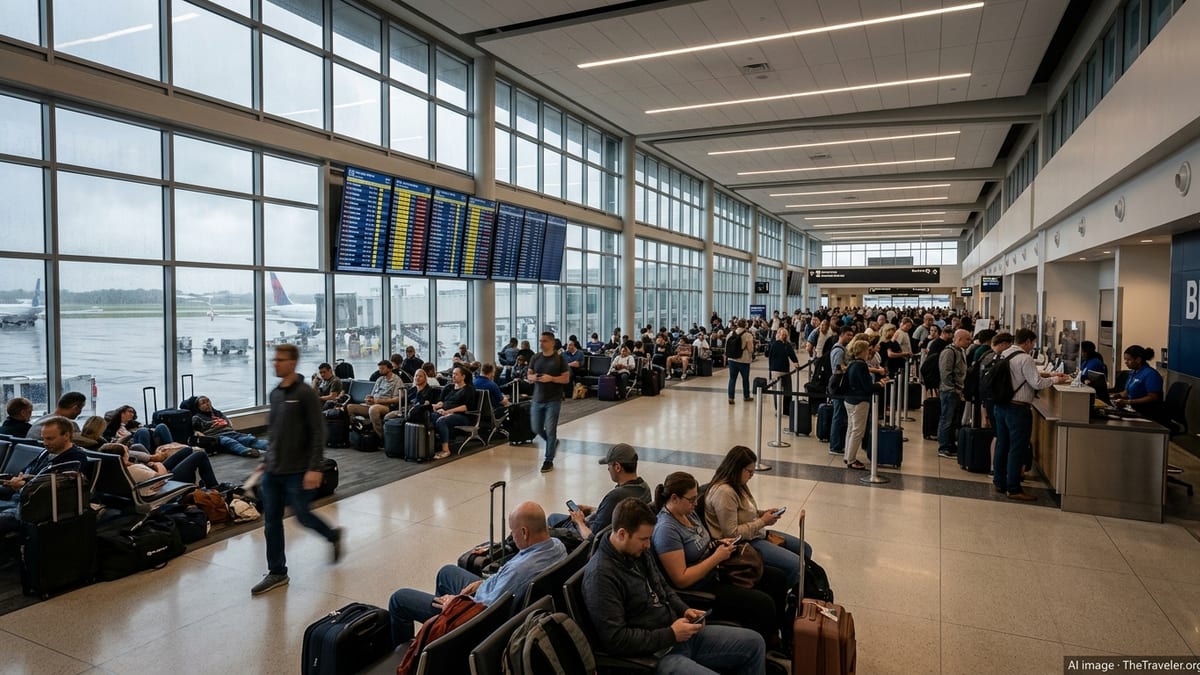
For passengers, the operational statistics at Nashville translated into long lines at check-in counters, busy customer service desks and extended waits at departure gates. Many travelers were forced to rearrange plans on short notice, including hotel bookings, ground transportation and time-sensitive commitments at their destinations.
Airlines serving Nashville deployed standard disruption-management measures, including rebooking affected passengers on later flights where space was available and adjusting aircraft assignments in an effort to restore on-time performance. Same-day alternatives were limited on some routes, however, given the relatively finite number of daily frequencies from Nashville to certain hubs and regional destinations.
Travel advisories commonly circulated in similar situations encourage passengers to monitor airline apps and online flight status tools, arrive early at the airport and remain prepared for gate or schedule changes. On days with widespread delays, publicly accessible guidance also often recommends that travelers consider longer connection times, especially when linking from Nashville to international departures via crowded coastal or Midwestern hubs.
As the day progressed on March 20, data from tracking services indicated that operations at Nashville International Airport were gradually moving back toward the published schedule, although residual delays remained in several evening departure banks. For hundreds of passengers caught in the middle of the disruption, the experience served as another reminder of how quickly routine journeys can be upended during a period of sustained strain on the U.S. air travel system.