

More news on this day
Thousands of travelers across China faced hours-long queues, missed connections and overnight waits as airports in Karamay, Chengdu, Xi’an, Yining, Urumqi and Beijing reported at least 156 cancellations and 1,512 delays on services operated by China Express Airlines, Air China, China Eastern, Chengdu Airlines and other major carriers.
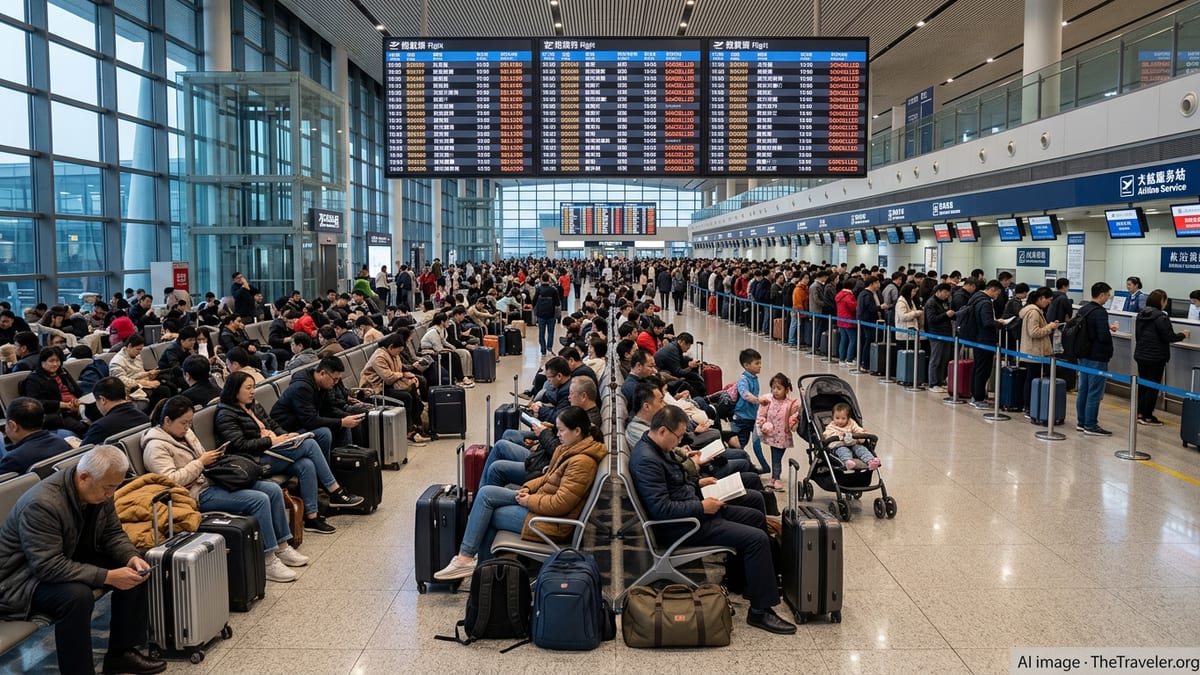
Major Hubs Across China Grind to a Crawl
The disruption rippled from regional gateways in Xinjiang to some of the country’s biggest aviation hubs, snarling domestic and international itineraries during an already busy travel period. In Urumqi and Yining, in the Xinjiang Uygur Autonomous Region, departures boards filled steadily with red and amber status updates as morning delays cascaded into the afternoon and evening.
Further east, Chengdu and Xi’an, both critical nodes in China’s fast-growing domestic network and important connectors to Central Asia and Europe, struggled to absorb the mounting backlog. At Beijing’s main airports, long lines formed at airline counters as stranded passengers sought rebooking options or overnight accommodation, with many told that the earliest available seats would be at least a day away.
In Karamay, a smaller but strategically located airport serving Xinjiang’s energy-producing region, even a modest number of cancellations created an outsized impact. With fewer alternate flights and limited intercity rail options, passengers reported being effectively marooned, weighing whether to wait out the disruption or attempt long-distance road journeys to larger hubs such as Urumqi.
Across all affected airports, operations staff faced the complex task of juggling aircraft rotations, crew duty limits and gate availability. As delays stacked up through the day, airlines were forced to trim schedules, contributing to the tally of 156 cancellations even as they sought to prioritize flights with the greatest number of onward connections.
China Express and Major Carriers Under Pressure
China Express Airlines, which maintains an extensive network in western China, was among the hardest hit as operational bottlenecks emerged in Xinjiang and neighboring provinces. The regional carrier’s reliance on tight aircraft turnarounds at smaller airports left little margin for recovery once early services ran late, pushing delays into double digits across Karamay, Yining and Urumqi.
National flag carrier Air China and fellow giants China Eastern and China Southern also reported significant disruption to their domestic rotations, including flights serving Chengdu, Xi’an and Beijing. These airlines anchor many of the country’s busiest trunk routes, meaning schedule changes in one city quickly knocked on to others, complicating recovery efforts throughout the day.
Chengdu Airlines and other secondary operators faced similar challenges, particularly on point-to-point services linking interior cities. With limited spare capacity in their fleets, carriers often had to choose between operating heavily delayed departures or canceling outright to reposition aircraft and crew for the following day’s schedule.
Industry analysts noted that while China’s aviation network has expanded rapidly in recent years, its resilience in the face of simultaneous disruptions at multiple hubs remains constrained. When several key airports in the west and center of the country slow down at once, the resulting knock-on effects can be felt all the way to Beijing and Shanghai.
Passenger Frustration Mounts as Delays Stretch On
Inside terminal buildings, the human impact of the disruption played out in crowded waiting areas, makeshift sleeping corners and abruptly changed travel plans. Families heading home, business travelers on tight schedules and tour groups bound for onward destinations all faced uncertainty as departure times were repeatedly pushed back or flights vanished from screens.
Many passengers described a familiar pattern: initial short delays of 30 to 60 minutes that gradually extended into several hours, followed by last-minute cancellations once crew duty limits or airport curfews loomed. For some, this meant missing international connections from Beijing or Shanghai, while others faced the prospect of losing hotel bookings and pre-paid tours in domestic destinations.
At check-in and customer service counters, staff attempted to manage expectations, offering meal vouchers and hotel arrangements where possible. However, limited nearby accommodation at airports such as Karamay and Yining meant that some travelers prepared to spend the night in terminals, improvising pillows from jackets and using phone apps to track evolving flight statuses.
Social media posts from travelers in Chengdu, Xi’an and Urumqi showed long lines at rebooking desks and departure halls crowded well beyond typical weekday volumes. Many complained of sparse or last-minute communications from airlines, saying they only learned of cancellations minutes before scheduled boarding times.
Operational and Weather Factors Converge
Aviation observers pointed to a combination of factors behind the latest wave of disruptions, including adverse weather in parts of western China, tight airspace constraints and knock-on effects from wider regional route adjustments. Western hubs such as Urumqi and Karamay are particularly vulnerable when low visibility, fog or strong crosswinds develop, with limited runway and taxiway capacity to recover once conditions improve.
Schedule density at large airports such as Chengdu and Beijing further complicates recovery, as any prolonged ground stop or flow control order can quickly leave dozens of aircraft out of position. When delays extend across multiple banks of departing and arriving flights, there is often no simple way to reset operations without canceling services to free up aircraft and crews.
In recent months, Chinese airlines have also been recalibrating some international routes in response to changing airspace patterns and geopolitical tensions. Even though the current disruption is centered on domestic services, the broader network adjustments have left carriers with less slack in their fleets and crew rosters, making them more vulnerable when several domestic hubs experience problems on the same day.
Industry experts say that as demand for air travel within China continues to grow, pressure will increase on both airlines and regulators to invest in additional capacity, more flexible routing and better contingency planning to reduce the risk of large-scale disruptions spreading across the network.
What Stranded Travelers Can Expect Next
With 1,512 delays recorded across the affected airports, recovery is expected to take at least into the following operating day, as airlines work to clear backlogs and reposition aircraft. Travelers still waiting to depart were advised to monitor airline apps and airport information screens closely, as gate assignments and departure times remained subject to rapid change.
Airlines encouraged passengers with flexible plans to accept rebookings on later flights or alternate routings, particularly from congested hubs such as Chengdu and Beijing. Some carriers also relaxed change fees for affected services, offering one-time free rebooking or travel vouchers as they sought to ease pressure at airport counters and call centers.
For those with onward international connections, agents focused on securing new itineraries via alternative hubs or different partner airlines where interline agreements allowed. However, limited remaining seat availability on popular routes meant that some travelers faced delays of a day or more before suitable options could be found.
As operations gradually stabilize, attention is likely to turn to whether airlines and airport authorities can improve communications and contingency planning for future disruptions. For now, thousands of passengers across Karamay, Chengdu, Xi’an, Yining, Urumqi and Beijing are left hoping that their long waits will translate into confirmed boarding passes and eventual takeoff within the coming hours.