

More news on this day
Thousands of travellers were left stranded across Europe on Sunday as severe operational disruptions at Amsterdam Schiphol and Paris Charles de Gaulle led to 474 delayed and 54 cancelled flights, snarling schedules for KLM, Qatar Airways, Saudia, Air Canada and other major carriers and triggering knock-on chaos on routes to Dubai, Frankfurt, Manchester, Oslo and beyond.
Amsterdam and Paris Hubs Buckle Under Mounting Disruptions
Amsterdam Schiphol and Paris Charles de Gaulle, two of Europe’s busiest hubs, spent much of the weekend struggling to clear backlogs after a fresh wave of delays and cancellations rippled through their schedules. Data from European flight tracking services for the past 24 hours show a combined 474 delayed flights and 54 cancellations at the two hubs, effectively grounding thousands of passengers and disrupting connections across Europe, the Middle East and North America.
Schiphol, home base for KLM, has already endured a punishing winter season, with repeated bouts of heavy snow, shifting crosswinds and staffing constraints forcing the airport and its main tenant to pare back operations. Recent storms in the 2025–26 European winter have repeatedly suspended de-icing and ground handling activities, leaving aircraft out of position and crews struggling to stay within duty-time limits as delays compound.
At Paris Charles de Gaulle, the main global hub for Air France, the picture was only marginally better. Weather-related schedule pressure, combined with tight aircraft rotations across transatlantic and Middle Eastern networks, left airlines with limited slack to recover once morning departures began slipping behind schedule. By late afternoon, banks of connecting flights were misaligned, forcing carriers to cancel some services outright in an effort to reset operations.
Airports and airlines have advised passengers to expect residual disruption into the start of the week, as aircraft and crews are repositioned and backlogged passengers are rebooked on already busy services ahead of the Easter travel period.
Global Carriers Hit as KLM, Qatar, Saudia and Air Canada Face Cancellations
The latest round of disruption was particularly acute for major international airlines that rely on Amsterdam and Paris as key transfer points. KLM bore the brunt of the problems at Schiphol, where it operates the majority of movements, while partner and rival carriers including Qatar Airways, Saudia and Air Canada also reported delays on flights operating to or through the affected hubs.
KLM, which has already been operating with reduced resilience after earlier aircraft availability issues and an intense winter weather pattern, was again forced to trim its schedule and consolidate services. Long-haul flights linking Amsterdam with destinations in the Middle East and North America were among those impacted, compounding wider regional disruptions tied to airspace restrictions and weather elsewhere in Europe.
Qatar Airways and Saudia services connecting through Amsterdam and Paris experienced extended ground times as slots were pushed back and de-icing and ramp operations were sequenced to prioritize safety. Several Gulf-bound departures left hours behind schedule, leaving passengers facing missed onward connections in Doha and Jeddah and lengthening already long journey times between Europe, Asia and Africa.
Air Canada, which depends heavily on punctual hub operations in Europe to feed its North American network, saw select transatlantic flights held at gates or on taxiways as congestion built. With crews nearing maximum duty periods, some rotations had to be swapped or curtailed, raising the likelihood of rolling knock-on delays into Monday on both sides of the Atlantic.
Ripple Effects Felt from Dubai to Frankfurt, Manchester and Oslo
The immediate impact of Sunday’s disruption was most visible in departure boards at Amsterdam and Paris, but the knock-on effects spilled quickly across the wider global network. Passengers heading to and from Dubai saw significant schedule changes as outbound flights from Europe left late, compressing connection windows for onward services and forcing rebookings onto later departures where seats were available.
Frankfurt, Manchester and Oslo, all major destinations linked frequently to both Schiphol and Charles de Gaulle, reported increased arrival delays as late-running aircraft filtered through the system. At several European airports, ground staff were forced to juggle arriving widebodies from Amsterdam and Paris with already busy local schedules, leading to longer waits for stands, baggage unloading and onward security checks.
For individual travellers, the disruption translated into missed business meetings, curtailed holidays and scrambled family visits. Transit passengers who had planned tight connections through Amsterdam or Paris were among the hardest hit, often arriving to find their onward flights already departed and alternative routes fully booked for hours or, in some cases, days.
Even airports not directly affected by adverse weather reported pressure on hotel capacity and ground transportation as misaligned flight banks pushed arrivals into late night and early morning hours, overwhelming normal staffing and infrastructure plans.
Passengers Face Long Queues, Rebookings and Uncertain Timetables
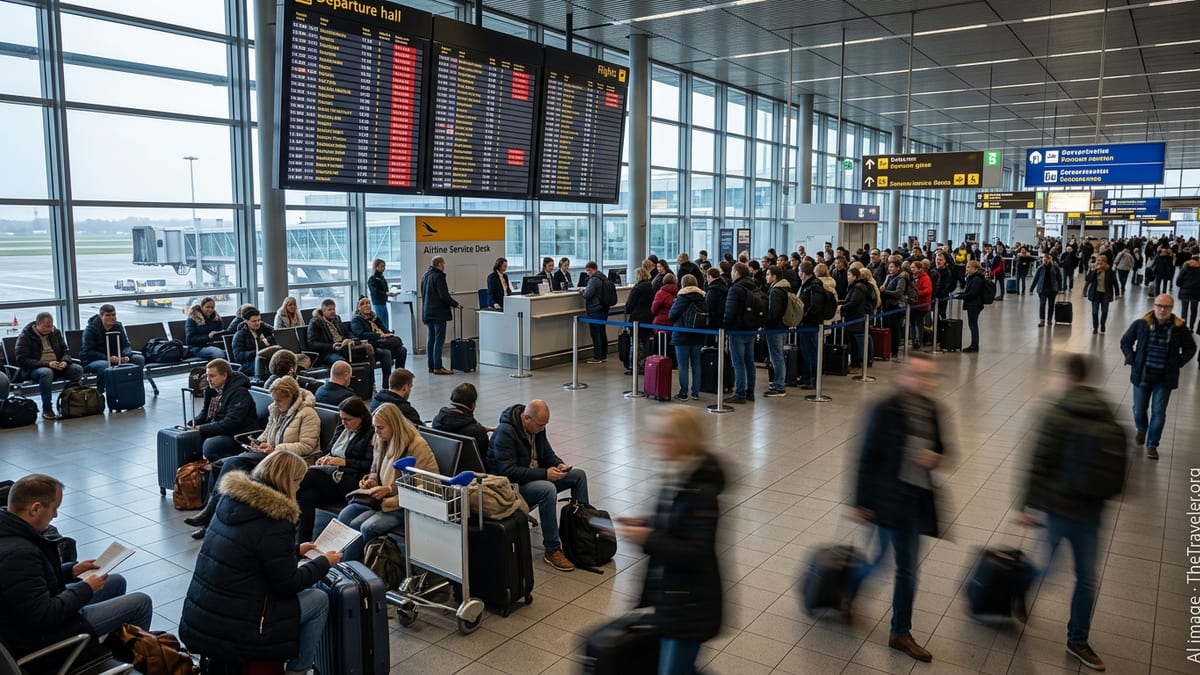
Inside the terminals at Amsterdam and Paris, passengers confronted long queues at airline service desks as they sought rebooking options, meal vouchers and hotel rooms. With hundreds of flights delayed and dozens cancelled, customer service teams struggled to keep up with demand, while phone lines and airline apps experienced surges in traffic as travellers searched for alternatives.
Many stranded passengers opted to accept rebookings via secondary hubs such as Frankfurt and Zurich, even if the routings added several hours to their journeys. Others, particularly those travelling within Europe, turned to rail as an alternative, with high-speed services between the Netherlands, France, Germany and Belgium seeing increased demand.
Consumer groups again urged travellers to familiarize themselves with their rights under European passenger protection rules, which may entitle eligible passengers to care, assistance and, in some circumstances, compensation when flights are significantly delayed or cancelled. Airlines, for their part, stressed that safety remained the overriding concern, and that ground handling and de-icing procedures could not be accelerated beyond safe limits simply to keep to schedule.
With many aircraft and crew pairings now out of position, operations managers warned that even once weather and immediate bottlenecks ease, it can take several days for flight schedules to fully normalize. Travellers with non-essential trips have been advised, where possible, to consider flexible rebooking to later dates or off-peak times.
Outlook: A Strained Winter Season Highlights Fragile Resilience
The latest wave of disruption underscores how fragile Europe’s aviation network remains in the face of compounding pressures, particularly during a challenging winter season. Airports like Amsterdam Schiphol and Paris Charles de Gaulle operate near capacity during peak periods, leaving little margin for recovery when severe weather or operational snarls force temporary slowdowns.
Aviation analysts note that recurring winter storms, tight labour markets in ground handling and air traffic control, and ongoing fleet and maintenance constraints have combined to reduce the system’s overall resilience. When major hubs experience even a few hours of reduced throughput, the result can quickly escalate into hundreds of delayed flights, strandings that affect tens of thousands of people and ripple effects that extend across continents.
In the near term, airlines are expected to maintain a cautious stance, trimming schedules where necessary and building in additional buffers for turnarounds and de-icing in northern Europe. Travellers planning to route through Amsterdam, Paris and other key hubs in the coming weeks are being urged to allow generous connection times, monitor flight status closely and prepare for itinerary changes at short notice.
While the current disruptions gradually ease, the weekend’s scenes of crowded departure halls, long lines at help desks and weary passengers stretched out across terminal floors have again highlighted the need for greater investment in capacity and contingency planning, as Europe’s aviation sector grapples with both rising demand and increasingly volatile operating conditions.