

More news on this day
Thousands of passengers across Asia and the Gulf are facing long queues, missed connections and unexpected overnight stays after more than 2,000 flights were delayed and 195 services cancelled, disrupting operations for carriers including AirAsia, Japan Airlines, Air China and Emirates at key hubs from Beijing and Tokyo to Kuala Lumpur and beyond.
Get the latest news straight to your inbox!
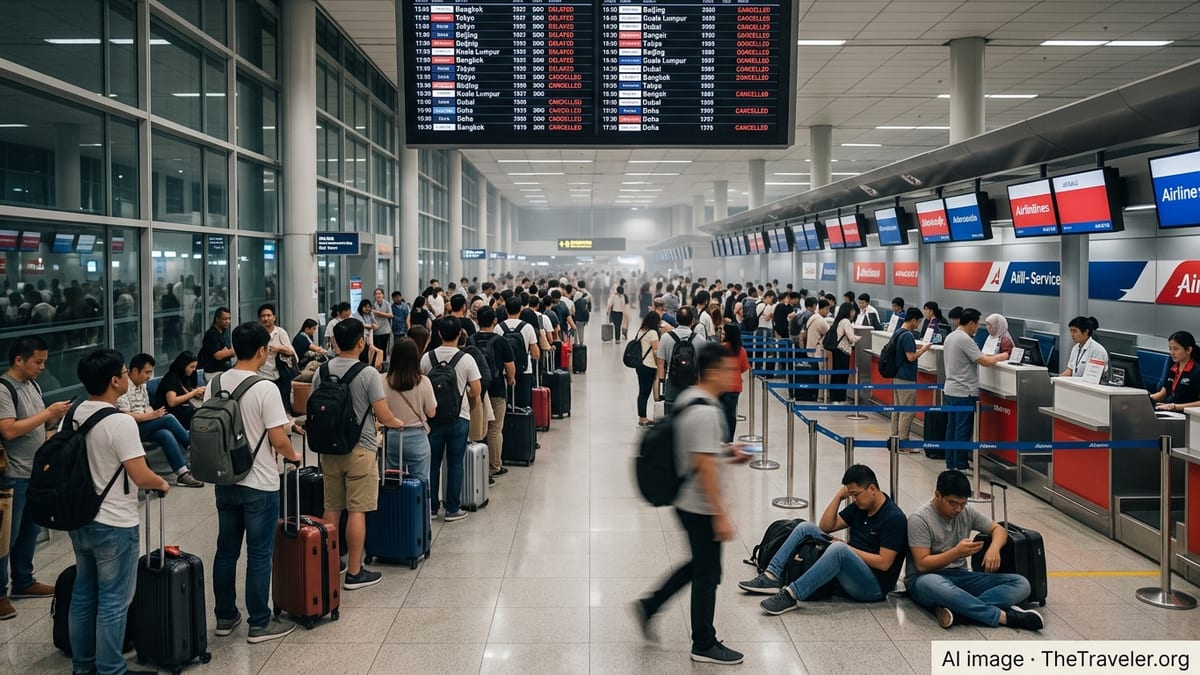
Major Hubs From Beijing to Kuala Lumpur Hit by Severe Disruptions
Published information from aviation trackers and regional media shows that airports in Thailand, Japan, Malaysia, Singapore, China, the United Arab Emirates and Qatar have all reported significant same-day schedule disruption, with 2,006 flights delayed and 195 cancelled across multiple carriers. The knock-on effect has rippled through major hubs such as Beijing Capital, Tokyo Haneda and Narita, Kuala Lumpur International, Bangkok Suvarnabhumi, Singapore Changi, Dubai and Doha, stranding transit passengers and complicating onward travel plans.
Operational data indicates that delays range from minor hold-ups of under an hour to extended disruptions of several hours, particularly on busy regional routes linking Southeast Asia with North Asia and the Gulf. With aircraft and crews out of position, some airlines have adjusted rotations or consolidated services, increasing pressure on already busy departure banks at peak times.
As a result, airport terminals from East Asia to the Gulf have seen crowded check in halls and transfer desks, with travellers seeking rebooking options or accommodation while they wait for later departures. Publicly available airport status boards show waves of red and amber indicators for late and cancelled flights, especially on routes connecting Asian capitals with long haul destinations in Europe, the Middle East and Oceania.
AirAsia, Japan Airlines, Air China and Emirates Among Affected Carriers
Low cost and full service airlines alike have been caught up in the disruption. Flight status information lists numerous delayed services for AirAsia on routes linking Kuala Lumpur, Bangkok and Singapore with secondary cities across the region. Japan Airlines has also reported pushed back departure times on select domestic and international sectors from Tokyo and Osaka, while Air China has experienced delays on services into and out of Beijing and other mainland hubs.
In the Gulf, publicly accessible timetables show Emirates operating with a revised schedule on certain Asia bound and Europe bound flights, with some services retimed or consolidated as airlines work to restore regular rotations. Qatar based services have also seen alterations, reflecting the broader regional impact of airspace constraints and congestion across busy long haul corridors.
Other regional and international carriers are facing similar challenges, with schedule adjustments visible on intra Asian routes and connecting services that rely on tight transfer windows. Aviation analysts note that when multiple hubs experience disruption on the same day, recovery becomes more complex, as each delayed aircraft can create further ripple effects across an airline’s network.
Passengers Face Long Queues, Missed Connections and Limited Seats
For travellers on the ground, the statistics translate into hours of uncertainty. Reports from passengers and local coverage describe long queues at check in counters, customer service desks and airline transfer offices, particularly at peak evening departure waves in Beijing, Tokyo, Kuala Lumpur and Dubai. With 195 flights cancelled, travellers on affected services have been seeking scarce seats on remaining flights that are often already heavily booked.
Published accounts highlight that some passengers have missed onward long haul connections after arriving late from regional feeders, forcing them to wait for next day departures or rerouting via alternative hubs. This has been especially challenging for travellers with complex multi stop itineraries that rely on tight connections through major Asian and Gulf airports.
Airport information screens and public announcements have advised passengers to expect extended waiting times for rebooking and to monitor their flight status closely. In some hubs, ground handling and security screening resources have been stretched by the volume of disrupted travellers, adding further delays at check points and boarding gates.
Regional Patterns Reveal Fragile Connectivity Across Asia and the Gulf
The widespread nature of the disruption across Thailand, Japan, Malaysia, Singapore, China, the United Arab Emirates and Qatar underlines how closely linked the region’s air travel networks have become. Even when issues originate at a limited number of hubs, the concentration of connecting traffic in cities such as Bangkok, Kuala Lumpur, Singapore, Dubai and Doha means that delays can quickly cascade across continents.
Industry data and past disruption patterns show that carriers like AirAsia, Japan Airlines, Air China and Emirates play a central role in connecting secondary cities with global long haul routes. When their schedules are affected, travellers in smaller markets can face fewer alternative options, longer detours and higher rebooking demand on the limited remaining services.
Aviation observers note that, while large hubs are designed to absorb a degree of irregular operations, simultaneous delays and cancellations across several regions expose the fragility of just in time aircraft and crew planning. Recovery often requires a full day or more of schedule adjustments, during which passengers continue to feel the impact in the form of altered departure times, last minute gate changes and congested terminals.
Airlines Urge Travellers to Monitor Flights and Plan for Flexibility
Public advisories from airport operators and airline customer information pages are encouraging travellers with upcoming flights through affected hubs to check their status frequently on official channels before departing for the airport. With aircraft and crews still being repositioned, additional minor timetable changes remain possible as carriers work through the backlog of delayed services.
Travel industry guidance suggests that passengers with flexible plans consider allowing extra connection time, particularly when transiting through multiple hubs in Asia and the Gulf on the same journey. Those with fixed commitments such as cruises, tours or events at their destination are being advised to review their arrangements and, where possible, build in additional buffer days to account for residual disruption.
While operations across the region are gradually stabilising, the combination of 2,006 delayed flights and 195 cancellations has provided a reminder of how quickly conditions can change for air travellers. For many stranded passengers in Beijing, Tokyo, Kuala Lumpur, Dubai and other hubs, the priority remains securing a confirmed seat and a clear path to their final destination.