

More news on this day
Hundreds of travelers have been left stranded across key Gulf aviation hubs after 166 flights were reportedly cancelled and at least 103 delayed at Bahrain International, Hamad International, Dubai International and King Khalid International Airport, intensifying an already severe period of disruption in Bahrain, Qatar, the United Arab Emirates and Saudi Arabia.
Get the latest news straight to your inbox!
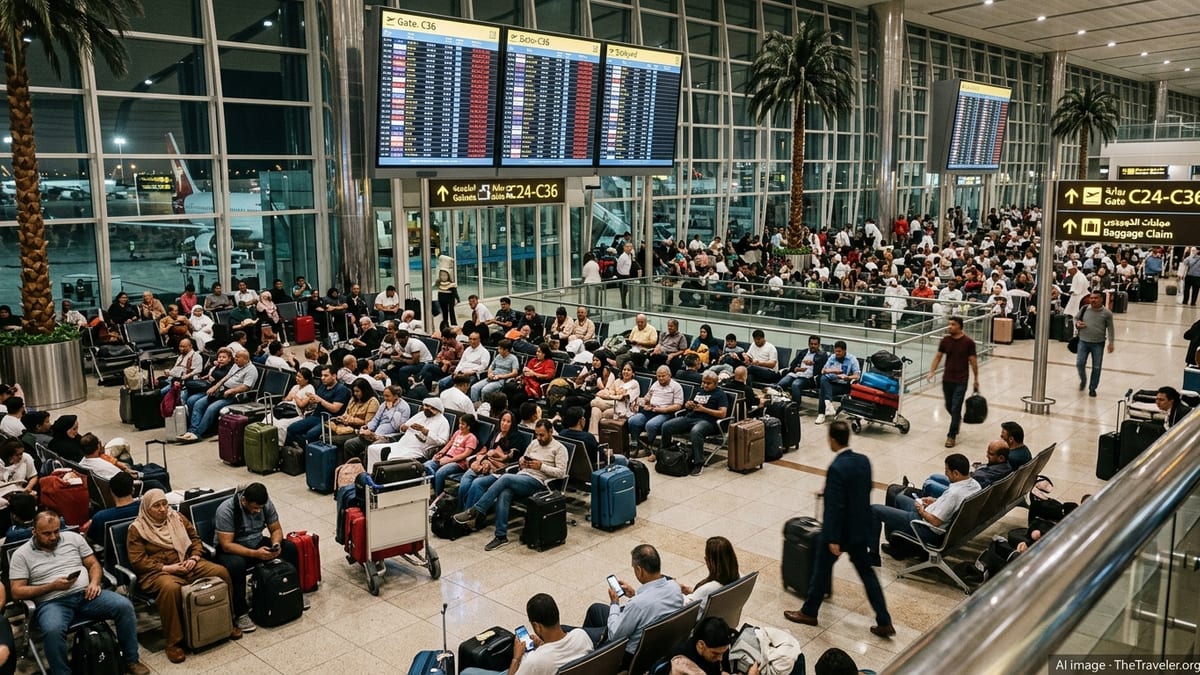
Major Gulf Hubs Hit by Wave of Cancellations
Recent flight data and regional coverage indicate that the latest interruption is part of a broader pattern of instability affecting air travel across the Middle East and North Africa, with Gulf hubs bearing a disproportionate share of the impact. Bahrain International Airport, Hamad International in Doha, Dubai International and Riyadh’s King Khalid International Airport have all recorded elevated numbers of cancellations and delays, compounding earlier disruptions linked to airspace restrictions and security concerns.
Published briefings from aviation and advisory firms in early March 2026 describe extensive airspace closures in Bahrain, Qatar and the United Arab Emirates, leading to widespread cancellations and schedule changes across long-haul routes. These closures have forced airlines to ground aircraft, reroute services or thin out frequencies on key corridors connecting Europe, Asia and North America via Gulf hubs, leaving passengers facing extended layovers and last-minute changes.
Publicly available information referencing 166 cancelled flights and 103 delayed across the four airports underscores the concentration of disruption in a relatively compact geographic area. While overall global cancellations remain higher than normal for the season, the clustering of affected operations in the Gulf has created intense pressure on airport infrastructure and customer service channels as travelers scramble to rebook.
The knock-on effect is being felt well beyond the immediate region. Airlines that rely on Gulf stopovers to bridge continents have been adjusting flight paths or temporarily suspending services, meaning that even travelers who are not originating in or destined for the Middle East may experience missed connections and interrupted travel plans.
Stranded Passengers Face Long Waits and Limited Options
Travelers transiting Bahrain, Doha, Dubai and Riyadh report long hours in terminals as flights are cancelled with limited notice or rescheduled multiple times. Accounts shared on public forums in recent days describe passengers waiting overnight near departure gates, watching departure boards cycle repeatedly between "delayed" and "cancelled" while airlines attempt to reposition aircraft and crew.
In Doha, travelers connecting through Hamad International describe flight itineraries that have been cancelled and rebooked several times over a short period, with the earliest available alternatives often pushed days or even weeks into the future. Similar patterns are described for passengers trying to reach Dubai after originating in neighboring countries, with some reporting that the next bookable seats fall well after their intended return dates.
At Dubai International, recent traveler reports suggest a mix of conditions depending on route and carrier. While some long-haul services have operated with only minor delays, others have seen consecutive cancellations, creating significant backlogs. The uneven pattern has contributed to uncertainty among passengers who arrive at the airport with confirmed bookings but find their flights subject to last-minute operational reviews.
Riyadh’s King Khalid International Airport has also been experiencing disruption as regional airspace changes ripple through Saudi Arabia’s wider network. Publicly available flight-status snapshots show clusters of delays around peak travel periods, alongside outright cancellations on selected regional and international services, leaving passengers to negotiate rebooking windows at short notice.
Airspace Restrictions and Security Concerns Drive Instability
Background briefings from regional analysts point to evolving security dynamics and airspace management decisions as central drivers of the current instability. Over recent weeks, multiple Middle Eastern states, including Bahrain, Qatar and the United Arab Emirates, have enacted full or partial airspace closures or restrictions, forcing airlines to suspend or reroute services.
These measures have directly affected Bahrain International Airport, where national carrier operations have been curtailed during periods of airspace closure. With Bahrain serving as a key transfer point for Gulf traffic, every extended suspension reverberates through connecting routes, adding pressure to alternative hubs in Doha, Dubai and Riyadh.
Hamad International and Dubai International, two of the region’s busiest transfer hubs, have also contended with fluctuating operational parameters. According to published coverage and airline travel advisories, carriers have been required at various points to suspend departures, adjust flight paths or introduce unplanned technical stops to avoid closed flight corridors, all of which contribute to cascading delays.
The cumulative effect has been a sharp reduction in predictability for passengers. Even when airports technically remain open, the need to avoid restricted airspace means that published schedules can change quickly, with some services departing on time while others are held back as airlines await updated clearances and crew availability.
Operational Challenges for Airlines and Airports
For airlines, the disruption has created a complex operational puzzle. Aircraft and crew have become misaligned with schedules, particularly when multiple rotations are cancelled in sequence. Publicly available information and airline advisories indicate that carriers have been forced to consolidate flights, combine passenger loads and prioritize specific routes in an effort to restore network stability.
This imbalance has been especially visible in the Gulf, where carriers typically operate dense banks of connecting flights. When a wave of cancellations affects a particular time band at airports like Dubai International or Hamad International, the entire structure of onward connections is undermined. Reaccommodation becomes more challenging because later flights may already be fully booked or themselves at risk of cancellation.
Airport operators across Bahrain, Qatar, the UAE and Saudi Arabia are also contending with practical pressures. Terminal facilities, designed to handle large but orderly passenger flows, are instead accommodating travelers who remain airside for extended periods while waiting for rebooked flights. Seating, food outlets and rest areas face sustained demand, especially during overnight hours when passengers had expected to be airborne.
Customer service and call centers are similarly stretched, as passengers seek clarification on their rights, eligibility for refunds or vouchers, and the likelihood of securing earlier alternatives. With information changing rapidly, standard scripted responses are often overtaken by events, leaving travelers reliant on real-time departure boards and carrier apps for the most current status.
What Affected Travelers Should Consider Now
Travel and consumer organizations monitoring the situation advise that passengers caught up in cancellations and heavy delays across Bahrain International, Hamad International, Dubai International and King Khalid International should first verify their flight status directly with the airline before going to the airport. In recent days, several airports in the region have urged travelers through public channels to arrive only with a confirmed, operating flight.
Given the volume of cancellations and the uneven pattern of resumed services, same-day or next-day rebooking may be difficult on popular routes, particularly between the Gulf and major European or North American cities. Travelers holding flexible tickets may have more options to adjust dates or reroute via alternative hubs that are less affected by current airspace constraints.
Publicly available guidance from travel insurers and consumer advocates also suggests that passengers review the terms of their policies and fare rules. In some cases, coverage may extend to additional accommodation, meals or replacement flights when disruptions are prolonged, though eligibility often depends on the cause of cancellation and the country of departure.
As conditions continue to evolve across Bahrain, Qatar, the United Arab Emirates and Saudi Arabia, observers note that further changes to airline schedules remain possible on short notice. Travelers planning to pass through the region in the coming days are being encouraged to build in extra time for connections, monitor official airport and airline communication channels closely and prepare contingency plans in case their itineraries are altered at the last minute.