

More news on this day
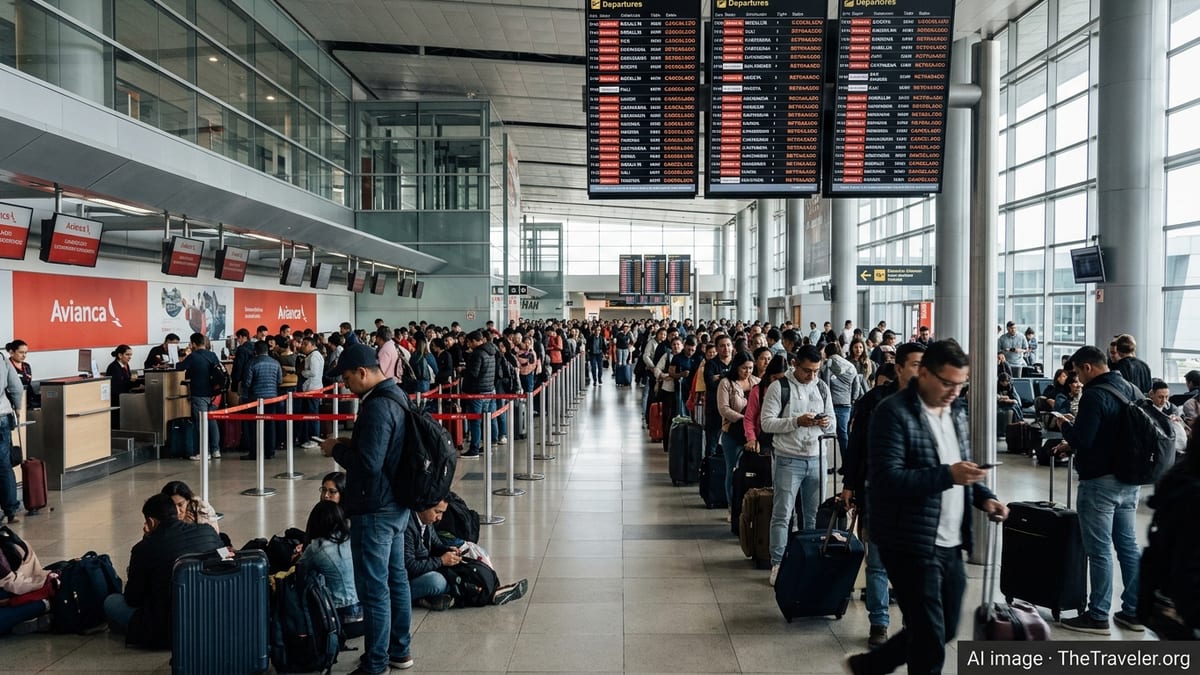
Hundreds of passengers faced long waits and missed connections at Bogotá’s El Dorado International Airport as 115 flights were delayed and 18 canceled, disrupting major regional and long haul routes across the Americas and Europe.
Get the latest news straight to your inbox!
Chain Reaction Across International and Domestic Networks
Operational disruption at El Dorado on March 31 triggered a ripple effect across Colombia’s busiest hub, where publicly available tracking data showed 115 delayed flights and 18 cancellations concentrated within a few hours of peak activity. The pattern of disruption fit a hub style shock, with delays spreading quickly from early bank departures into afternoon and evening operations.
According to airport performance dashboards and third party flight status platforms, the impact was felt on a mix of domestic shuttles and high demand international routes. Services linking Bogotá with Miami, New York, Madrid and São Paulo were among the most affected, alongside dense domestic corridors to cities such as Medellín, Cali, Cartagena and San Andrés.
As schedules slipped, aircraft and crews fell out of position, creating further knock on delays. Turnaround times at Bogotá lengthened as airlines worked through backlogs of boarding, baggage handling and aircraft servicing, leaving many passengers waiting in terminal areas while departure boards cycled repeatedly through revised times.
The combined effect left travelers facing uncertainty over onward connections, particularly those transiting Bogotá from secondary Colombian cities to long haul flights bound for North America and Europe.
Major Airlines Caught in the Disruption
The disruption touched a broad cross section of carriers that rely on El Dorado as a primary or secondary hub. Avianca, the country’s largest airline and the dominant operator at Bogotá, saw multiple departures pushed back from their scheduled slots, including services to Miami and other key North American gateways, as well as high frequency domestic routes.
LATAM Airlines also experienced irregular operations on links between Bogotá and regional leisure and business destinations. Real time status information indicated schedule changes on services to Colombia’s Caribbean islands and to major South American hubs, compounding challenges for travelers connecting onward to Chile, Peru and Brazil.
Spirit Airlines, which operates point to point low cost services between the United States and Bogotá, appeared in the affected roster as delays built on northbound and southbound services. Online customer reports highlighted concerns about missed connections at US airports for passengers using Bogotá as a springboard to domestic itineraries in the United States.
Other international operators serving Bogotá, including additional North American and European carriers, were indirectly impacted where their ground handling, shared infrastructure or connecting passenger flows intersected with the congested operation at El Dorado.
Key Routes to Miami, New York, Madrid and São Paulo Hit Hard
The most visible disruptions were concentrated on some of Bogotá’s highest profile international routes. Miami and New York, two of the busiest US gateways for Colombian travelers, saw multiple schedule changes, with delayed arrivals into El Dorado creating late evening departures and missed onward connections.
Transatlantic services to Madrid were similarly affected, with late inbound aircraft and congested departure windows pushing back departure times. For many travelers, delays on feeder flights from regional Colombian cities translated into tight or missed connections onto overnight departures to Spain, increasing demand for rebooking and overnight accommodation in Bogotá.
In the Southern Cone, services linking Bogotá with São Paulo experienced irregular operations as the disruption reverberated through shared aircraft rotations and crew rosters. Passengers on these routes faced particular challenges when connecting onward to other Brazilian or regional South American destinations with limited daily frequencies.
Within Colombia, high density domestic links such as Bogotá to Medellín, Cali and the Caribbean coast absorbed much of the initial shock. Short haul delays quickly stacked up into a patchwork of late departures and aircraft swaps, further complicating the task of restoring a predictable timetable for travelers.
Stranded Passengers Face Long Lines and Complicated Rebookings
Scenes at El Dorado reflected the familiar pattern of large scale disruption: crowded check in halls, long queues at airline service desks and boarding gates filled with travelers refreshing mobile apps for status updates. Social media posts and forum discussions from passengers in real time described uncertainty around revised departure times and limited availability on alternative flights.
Publicly available information on airline customer policies shows that carriers such as Avianca and LATAM typically offer same day changes, rebooking options on later flights and, in some cases, accommodation and meal vouchers when delays extend significantly or flights are canceled. However, travelers reported that accessing these remedies could be time consuming, particularly where call centers and in airport counters were under heavy load.
For passengers on low cost carriers including Spirit, options could be narrower, especially on routes with limited daily frequencies. Some travelers facing cancellations or severe delays turned to same day bookings on competing airlines at higher last minute fares, while others opted to delay trips entirely, seeking refunds or travel credits according to each airline’s published rules.
Families, elderly travelers and those without flexible onward plans appeared to be among the most affected, with many facing the prospect of unscheduled overnight stays in Bogotá and rearranged ground transportation or accommodation at their final destinations.
What the Disruption Reveals About Bogotá’s Role as a Regional Hub
The episode underscored the central role of El Dorado International Airport in Colombia’s aviation system and in broader regional connectivity. As the country’s main hub for both domestic and international traffic, even a single day of significant disruption has a cascading effect on business travel, tourism flows and cargo movements.
Analysts who track airport performance note that hub airports with dense wave structures are especially vulnerable when early departures are disrupted, since aircraft and crew are scheduled to operate multiple sectors per day. Once delays surpass certain thresholds, recovery can take many hours and may require selective cancellations to reset the operation.
In recent years, debates over infrastructure capacity, air traffic management and resilience planning at major Latin American hubs have gained prominence, with Bogotá frequently cited as an airport operating near its structural limits at peak times. Events such as the latest wave of delays and cancellations are likely to renew calls from industry observers for continued investment in runway capacity, terminal expansion and operational contingency planning.
For passengers, the disruption serves as a reminder of the importance of checking real time flight status, allowing generous connection windows on complex itineraries and understanding the rebooking and compensation policies of the airlines they fly. As operations at El Dorado gradually normalize, attention is expected to turn to how carriers and airport managers incorporate lessons from the incident into future planning.