

More news on this day
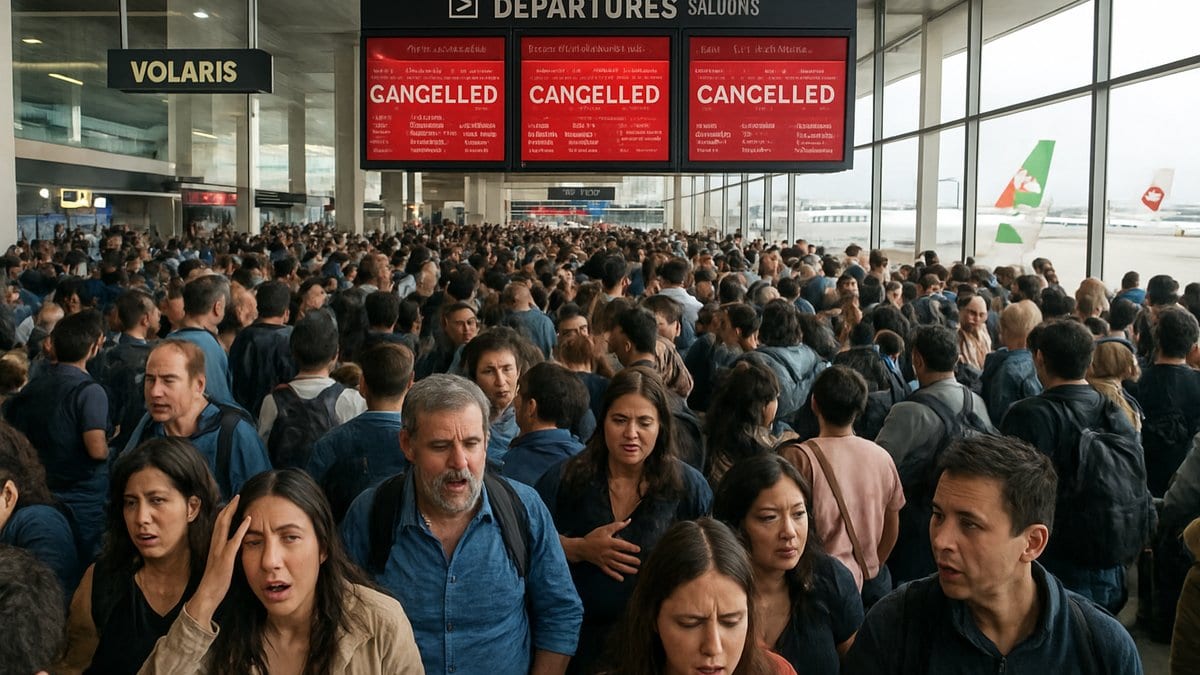
Mexico’s tightly woven domestic air network is facing acute disruption as low cost giants Volaris and VivaAerobus confront large scale, unplanned groundings of Airbus jets tied to software changes and engine maintenance constraints, forcing widespread schedule cuts, last minute cancellations and growing passenger frustration across the country’s key holiday and business corridors.
Get the latest news straight to your inbox!
Grounded Airbus Fleets Hit Mexico’s Two Largest Low Cost Carriers
The latest disruption traces back to a confluence of safety and maintenance issues affecting Airbus narrow body aircraft that form the backbone of both Volaris and VivaAerobus fleets. Publicly available information from Mexican and international outlets indicates that software updates required on thousands of Airbus aircraft worldwide have temporarily sidelined a significant number of jets, while ongoing shortages of maintenance slots and spare parts for certain engines continue to limit capacity.
Earlier coverage in Mexican media described how both Volaris and VivaAerobus began canceling dozens of flights while Airbus pushed out a software update affecting a large portion of the global A320 family fleet. Although the update is designed to enhance operational safety and reliability, it has required aircraft to be taken out of service for checks and reconfiguration, a particular challenge for carriers that operate high utilization, point to point networks with thin schedule buffers.
Industry data shows that Volaris and VivaAerobus depend almost entirely on Airbus single aisle aircraft for their domestic and near international routes. As a result, any technical grounding disproportionately affects their ability to maintain frequencies between major hubs such as Mexico City, Guadalajara, Monterrey, Tijuana and Cancun, as well as secondary cities that have few alternative air options.
The impact is magnified by the scale of operations both carriers have built in recent years. Comparative fleet and traffic figures published in late 2025 show that together they carried tens of millions of domestic passengers annually and controlled well over half of Mexico’s internal seat capacity, meaning interruptions at these airlines quickly translate into system wide constraints.
Delays, Cancellations and Stranded Passengers Across Key Airports
The grounding related capacity squeeze is coinciding with a period of heightened operational strain across Mexican aviation. Recent travel industry reports describe days with nearly 200 delays and several dozen cancellations at major airports including Cancun, Guadalajara, Monterrey and Mexico City, with Volaris flights frequently among those affected and VivaAerobus also altering schedules.
Separate coverage of cartel related unrest in Jalisco in late February already highlighted how domestic and international carriers were forced to halt or divert services to Guadalajara, Puerto Vallarta and Tepic. Volaris was listed among the airlines suspending or rerouting flights during those security incidents, adding another layer of disruption to an already fragile timetable.
As grounded aircraft reduce available spare capacity, the ability of Volaris and VivaAerobus to recover from weather events, security alerts or airport bottlenecks has diminished. When one flight is delayed or cancelled, knock on effects ripple through the rest of the day’s rotations, particularly on dense leisure routes such as Tijuana to Cancun or Guadalajara to Cancun, which rely heavily on the two low cost brands.
Travel forums and social media posts from recent weeks describe passengers facing last minute cancellations at the gate, extended delays without clear rebooking options and, in some cases, multi day waits for alternative flights. While such anecdotal accounts vary in reliability, they underscore the perception of a network stretched thin, where any technical grounding quickly translates into a customer service problem.
Regulatory Pressure and Cross Border Constraints Intensify the Squeeze
The fleet groundings are unfolding against a backdrop of rising regulatory and diplomatic friction that further constrains the Mexican market. In late 2025, the United States Department of Transportation ordered the suspension of a series of routes operated by Mexican carriers, including Volaris and VivaAerobus, over disputes tied to the bilateral air transport framework. Those measures reduced flexibility for airlines to redeploy aircraft and rebalance capacity between domestic and transborder networks.
At the same time, security turbulence linked to organized crime has periodically forced temporary shutdowns or operating restrictions at airports in western Mexico. Publicly accessible aviation security analyses for March 2026 continue to cite Mexico as a country where volatile conditions can rapidly affect air operations, requiring contingency planning and adding risk premiums to already complex scheduling decisions.
For low cost carriers built on rapid aircraft turnarounds and tight cost control, these overlapping pressures leave little margin when technical issues demand that several aircraft be withdrawn from service. Every grounded A320 or A321 represents multiple daily sectors lost, and the capacity cannot easily be replaced in a market where demand remains robust and leasing additional aircraft is constrained by global supply and maintenance backlogs.
Industry presentations and investor materials from Mexican airport operators have previously highlighted how Volaris and VivaAerobus have been central to traffic growth in the years following the pandemic. With those same airlines now forced to trim or reshuffle schedules because of grounded units, airports and tourism dependent regions are exposed to sudden drops in connectivity and visitor numbers.
Tourism and Domestic Mobility Face New Uncertainty
The timing of the disruptions is particularly sensitive for Mexico’s tourism industry and for residents who rely on budget carriers for domestic travel. Recent statistics on Mexican air travel show that low cost airlines have driven a large share of the growth in passenger numbers, connecting secondary cities and popular beach destinations with affordable fares that compete directly with long distance buses.
As Volaris and VivaAerobus grapple with grounded planes and thinned out timetables, passengers in smaller markets risk seeing their few daily flights reduced to even more limited options. This can complicate access to medical care, business travel and family visits, not just leisure trips to coastal resorts. In regions where road travel may be affected by security concerns, the loss of air capacity can have outsized social and economic effects.
Tourism operators are also watching the situation closely. Coverage in trade publications has warned that repeated waves of delays and cancellations risk damaging Mexico’s reputation among international visitors, particularly those connecting through domestic flights after long haul journeys. Missed connections, rebookings at short notice and overnight stays caused by grounded aircraft add costs for hotels, tour operators and travelers alike.
The broader context includes preparations for events such as the 2026 World Cup, which are expected to bring a surge of visitors through Mexican airports. If the fleet grounding issues are not resolved in time, or if new technical or regulatory hurdles arise, planners may have to adjust expectations around capacity and resilience in the country’s air transport system.
Merger Plans and Recovery Prospects for Mexico’s Low Cost Sector
Despite the immediate turmoil, both Volaris and VivaAerobus continue to outline growth ambitions and structural changes that could reshape the landscape once fleet constraints ease. A recently announced plan to create a new airline group combining the two low cost brands, widely covered in business media, is framed as a way to expand access to budget travel and unlock efficiencies, subject to regulatory approvals.
Supporters of the merger concept argue that a more integrated group could better optimize aircraft deployment, maintenance planning and route networks, helping to absorb shocks such as unplanned groundings. By consolidating orders for new Airbus aircraft, coordinating spare parts inventories and harmonizing cabin configurations, the combined entity might reduce the vulnerability that each airline currently faces when multiple jets are taken out of service at once.
However, consumer advocates and some competitors have raised questions about concentration in the domestic market and the potential for reduced competition on key routes if the merger proceeds. If two of the largest low cost players share ownership and close operational ties, passengers may have fewer alternatives when disruptions occur, especially if Aeromexico or foreign carriers do not offer comparable frequencies or fares on certain city pairs.
For now, Mexico’s air travelers remain caught between the promise of a more extensive low cost network in the future and the reality of near term schedule instability driven by grounded aircraft, maintenance logjams and regulatory headwinds. How swiftly Volaris and VivaAerobus can return their full Airbus fleets to service, and how regulators respond to consolidation plans, will determine whether the current paralysis marks a short lived shock or a longer adjustment for the country’s air transport system.