

More news on this day
Air travel across the Gulf ground to an abrupt halt on February 28 as Qatar, the United Arab Emirates and Kuwait temporarily shut their airspace in response to fresh Iranian missile strikes, stranding thousands of passengers and forcing airlines to cancel or reroute flights linking Asia, Europe, Africa and the Americas.
What Triggered the Sudden Regional Airspace Shutdown
The latest disruption follows a new round of Iranian attacks on United States military facilities in the Gulf, part of a rapidly escalating confrontation that has turned one of the world’s busiest aviation corridors into a conflict zone. Regional civil aviation authorities moved within hours to close airspace, citing heightened security risks for commercial jets transiting the region.
Iran’s missile launches toward US bases in and around Qatar prompted immediate precautionary action from Gulf governments. Officials in Doha, Abu Dhabi and Kuwait City issued temporary airspace closure notices, effectively freezing takeoffs and landings and forcing overflying traffic to divert around the Gulf. Aviation regulators in Europe and Asia quickly followed with stark warnings about operating anywhere near the affected skies.
The resulting shutdown has rippled far beyond the Middle East. Because hubs such as Doha, Dubai and Abu Dhabi serve as connecting crossroads for long haul flights between continents, even travelers who never planned to set foot in the region are now facing cancellations, lengthy diversions and missed connections.
Qatar, UAE and Kuwait Halt Flights from Key Hubs
In Doha, Qatar Airways confirmed a temporary suspension of flights to and from Hamad International Airport after Qatari authorities closed national airspace early on Saturday. The carrier said it is working with government agencies and foreign regulators to support affected travelers and will restart operations only when officials deem conditions safe.
Across the Arabian Gulf, the United Arab Emirates has moved to restrict traffic through its own skies, hitting two of the world’s busiest international hubs. Dubai International Airport, home to Emirates, and Abu Dhabi International Airport, base for Etihad Airways, both reported widespread cancellations and delays as airlines halted departures and inbound flights were either turned back, diverted or kept on the ground.
Kuwait’s civil aviation authority also announced a temporary airspace closure as a precautionary measure, suspending operations at Kuwait International Airport. The move followed similar steps taken by neighboring states and effectively sealed off large portions of the northern Gulf to civil aviation, further complicating routing options for international carriers.
Thousands of Passengers Stranded and Flights Rerouted Worldwide
The most immediate impact has been on passengers already en route when airspace restrictions took effect. Aircraft bound for Doha, Dubai, Abu Dhabi and Kuwait City have been forced to divert to alternative airports across the wider Middle East, Europe, North Africa and South Asia, leaving thousands of travelers stranded far from their intended destinations.
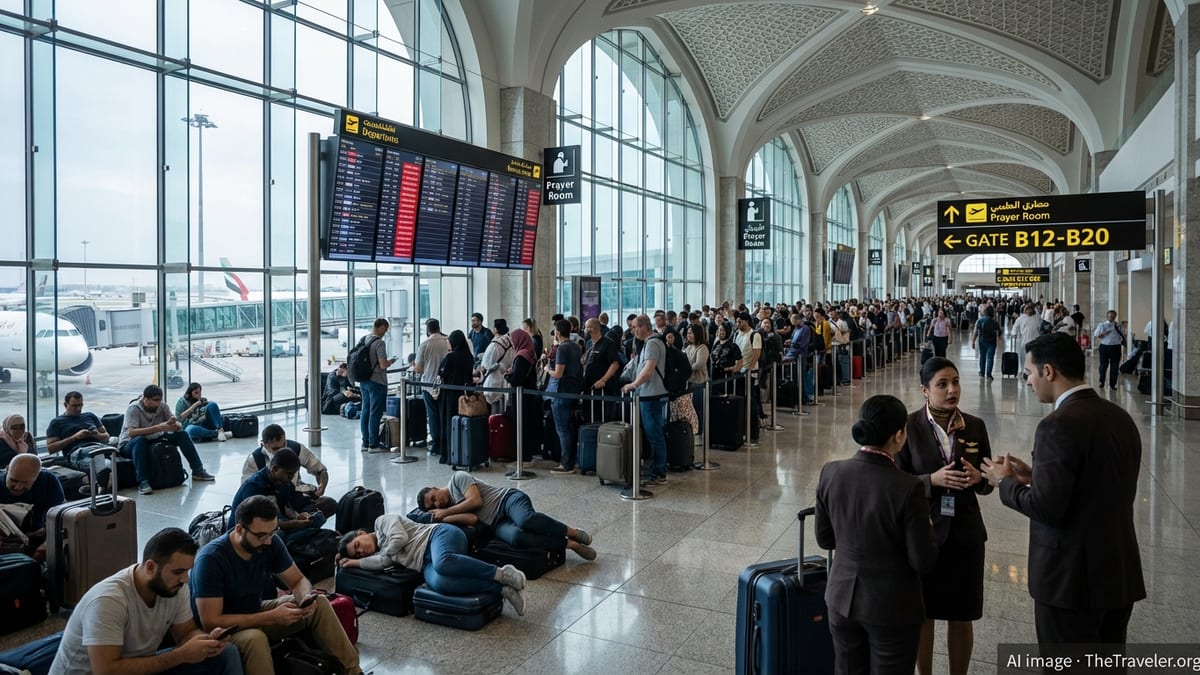
Airlines are scrambling to organize hotel accommodation, meal vouchers and rebooking options, but the scale of the disruption means many passengers are facing long queues, limited information and uncertain timelines. Social media posts from transit terminals in the Gulf show crowded departure halls, exhausted families and departure boards filled with cancellations.
For flights that can still operate, the closure of key Gulf and Iranian airspace corridors has created complex detours. Long haul routes between Europe and Asia, and between North America and the Indian subcontinent, are being re-planned in real time, often adding several hours of flying time and requiring extra fuel stops. Industry analysts warn that aircraft and crew displaced by these diversions will cause knock-on schedule chaos for days, even if airspace is reopened quickly.
Safety Bulletins, Airline Waivers and What Travelers Should Expect
International aviation watchdogs have responded with unusually strong language. Europe’s aviation safety regulator has issued a conflict zone bulletin urging airlines to avoid affected skies entirely, warning of a high risk to civil aviation while military operations and retaliatory strikes continue. Other national regulators in Asia and North America are updating advisories and routing guidance as intelligence assessments evolve.
Major global airlines that rely on Doha, Dubai and Abu Dhabi as key stopover points are rolling out flexible rebooking policies and fee waivers, allowing passengers to change travel dates or routes without penalties. Some carriers have temporarily suspended services to Gulf destinations, while others are operating limited flights that detour around closed airspace, subject to regulatory approvals.
Travelers with imminent departures to or through the Middle East are being urged to monitor their airline’s official channels and flight status tools closely, as conditions can change within hours. Those already on multi leg itineraries should expect potential missed connections and be prepared for overnight layovers while new routings are arranged. Travel insurance coverage will vary widely depending on policy wording around war and civil unrest.
How Long Could the Crisis Last and What It Means for Global Travel
Officials in Qatar, the UAE and Kuwait continue to describe the closures as temporary and precautionary, but regional diplomats acknowledge that the duration will depend heavily on whether Iran and the United States pull back from further escalation. Previous missile incidents in the Gulf led to airspace shutting for less than a day, but the current round of strikes is unfolding in a more volatile strategic context.
Even a short lived shutdown can leave a long tail of disruption across global airline networks. Aircraft and crew are out of position, slot allocations at major airports must be reworked, and hundreds of thousands of passengers will need to be reaccommodated. Industry experts say it could take a week or more for schedules to fully normalize once airspace is deemed safe and reopened.
Longer term, repeated conflict related closures in the Gulf are likely to reshape how airlines plan routes and contingencies in the region. Carriers may diversify connecting hubs, build in more fuel and crew buffers, and reevaluate overflight exposure to rapidly shifting geopolitical flashpoints. For travelers, the events of February 28 serve as a stark reminder that the world’s tightest aviation chokepoints are also some of its most politically fragile.