

More news on this day
Massachusetts Governor Maura Healey will lift the South Coast travel ban at noon Tuesday following a crippling blizzard, but officials are urging residents across the South Shore and Cape to stay off hazardous roads as widespread power outages and intensive cleanup operations continue.
Travel Ban Ends, State of Emergency Largely Remains
The nonessential motor vehicle travel ban covering Bristol, Plymouth, Barnstable and Dukes counties is set to end at midday Tuesday, a day after near-blizzard and blizzard conditions buried southeastern Massachusetts under well over two feet of snow in places. The order, put in place Monday to keep cars off the roads and allow plows and emergency vehicles to operate, had effectively shut down much of the South Coast, Cape Cod and Martha’s Vineyard.
Even as the restrictions are lifted, the statewide response to what some officials are already dubbing the “Blizzard of ’26” is far from over. The governor’s office said the overarching state of emergency remains in effect for every county except Berkshire, Hampden, Hampshire and Franklin, where conditions have improved enough for formal emergency status to be withdrawn.
Local leaders from New Bedford to Brockton stressed that the end of the statewide travel ban does not mean a return to normal. A patchwork of city and town level restrictions, including local travel advisories and parking bans on narrow, snow-choked streets, remains in force across much of the South Shore and South Coast.
Residents who do venture out are being asked to do so only if necessary, to drive slowly and to give snow removal and utility crews a wide berth as they work to clear roads and restore essential services.
Power Outages and Bitter Cold Challenge Recovery
At the height of the storm, nearly 300,000 customers in Massachusetts were without electricity, with the brunt of the outages concentrated along the South Shore, South Coast and Cape. By Tuesday morning that number had dropped, but roughly a quarter of a million homes and businesses were still in the dark as temperatures hovered near freezing.
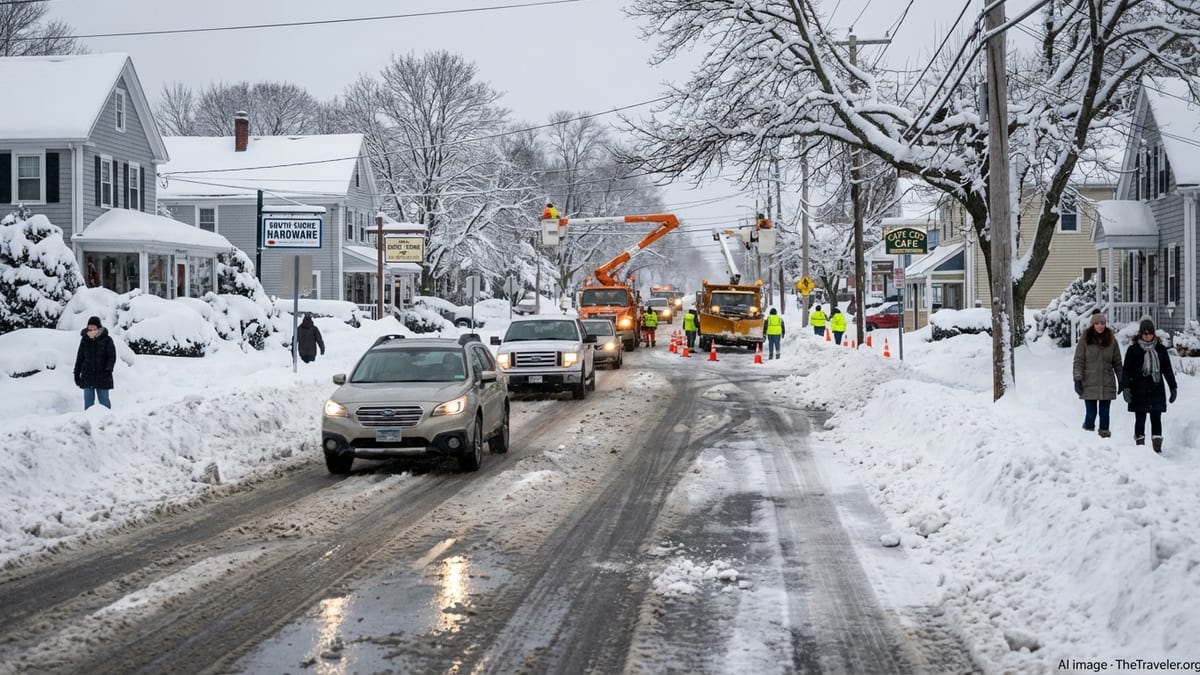
Utility companies reported hundreds of crews fanned out across southeastern Massachusetts, many working 16-hour shifts to replace snapped poles, restring lines and cut away fallen branches that had crashed through distribution networks under the weight of heavy, wet snow. Strong winds that lingered into Tuesday complicated the work, making bucket operations more dangerous and forcing crews to pause in some exposed coastal locations.
Officials warned that for some of the hardest hit neighborhoods, particularly on the South Shore and out toward the Cape, full restoration could still be days away. Warming centers and emergency shelters have opened in dozens of communities to accommodate residents who cannot safely remain at home without heat or power.
Emergency managers urged people using portable generators to operate them outside and away from windows, and reminded residents not to attempt to clear downed wires on their own, noting that live lines may be hidden under snowbanks or tangled in fallen trees along secondary roads.
Hazardous Roads Persist Across South Shore and Cape
Despite improving visibility and lighter winds, travel across much of the South Shore remained treacherous on Tuesday. State transportation officials described many secondary and neighborhood roads as rutted, icy and narrowed to a single passable lane, particularly in coastal communities where drifting has piled snow shoulder high.
Highways that were largely empty at the height of the storm are slowly reopening to regular traffic, but drivers are contending with frozen slush, scattered debris and snowbanks that severely limit sightlines at on- and off-ramps. On Route 24 and other major corridors south of Boston, abandoned vehicles and jackknifed trucks that were stranded during whiteout conditions have added to the challenge for plow operators trying to fully clear the pavement.
Massachusetts transportation officials said speed limits would remain reduced on some key routes while crews continue to push back snow, widen lanes and treat black ice. Motorists are being encouraged to avoid unnecessary trips into and out of the most heavily affected South Shore communities, both to reduce the risk of collisions and to keep congestion from slowing plows and emergency responders.
Public works departments from Quincy to Plymouth reported that they are still in the “dig-out” phase, with sidewalks, crosswalks and school zones yet to be fully cleared. Authorities cautioned pedestrians to be especially careful at intersections where towering snowbanks and narrowed shoulders have left little room between moving vehicles and those on foot.
National Guard, Local Crews Continue Intensive Cleanup
The historic scale of the storm has prompted one of the largest coordinated cleanup operations Massachusetts has seen in years. Roughly 350 members of the Massachusetts National Guard have been activated to assist local agencies in southeastern parts of the state, using high-water vehicles, specialized snow equipment and all-terrain transports to reach isolated neighborhoods.
In coastal communities, Guard teams and local first responders have conducted wellness checks on residents in low-lying areas, delivered supplies to those unable to leave their homes and assisted in transporting patients to medical appointments when standard ambulance access has been hampered by drifts and blocked side streets.
Municipal public works crews, private contractors and state plow operators are working in shifts around the clock to push snow off main arteries, clear access to hospitals and fire stations, and reopen critical commuter routes. Officials in several South Shore towns have asked residents to move vehicles off the street and to avoid pushing snow back into roadways during shoveling and snow blowing, saying those actions can erase hours of plow work and create new hazards.
Waste collection, postal deliveries and other everyday services remain erratic in many communities, with schedules likely to be disrupted for several days as crews focus first on making roads safe and restoring core infrastructure.
Officials Urge Patience as Region Slowly Reopens
State and local leaders are attempting to balance residents’ desire to resume routines with the practical realities of a region still digging out. While the lifting of the travel ban is a key milestone, many school districts across eastern Massachusetts have canceled or delayed classes, and employers are being encouraged to allow remote work wherever possible for the remainder of the week.
Tourism-dependent communities on the South Shore and Cape are also weighing how quickly to reopen to visitors after the storm. Local chambers of commerce say businesses are eager to welcome customers back, but they acknowledge that unsafe sidewalks, uncleared parking lots and intermittent power make an immediate return to normal operations unrealistic.
Public safety officials continue to emphasize a simple message for residents and travelers alike: if you do not have to be on the road, stay home. For those who must drive, they recommend packing extra blankets, water and a charged phone, keeping gas tanks at least half full and allowing ample time to reach destinations given the likelihood of detours and slow-moving traffic.
With another shot of colder air forecast to settle over the region, any remaining slush is expected to refreeze overnight, prolonging the threat of black ice. Even as bright winter sun returns to the South Shore in the days ahead, officials warn that the real end of this storm will come not with the lifting of a travel ban, but only once the last customer has power restored and the final snowbank has melted back from the curb.