

More news on this day
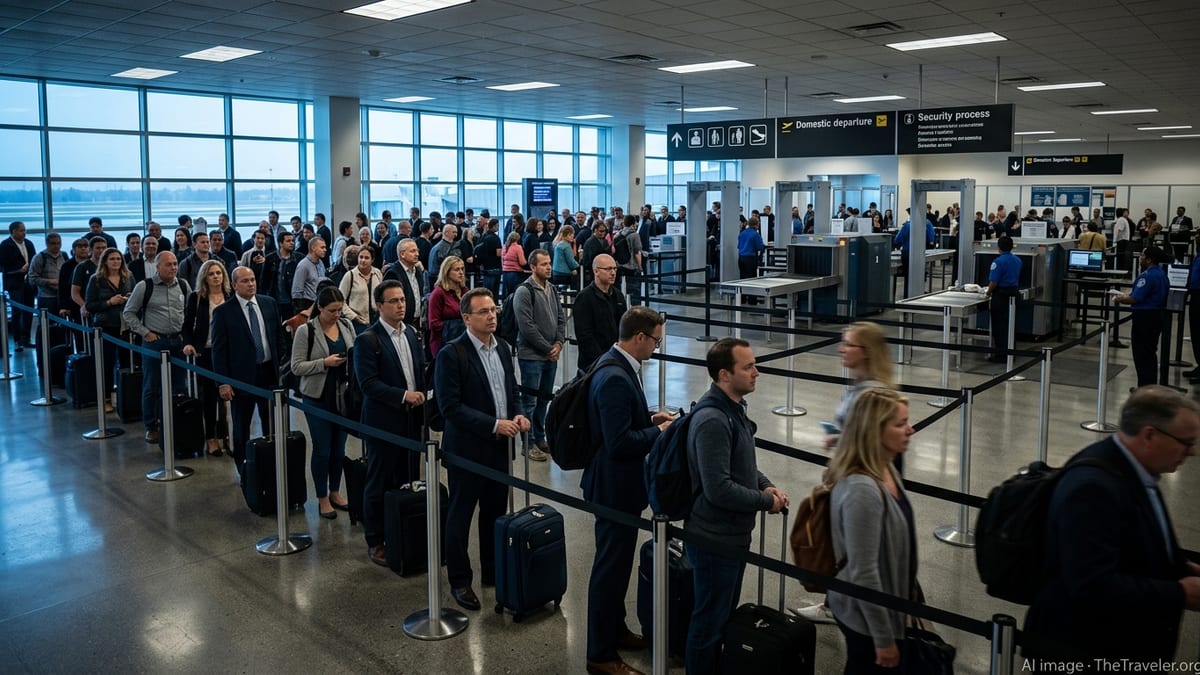
Hours long queues at U.S. airport security checkpoints during the current Department of Homeland Security shutdown are reshaping the flying experience, eroding long standing advantages once enjoyed by premium travelers and bureaucrats who relied on priority lanes, trusted traveler programs and elite status to bypass the worst of the crowds.
Get the latest news straight to your inbox!
Aviation Bottlenecks Enter a New Phase
Across major U.S. hubs, reports indicate that security delays have become a defining feature of the spring 2026 travel season. Staffing shortfalls at the Transportation Security Administration, compounded by a Department of Homeland Security funding lapse that began on February 14, 2026, have triggered what some analysts describe as a rolling aviation standstill, with checkpoint queues stretching deep into terminal concourses. Recent coverage of the shutdown notes that TSA officers are required to report to work even without pay, a pattern that has historically produced rising sick calls and attrition when funding gaps extend for weeks.
Publicly available checkpoint data and travel industry reporting show that this disruption comes on top of a broader capacity crunch in U.S. aviation. Air traffic control facilities entered 2026 with chronic staffing shortages following a prolonged federal shutdown in late 2025 and years of underinvestment in controller recruitment and training. Government watchdog audits and policy documents highlight that key facilities have been operating with extended overtime, and that the system has little slack when demand surges during holidays or school breaks.
The result is a layered crisis for travelers. Extended TSA lines delay passengers at the front end of the journey, while thinning air traffic control ranks and crowded schedules heighten the risk that missed departures cascade into wider disruption. Travel news outlets tracking day to day operations report thousands of delays on some peak days, as carriers juggle crew availability, weather and constrained departure slots at busy hubs.
Premium Lanes Lose Their Edge
One of the most striking shifts for frequent travelers is the apparent blurring of traditional distinctions between standard screening and premium access. For years, federal employees, lawmakers, corporate executives and elite status holders have leaned on priority lanes, TSA PreCheck, Global Entry and commercial fast track services to keep airport time predictable, even when regular queues snaked through terminals. This year, however, scattered reports from major airports suggest that those advantages are narrowing or, in some cases, disappearing entirely during peak congestion.
Travel forums and social media posts from March 2026 describe instances where priority or elite security areas at large hubs were either de emphasized or folded into common screening flows. In at least one busy Midwestern airport, frequent flyers reported that a long standing priority lane for airline elites had been removed, with staff indicating that passenger status was no longer being recognized at that checkpoint. Other accounts from hubs in Texas and Georgia describe situations where PreCheck lanes opened late, were temporarily closed, or were so congested that their time savings compared with general screening became negligible.
According to published coverage that aggregates TSA wait time reports, some terminals have seen PreCheck and Clear users forced into shared lines during staffing pinch points, particularly early in the morning and late in the evening. In Houston and New Orleans, local news and travel advisory sites recently highlighted guidance for passengers to arrive up to four or five hours before departure during the height of the spring break rush, regardless of their enrollment in trusted traveler programs. Under such conditions, the traditional value proposition of premium access is less about skipping the queue and more about marginal, inconsistent gains.
Government Travelers Caught in the Same Gridlock
The current upheaval is also notable for what it reveals about official and bureaucratic travel. Historically, segments of the federal workforce, including some senior officials and frequent duty travelers, have benefited from expedited screening arrangements and predictable access to priority lanes. While those arrangements vary by agency and airport, the present shutdown related disruption has shown that even travelers with official orders or government credentials are subject to the same systemic bottlenecks when staffing shortages close lanes and consolidate checkpoints.
Information in recent analyses of the Department of Homeland Security shutdown indicates that a large majority of TSA personnel are designated as essential and must work during funding lapses, but ancillary services and special accommodations are more vulnerable to cutbacks. When airport authorities and TSA management respond to constrained staffing by concentrating personnel in fewer open lanes, premium and dedicated queues are often the first to be scaled back. Under that model, specialized access for government travelers offers little protection from the overall slowdown.
Policy researchers also point out that these disruptions come at a time when federal travel has been rebounding from pandemic era lows. Conferences, inspections, field visits and interagency coordination trips that were once conducted virtually are increasingly returning to in person formats. As a result, bureaucrats and official travelers who had come to rely on relatively frictionless movement through the aviation system are now competing with record numbers of leisure passengers for the same limited checkpoint capacity.
Checkpoint Congestion Becomes a Systemwide Risk
While long lines are most visible at the security entrance, the underlying pressures reach across the national air network. A recent travel trends analysis published by a national membership organization for older Americans noted that nearly half of surveyed respondents planned domestic air trips in 2026, a figure that reflects sustained demand despite repeated episodes of disruption. At the same time, academic research on aviation operations has begun to quantify how security queues at major hubs feed into broader patterns of delay, especially when those hubs act as connecting nodes for multiple carriers.
One 15 year longitudinal assessment of U.S. aviation performance released in March 2026 found that in the post pandemic period, security related delays at high volume airports have become a more visible contributor to overall schedule reliability. When checkpoint backlogs force large numbers of passengers to miss boarding times on tightly banked departure waves, the research suggests that airlines face harder choices between holding flights for late connecting travelers, rebooking passengers on already full later departures, or allowing misconnects to cascade through the system.
Operational reporting from airlines and air traffic officials over the past year similarly underscores the fragility of the system under current staffing models. Industry briefings and regulatory filings submitted during and after the 2025 federal shutdown pointed to chronic shortages at key air traffic centers, leading to mandated schedule cuts in several high traffic markets. Combined with TSA staffing strain and the current DHS funding impasse, these constraints make it harder to recover from even routine disruptions such as thunderstorms or equipment outages.
What Travelers and Explorers Should Prepare For Now
For leisure travelers and frequent explorers, the immediate implication is that the old rulebook for airport timing is being rewritten. Travel advisories issued in recent weeks consistently recommend arriving significantly earlier than pre pandemic norms, especially at large hubs and during school holidays. In markets hit hardest by staffing strain, including parts of Texas, Louisiana and California, local outlets have documented lines of one to three hours at security checkpoints on peak days. Under these conditions, a two hour arrival window for domestic flights may no longer be sufficient, even for those with PreCheck, Clear or elite status.
Published coverage from travel risk and health advisory platforms also stresses the importance of building more flexibility into onward plans. Explorers connecting to international flights, cruises, rail journeys or time sensitive tours are encouraged to schedule longer layovers and avoid tight back to back itineraries when possible. With airlines still operating near capacity on many popular routes, same day rebooking options for missed connections can be limited, particularly for economy class tickets purchased far in advance.
Experienced travelers increasingly emphasize practical strategies that do not depend on preferential access. These include checking real time security wait times provided by airports and TSA before leaving for the airport, favoring early morning departures that may be less exposed to rolling delays, and packing carry on bags in ways that simplify secondary screening. While trusted traveler programs and premium cabin tickets still offer benefits such as dedicated check in counters and more generous baggage rules, they are no longer a reliable shield against the knock on effects of nationwide staffing shortfalls.
Looking ahead, analysts note that the duration of the current DHS shutdown, and the pace at which TSA and air traffic control vacancies can be filled afterward, will largely determine how long this phase of the great aviation standstill lasts. Even under optimistic hiring scenarios, training pipelines for new controllers and security officers extend many months. For now, travelers across the spectrum from budget backpackers to senior bureaucrats may need to accept that long checkpoint queues are part of the new normal and plan their journeys with a margin of patience and time that would have seemed excessive just a few years ago.