

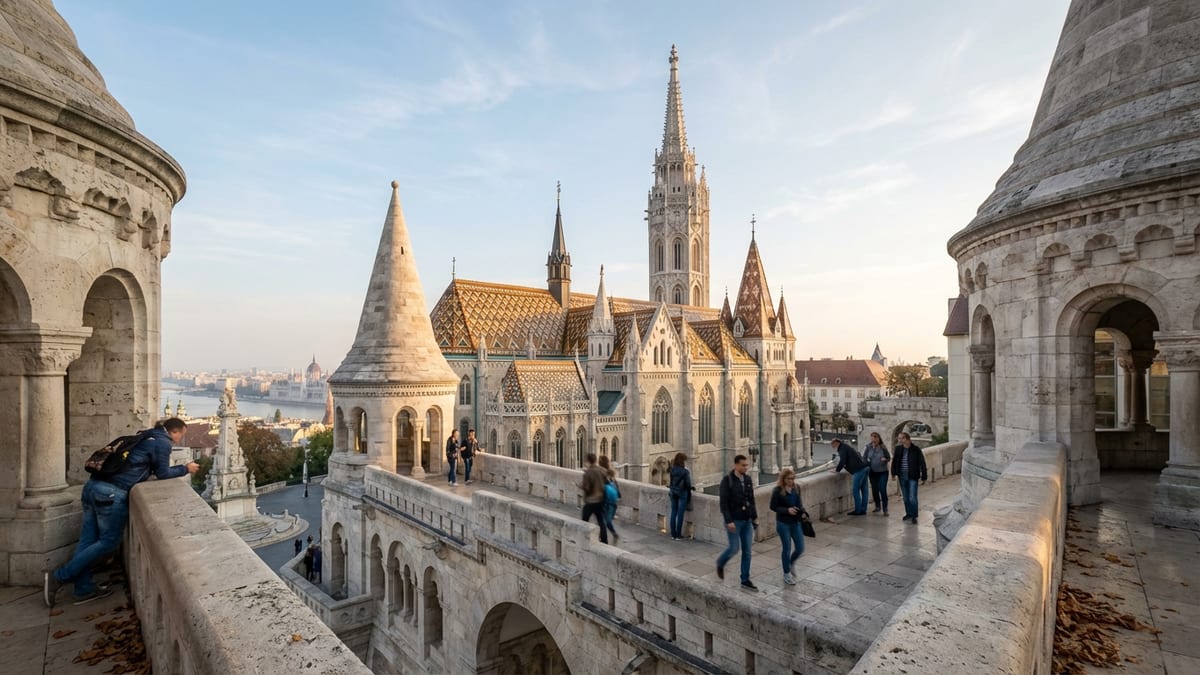
Matthias Church rises above Budapest’s Castle Hill in a blaze of patterned tiles and Gothic spires, its silhouette one of the most recognizable along the Danube. Officially known as the Church of Our Lady of Buda Castle, this landmark has served as a royal coronation church, Ottoman mosque, and modern-day parish and concert venue. For travelers, it offers a rich blend of history, architecture, and sweeping views across the city, all concentrated in one compact site just steps from Fisherman’s Bastion.
Historical Background: From Royal Foundation to Coronation Church
According to long-standing tradition, the first church on this site was founded by Saint Stephen, the first king of Hungary, around 1015. That early Romanesque structure did not survive the Mongol invasion of 1241, when large parts of medieval Buda were destroyed. The church that visitors see today largely dates from the second half of the 13th century, when it was rebuilt in a Gothic style as the main parish church of the newly fortified Buda Castle district.
In its medieval heyday, the Church of Our Lady, as it was then known, grew into one of the largest churches of the Hungarian kingdom. It became intimately tied to royal ritual and politics. Several kings were married and crowned here, reinforcing Buda’s status as a power center. Over time, wealthy guilds and noble families endowed side chapels and altars, adding to the building’s complexity and prestige.
The church’s later nickname, Matthias Church, comes from King Matthias Corvinus, the Renaissance ruler who reigned in the 15th century. He oversaw significant expansions, including the transformation of the southern tower that today bears his name. Under Matthias, the church became a showcase for late Gothic splendor, reflecting Hungary’s flourishing cultural ties to other European courts.
The 16th and 17th centuries brought upheaval as the Ottoman Empire captured Buda in 1541. The church was converted into one of the city’s principal mosques, its Christian furnishings removed or covered and a mihrab added to orient worshippers toward Mecca. When a Christian coalition retook Buda in 1686, a dramatic episode known as the “Marian Miracle” was said to have occurred: cannon fire exposed a hidden statue of the Virgin Mary behind a wall, a sight that reportedly shook Ottoman defenders and boosted the attackers’ morale.
Reconstruction, Restoration and the Zsolnay Roof
By the 18th century, the church had been rededicated as a Catholic place of worship and refitted in Baroque style, in line with contemporary taste. Frescoes, altars, and stucco work softened the structure’s Gothic lines. Yet by the mid-19th century, a new generation of architects and historians began to value medieval architecture more highly. They considered the Baroque additions inauthentic and launched an ambitious restoration campaign aimed at recovering a Gothic character.
The key figure in this transformation was Hungarian architect Frigyes Schulek, who led a sweeping reconstruction between the 1870s and 1890s. Schulek stripped away many Baroque elements, uncovered original Gothic features, and rebuilt damaged portions according to what he believed to be the church’s 13th-century plan. At the same time, he was not afraid to innovate. He added sculptural details and decorative programs of his own, ensuring that the renewed Matthias Church was both a historical reconstruction and a creative 19th-century work.
One of Schulek’s most visible interventions is the church’s dazzling roof. Covered in geometric patterns made from colorful Zsolnay ceramic tiles, the roof is instantly recognizable from across the Danube. Produced by the renowned Zsolnay manufactory in Pécs, these tiles are both decorative and practical, able to withstand harsh Central European winters and hot summers. The diamond and hexagonal patterns in shades of green, terracotta, yellow, and white lend the church an almost storybook appearance while remaining rooted in historicist design.
Schulek’s work extended beyond the roof and façade. He commissioned new stained glass, reimagined the pulpit and high altar, and even reshaped the surrounding urban space by freeing the church from the former Jesuit buildings that once crowded it. The result was a stand-alone landmark crowned by the neighboring Fisherman’s Bastion, which Schulek also designed to complement the church’s romantic neo-Gothic silhouette. Today, Matthias Church and its surroundings form part of the UNESCO-listed Buda Castle Quarter.
Architectural Highlights: Towers, Portals and Interior Decoration
Approaching from Trinity Square, visitors first encounter the richly ornamented main façade. The most striking feature here is the Matthias Tower, a tall, lace-like Gothic spire that rises above the western end of the church. Its levels of windows, pinnacles, and crockets create a vertical rhythm that draws the eye upward. On the opposite side, the somewhat shorter Béla Tower, topped with its own patterned roof, balances the composition while adding another point of interest.
Beneath the towers, the main portal, often called the Mary Portal, deserves close study. Carved archivolts, columns, and sculpted figures frame the entrance, illustrating scenes from the life of the Virgin Mary and other biblical motifs. Many of these sculptures are 19th-century reconstructions based on fragments and historical sources, yet they succeed in evoking the feel of a medieval doorway. Gargoyles around the church, including dragons and fantastical beasts, meanwhile serve as both decorative flourishes and drainage outlets.
The interior of Matthias Church is strikingly different from the pale stone naves of some Western European cathedrals. Inside, visitors are immersed in warm, saturated colors. Walls and vaults are painted with intricate patterns, floral motifs, and stenciled designs in reds, ochres, and blues, reflecting a 19th-century taste for historicizing yet imaginative decoration. This painted surface, combined with stained glass windows, gives the interior a jewel-box quality, particularly on sunny days when light filters through the glass in rich hues.
The architectural structure itself is a classic Gothic hall church with a vaulted nave and side aisles, pointed arches, and clustered columns. Look closely at the capitals and column bases to see a mix of original medieval stonework and 19th-century replicas. The floor plan includes a main nave leading to the sanctuary, side chapels along the aisles, and galleries above. At the eastern end, the polygonal apse houses the high altar, while the transepts extend slightly, giving the church a Latin cross outline.
What to See Inside: Altars, Chapels and Royal Tombs
Once inside, many visitors gravitate first toward the high altar, designed during the 19th-century restoration. Inspired by medieval triptychs, it features sculpted figures of saints and Hungarian kings, with the Virgin Mary prominently displayed. The sanctuary area around the altar is richly decorated with wall paintings and gilded details, emphasizing the church’s role as a national shrine as well as a parish church.
To the side of the main nave, the Chapel of the Blessed Virgin Mary and other chapels display frescoes and decorative cycles that narrate Hungarian history and Christian legend. The Saint Ladislaus Chapel is especially notable for its 19th-century frescoes by Károly Lotz, depicting episodes from the life of King Saint Ladislaus. These narrative scenes are a vivid example of how the 19th-century artists wove together national identity and religious devotion.
Another key area is the Chapel of the Holy Trinity, which houses the marble tombs of King Béla III of Hungary and his wife Agnes of Antioch. Their remains were moved here from Székesfehérvár in the 19th century, emphasizing the church’s status as a royal pantheon. The tombs, accompanied by explanatory plaques, give a tangible sense of Hungary’s medieval monarchy and its connections to the wider European nobility.
Be sure to pay attention to the pulpit, located not far from the sanctuary. Built from sandstone in the late 19th century, it is richly carved with figures of the Four Evangelists and the Latin Fathers of the Church under arcades, all painted and ornamented in neo-Romanesque style. Above, an elaborate wooden sounding board carved to resemble a miniature tower emphasizes the vertical thrust of the design. Even small details, such as the wrought-iron railings and mosaic-like floor patterns, reward careful observation.
Visiting Matthias Church: Hours, Tickets and Practical Tips
Matthias Church functions both as a working parish and as one of Budapest’s most visited attractions, so its opening hours are carefully structured around liturgical life. As of early 2026, typical visiting hours for tourists are from 9:00 to 17:00 Monday to Saturday, and from early afternoon, usually 13:15 to 17:00, on Sundays. These hours can change on church feast days, during state events, or for special liturgies, so it is wise to check same-day information on-site or via local tourist information before you go.
Entry to the nave and main interior requires a ticket. Current published prices list adult church tickets at just over 3,000 Hungarian forints, with reduced rates for students and seniors, and free entry for children under six. Families benefit from a fixed-price family ticket that covers two adults plus multiple children. Separate tickets are sold for the tower, which includes a short guided component at a set time slot. Tickets can be bought in person at the church’s ticket office or in advance through the official sales platform. Note that both church and tower tickets are non-refundable, and tower tickets are tied to a specific date and time.
Because Matthias Church is a functioning place of worship, a modest dress code is enforced. Shoulders and knees should be covered, and visitors are expected to behave quietly and respectfully inside. Photography is generally allowed for personal use, but flash, tripods, and professional equipment may be restricted. Food, drink, and large backpacks are not permitted in the church. Security staff and posted visitor rules provide guidance, and non-compliance can result in being asked to leave without a ticket refund.
Lines can be longest in high season and on weekends, particularly when bus tours arrive. Arriving in the morning soon after opening or later in the afternoon often allows for a more relaxed visit. If you plan to climb the tower, consider doing that first, as tower slots can sell out for peak times. Comfortable shoes are essential, especially if you will be tackling the staircase to the tower’s observation terrace.
Climbing the Tower and Exploring the Surroundings
For many visitors, the highlight of Matthias Church is the chance to climb its tower and take in panoramic views of Budapest. Access is possible only on a guided basis at specific times, with groups limited in size for safety and comfort. After an initial briefing in a small room partway up, participants climb the remaining narrow spiral staircase at their own pace while a guide waits at the top and a staff member at the bottom controls the flow of traffic. The climb involves around 197 steps, and there is no elevator, so it is not suitable for everyone.
From the viewing platform, the city spreads out in every direction. To the east, the Danube flows between Buda and Pest, with the Hungarian Parliament Building, Chain Bridge, and St. Stephen’s Basilica clearly visible. To the west, the green hills of Buda roll away toward the horizon. The roof patterns of Matthias Church and the adjacent Fisherman’s Bastion are especially striking from this vantage point, allowing you to appreciate details that are easy to miss from ground level.
Once back at street level, it is worth taking time to explore Trinity Square and the Castle Hill neighborhood. Directly in front of the church, the Holy Trinity Column is a Baroque plague monument topped with sculpted saints and angels. Just beyond, the white turrets and terraces of Fisherman’s Bastion offer yet another set of viewpoints over the river, framed by neo-Romanesque arcades that echo the church’s Gothic forms. Combining a church visit with a stroll along these ramparts makes for a classic Budapest experience.
Reaching Matthias Church is straightforward. Public buses serving Castle Hill stop nearby at Szentháromság tér, and the funicular from the Buda riverfront brings you up to the castle district within a short walk of the church. Hop-on hop-off sightseeing buses also include stops in the area, and many guided tours of Buda Castle incorporate a visit to Matthias Church either inside or as part of an exterior walking itinerary.
Music, Events and Religious Life Today
Beyond its architectural and historical appeal, Matthias Church remains an active center of Catholic worship. Regular Masses, baptisms, weddings, and feast day celebrations structure the weekly calendar. Visitors who wish to attend a liturgy rather than a tourist visit can usually enter without a ticket during specific service times, though photography and sightseeing are not appropriate during worship. Schedules for Mass and special events are posted at the entrance and updated regularly.
The church is also known for its acoustics and musical programs. Organ recitals and classical concerts are held throughout the year, ranging from solo organ evenings to choral performances and chamber music. These events often take place after regular visiting hours, creating an atmospheric setting among dimmed lights and illuminated stained glass. Tickets for concerts are typically sold separately via local concert agencies or the church’s own channels.
Exhibitions and guided thematic tours sometimes focus on the church’s role in royal coronations, including the crowning of Emperor Franz Joseph as King of Hungary in the 19th century and the coronation of Charles IV in 1916, the last Habsburg ruler of the Dual Monarchy. Displays of liturgical vestments, coronation replicas, and archival photographs help contextualize these events. Together with the royal tombs inside, they underscore Matthias Church’s dual identity as both a parish church and a site of national memory.
For those interested in deepening their visit, audio guides and guided tours are available in multiple languages. These often highlight lesser-known corners, such as the crypt, small devotional chapels, and various artworks that might otherwise go unnoticed. They also address some of the symbolism woven into the decorative scheme, from heraldic shields to Marian imagery and scenes drawn from Hungarian legends.
The Takeaway
Matthias Church is far more than a postcard silhouette on Budapest’s skyline. It is a living chronicle of Hungarian history, layered with royal ceremony, wartime upheaval, and ambitious 19th-century restoration. Its Gothic towers and vivid Zsolnay-tiled roof make a powerful first impression, but it is the interior, with its painted vaults, royal tombs, and richly carved pulpit, that reveals the full depth of its story.
For travelers, a visit here offers multiple rewards in a compact area. Within a short walk you can experience the church’s evocative interior, climb its tower for some of the city’s best views, and wander the terraces of Fisherman’s Bastion and the streets of the Buda Castle Quarter. Whether you are drawn by architecture, music, religious heritage, or simply the promise of a spectacular panorama, Matthias Church justifies a generous place on any Budapest itinerary.
FAQ
Q1: Where is Matthias Church located in Budapest?
Matthias Church stands on Trinity Square in the Buda Castle district, on the Buda side of the Danube. It is just behind Fisherman’s Bastion and a short walk from the main castle complex, making it easy to include in any visit to Castle Hill.
Q2: What are the current opening hours for visitors?
As of early 2026, visiting hours for tourists are generally from 9:00 to 17:00 Monday through Saturday, and from early afternoon, typically 13:15 to 17:00, on Sundays. These hours can vary on religious feast days, during state events, or for private ceremonies, so visitors should verify same-day hours locally before planning their visit.
Q3: How much do tickets cost and do I need a separate ticket for the tower?
Recent official price lists show adult tickets for the church interior at a little over 3,000 Hungarian forints, with reduced rates for students and seniors and free entry for children under six. Families can purchase a discounted family ticket. Tower access requires a separate ticket, with its own pricing and a specific time slot, because visits are only possible in guided groups.
Q4: Is there a dress code at Matthias Church?
Yes. Matthias Church is first and foremost a place of worship, so visitors are expected to dress modestly. Shoulders and knees should be covered for both men and women, and clothing with offensive slogans or imagery is not appropriate. Hats are usually removed inside, and respectful behavior, including keeping noise to a minimum, is required.
Q5: How difficult is the climb to the tower and is there an elevator?
The tower climb involves about 197 narrow steps in a spiral staircase, with no elevator available. The ascent can be challenging for those with limited mobility, heart or respiratory issues, or a fear of confined spaces. However, participants can usually climb at their own pace during the allotted time, and the views from the top are a significant reward for those able to manage the stairs.
Q6: Can I attend a church service without buying a ticket?
In most cases, visitors who wish to attend Mass or other liturgical services may enter without a tourist ticket during the specific service times. However, they should participate respectfully as worshippers rather than sightseers. Photography and general sightseeing are not appropriate during services, and access to some areas may remain restricted.
Q7: Are guided tours or audio guides available in English?
Yes. Matthias Church offers audio guides in several languages, including English, which can be added to the ticket for an additional fee. There are also guided tours, sometimes focusing on the general history and architecture and at other times on more specialized themes. These options are particularly useful for understanding the symbolism of the decoration and the church’s role in Hungarian history.
Q8: What is the best way to reach Matthias Church by public transport?
The most convenient public transport option is the bus that serves the Buda Castle district, with a stop at Szentháromság tér just steps from the church. Popular lines include those connecting from central Pest across the river. Visitors can also take the castle funicular from the Buda riverfront up to the castle area and then walk a short distance to the church.
Q9: Why is it called Matthias Church if its official name is the Church of Our Lady?
The church’s official dedication is to the Virgin Mary, hence the name Church of Our Lady of Buda Castle. Over time, however, it became popularly known as Matthias Church because of its close association with King Matthias Corvinus, who commissioned important alterations in the 15th century, including work on the southern tower that now bears his name.
Q10: How much time should I plan for a visit?
If you plan to see only the interior, examine the main artworks, and take a few photographs, about one hour is usually sufficient. Adding a tower climb, more detailed exploration of chapels and decorative details, or a quiet moment to sit and absorb the atmosphere can easily extend your visit to between 90 minutes and two hours. Allow extra time if you also plan to stroll Fisherman’s Bastion and the nearby streets of the Buda Castle Quarter.