

More news on this day
Mawlynnong, the Khasi village in Meghalaya often hailed as Asia’s cleanest, has introduced a weekly pause for day tourists on Sundays, reshaping how visitors experience one of India’s best-known rural destinations.
Get the latest news straight to your inbox!
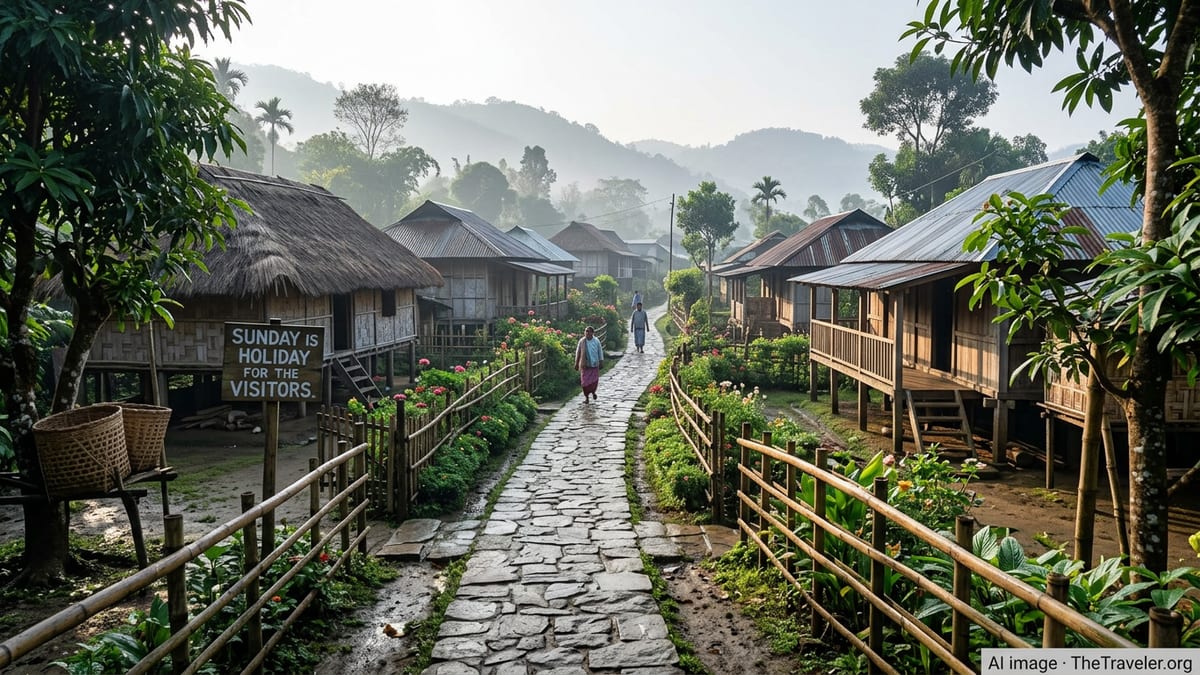
A Weekly Tourism Pause in Asia’s “Cleanest Village”
From January 2026, Mawlynnong in Meghalaya’s East Khasi Hills is remaining closed to single-day tourists every Sunday, creating a designated weekly break from high visitor traffic. Publicly available notifications from the village council indicate that the pause applies to all day visitors and organised tours, even as the village remains open from Monday to Saturday.
The move marks a rare instance of a popular rural destination deliberately limiting access on a specific day of the week at the height of its fame. Mawlynnong has drawn steady domestic and international attention for nearly two decades after being widely promoted as Asia’s cleanest village, transforming a remote hill settlement into a flagship stop on Meghalaya travel itineraries.
Reports indicate that on Sundays all tourist-oriented services, including eateries, souvenir stalls and public toilets, are required to remain shut. Signboards at the village entrance now inform arriving visitors that Sunday is a non-operational day for day tourism, effectively turning back those who have not planned an overnight stay.
The change reflects growing acknowledgement that even small-scale tourism can strain the social fabric and infrastructure of compact rural communities when footfall remains constant throughout the week.
Balancing Faith, Family Time and Visitor Demand
At the core of the Sunday pause is the community’s desire to protect its religious and family routines. Mawlynnong’s residents are predominantly Christian, and Sundays are traditionally devoted to church services and community gatherings that span much of the day. Village notifications describe Sunday as a time when almost everyone is engaged in worship, leaving little capacity to host visitors or keep shops and facilities open.
Local coverage of the decision notes that hospitality providers, from homestay owners to stall operators, were increasingly caught between religious obligations and the expectations of tourists arriving on tight schedules. When services were limited or unavailable, elderly travellers and families in particular reported inconvenience, such as difficulty accessing toilets, food or resting spaces during the hottest hours of the day.
By clearly designating Sunday as a visitor-free day for day trippers, the village council aims to avoid such situations while giving residents uninterrupted time for spiritual life and family commitments. Publicly available information shows that this structured break is framed as a way to maintain Mawlynnong’s reputation for warmth and cleanliness without stretching the community beyond its capacity.
The decision also aligns with a broader conversation in India’s hill states about how tourism-driven income should be balanced with quality of life for local residents who often shoulder the invisible work of keeping destinations attractive and accessible.
Preserving an Eco-Tourism Model Built on Cleanliness
Mawlynnong’s image as an immaculate village has long been central to its tourism appeal. Visitors come to walk its swept pathways, observe bamboo waste bins at every turn, and photograph flower-bordered lanes that appear almost free of litter. Travel features and tourism campaigns have repeatedly highlighted its strict no-litter and no-plastic norms, positioning the village as a model of community-led cleanliness.
However, as day-trip traffic grew, particularly in peak seasons, concerns mounted about congestion in narrow lanes, vehicle build-up near the entry point and strain on shared facilities. Public reports on the new rule suggest that the Sunday pause is part of a broader effort to prevent overcrowding from eroding the very qualities that first drew attention to the village.
Residents organise regular cleaning drives, often on Saturdays, when households come together to sweep common spaces and maintain drainage and pathways. A guaranteed quiet Sunday following these efforts gives the environment, and the people who care for it, time to breathe. The weekly reset also reduces wear on fragile infrastructure, from wooden walkways to small bridges and viewing platforms overlooking the nearby living root bridges and valleys.
By linking tourism access to the village’s own rhythm of maintenance and rest, Mawlynnong reinforces its identity as an eco-tourism destination that places community wellbeing and environmental care at the centre of visitor management.
What Changes for Visitors and Tour Operators
The Sunday restriction is narrowly targeted at single-day tourists, with some flexibility for those who are already staying in the village. Notices summarised in regional media state that guests checked into homestays or guest houses before Sunday may remain and complete their stay, with their hosts responsible for meeting basic needs. New day visitors, however, are requested not to enter the village on Sundays, and tourist vehicles are being discouraged from approaching the main parking area.
For tour operators and independent travellers, the policy shift effectively means that Mawlynnong can no longer be treated as a spontaneous Sunday add-on to Dawki or other nearby attractions. It now requires more deliberate itinerary planning, steering visitors either toward weekday visits or toward slower, overnight stays that extend beyond a quick photo stop.
Travel industry coverage suggests that the change could prompt a modest reorientation from high-volume, short-stay tourism toward fewer, longer and potentially higher-value visits. Homestays and small lodgings may benefit from travellers who choose to spend the night in order to experience the village’s quieter side, while day-visit traffic gets redistributed across the rest of the week.
The policy may also influence how guidebooks, digital platforms and travel planners describe Mawlynnong, with Sunday warnings likely to become a standard advisory alongside information on permits, road conditions and weather.
A Signal for Responsible Rural Tourism Across Meghalaya
Mawlynnong’s Sunday pause is being widely read as a symbolic step within Meghalaya’s growing network of rural and nature-based destinations. The state has promoted homestay-led tourism in villages known for living root bridges, forest trails and distinctive cultural practices, and several communities are now openly debating visitor caps, entry fees and restricted days.
Reports indicate that other villages in the region are watching Mawlynnong’s experiment closely as they consider their own guidelines for managing crowds, protecting traditional practices and preserving fragile landscapes. The decision resonates with broader national conversations around “overtourism” in small Himalayan settlements that lack the infrastructure to cope with sudden spikes in demand.
For travellers, the new rule offers a clear reminder that responsible tourism may increasingly involve adapting to community-led schedules rather than expecting destinations to remain perpetually open. Planning weekday visits, respecting posted notices and considering overnight stays instead of quick stopovers are emerging as practical ways to support Mawlynnong’s attempt to safeguard its culture and environment.
As Asia’s celebrated “cleanest village” recalibrates its relationship with visitors through a weekly day of rest, its experience is likely to inform how other rural destinations in India balance visibility with vulnerability, ensuring that the benefits of tourism do not come at the expense of the lives and landscapes that make such places unique.