

More news on this day
Visitors are pouring into the Philippine province of Albay to watch glowing lava stream down Mayon Volcano, transforming the restive peak into an unlikely tourist magnet even as authorities warn that an escalation in activity remains possible.
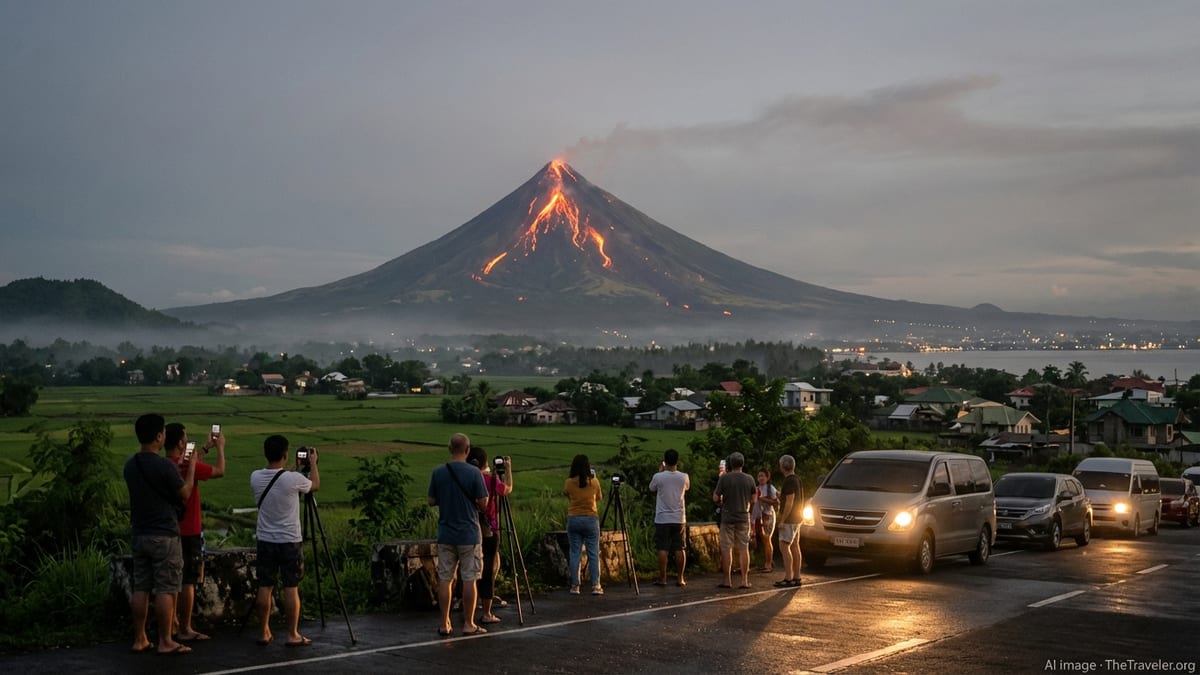
Fiery Spectacle Draws Crowds Despite Alert Level 3
The Philippine Institute of Volcanology and Seismology has kept Mayon at Alert Level 3, indicating a magmatic eruption with the potential for stronger explosive activity. In its latest 24-hour bulletin on February 24, the agency reported continuous lava effusion from the summit crater, with flows snaking several kilometers down the Basud, Bonga and Mi-isi gullies, accompanied by rockfalls, volcanic earthquakes and multiple pyroclastic density currents.
The heightened activity has not deterred visitors. On the contrary, the volcano’s steady outpouring of incandescent lava has become a powerful nighttime attraction. Local media report tourists converging on vantage points around Legazpi City and neighboring towns, treating the glowing slopes as a kind of natural fireworks show as the cone illuminates the cloud-fringed sky.
Provincial officials emphasize that the permanent six kilometer danger zone around Mayon remains strictly off limits to residents, tourists and aviation. Yet beyond that radius, hotels and tour operators say demand has surged, with many properties nearing or reaching full occupancy as travelers seize the chance to witness one of the world’s most perfectly shaped active volcanoes in action.
Hotels Fill Up as Mayon Puts Albay in the Spotlight
The Bicol regional office of the Department of Tourism reports a sharp uptick in arrivals since Mayon’s current eruptive episode intensified, now stretching into its eighth week. Regional tourism officials say accommodations in and around Legazpi, Daraga and nearby municipalities are heavily booked, from business hotels and boutique stays in the city center to beachfront resorts along Albay Gulf.
Operators describe a brisk trade in viewing tours that keep to officially designated safe zones. Many packages bundle transfers to popular lookout spots with evening schedules timed to coincide with the best views of the lava cascades, along with local food stops and side trips to heritage and nature attractions. In Legazpi, long-established “adventure” brands that once focused on all-terrain vehicle runs over old lava fields now market their excursions as opportunities to photograph the cone backlit by fresh activity from a safe distance.
Local businesses are scrambling to adapt. Restaurants are extending hours for late-night crowds returning from viewing sites, while souvenir shops in tourist hubs report increased sales of Mayon-branded items. For many proprietors still recovering from pandemic-related losses, the renewed spotlight on Albay is a welcome lifeline, though they acknowledge the ethical tension of benefiting from a disaster-prone landscape.
Balancing Economic Boost With Volcanic Risk
Behind the surge in visitor numbers is a complex calculus for authorities tasked with both safeguarding lives and sustaining livelihoods in a province long dependent on tourism. Mayon has erupted more than 50 times over the past four centuries, with several deadly events etched into local memory, including historic eruptions that buried entire communities. Its reputation as both a scenic icon and a persistent hazard shapes nearly every decision taken by emergency managers and tourism planners.
In recent weeks, provincial and municipal governments have reinforced evacuation and contingency plans as the volcano’s activity climbed from Alert Level 2 to 3. Thousands of residents living on the flanks, many of them farmers and informal settlers, have been moved to temporary shelters to clear the danger zone. Local authorities have also tightened controls on access roads leading closer to the cone, limiting activities such as farming, hiking and unregulated sightseeing that once took people perilously near the lava front.
Officials insist that visitor experiences are being carefully curated to remain outside restricted areas, with Philippine tourism and disaster agencies coordinating advisories and monitoring crowd behavior. Still, the allure of dramatic close-up images risks encouraging some travelers and local guides to push boundaries, prompting repeated warnings that conditions on an active volcano can shift rapidly with little notice.
Old Icons, New Viewpoints Around a Restive Cone
Even as access inside the danger zone is barred, classic viewing sites just beyond the perimeter are experiencing renewed attention. The Cagsawa Ruins Park in Daraga, where the remnants of a church buried by a historic eruption stand against Mayon’s near-perfect cone, has become one of the most photographed spots in the region as visitors seek to frame the glowing summit above the stone belfry. Tour organizers say the juxtaposition of current lava flows with a landmark that commemorates past disasters underscores both the beauty and the peril of life in Mayon’s shadow.
Elsewhere, vantage points on hills and lakesides around Legazpi and neighboring towns offer sweeping panoramas of the volcano and the surrounding coastal plain. Some community-based tourism enterprises have begun offering guided twilight and pre-dawn viewings, pairing them with storytelling about local evacuation experiences, religious traditions tied to the mountain and the science of volcanic monitoring.
For many visitors, these layered narratives deepen the experience beyond the spectacle of the lava itself. Residents who have endured multiple eruptions explain how ashfall, sulfurous fumes and sudden pyroclastic flows can disrupt daily life for weeks, even as the volcano continues to define local identity and attract visitors from across the Philippines and abroad.
Authorities Urge Caution as Lava Show Continues
While travel promotions highlight that activities outside the six kilometer danger zone remain open, national and local agencies continue to stress that Mayon’s status can change quickly. The latest monitoring shows persistent sulfur dioxide emissions, frequent rockfalls and pyroclastic density currents rolling down the slopes, all signs that magma is still being supplied to the summit dome and that a more explosive phase cannot be ruled out.
Disaster officials are urging tourists to follow advisories, stay with accredited guides and respect police and military checkpoints that mark the closest permissible approach. Civil aviation authorities have advised pilots to steer well clear of the summit, where ash and gas plumes could endanger aircraft engines should the eruption intensify.
For now, the glow of Mayon against the night sky continues to power both social media feeds and the local economy, even as it keeps volcanologists and emergency managers on round-the-clock watch. In Albay, where the perfect cone dominates the horizon from almost every vantage point, the latest eruption is once again testing how a community built around a spectacular natural asset lives with the ever-present prospect of danger.