

More news on this day
From long maintenance backlogs to headlines about regulatory audits, a global shortage of aircraft mechanics in 2026 is beginning to erode the quiet assumption many travelers once held that planes are always ready, and always reliably maintained, behind the scenes.
Get the latest news straight to your inbox!
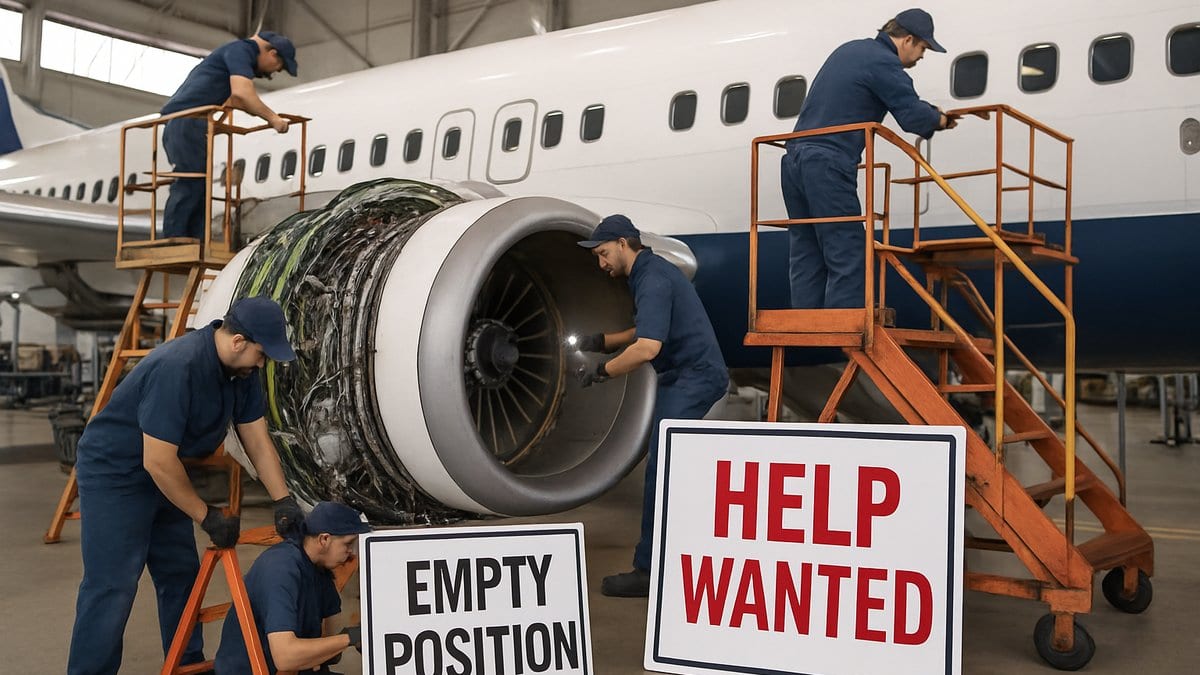
Image by Nomad Lawyer
A Structural Gap in the Aviation Workforce
Industry data published over the past year indicate that aviation is entering 2026 with a persistent and widening shortage of certified aircraft maintenance technicians. Recent pipeline assessments from maintenance education councils and consulting firms point to an 8 to 10 percent shortfall in commercial aviation maintenance workers in North America this year, with projections that the deficit could climb to roughly a quarter of required staffing later in the decade if current trends continue. Analysts describe the gap as structural rather than cyclical, shaped by retirement waves, training bottlenecks and intense competition for technical talent.
Publicly available reports show that the current workforce is heavily skewed toward older employees. Surveys of Federal Aviation Administration certificated mechanics in the United States put the average age in the mid‑50s, with more than a quarter of technicians already over traditional retirement age and a large share expected to leave the industry within five to ten years. At the same time, new license issuance, while improving, has not kept pace with retirements and growing fleet size. Research cited by industry groups suggests that even with a recent rise in newly certificated mechanics, the underlying shortage remains around 9 to 10 percent and is on track to deepen without significant intervention.
Consultancies tracking the maintenance, repair and overhaul market add a global dimension to the picture. Forecasts released by firms such as Bain & Company and MRO specialists suggest that engine maintenance and heavy checks are peaking around 2026, creating a surge in demand for skilled labor just as many experienced technicians exit the workforce. Boeing’s long‑range outlook has estimated that airlines and maintenance providers worldwide will need hundreds of thousands of new technicians over the next two decades, underscoring the scale of the challenge.
These workforce imbalances do not automatically translate into safety issues, but they are reshaping how maintenance is scheduled, where it is performed and how resilient airlines can be when operations come under stress. For passengers, the most visible effects show up in delays, cancellations and changing communication around the status of aircraft repairs.
From Hangar Backlogs to Departure Boards
The connection between mechanic shortages and real‑world travel disruption is increasingly visible in operational data and case studies. Analyses of U.S. airline performance for 2024 and early 2025, covered by travel industry outlets, document a sharp rise in delays and cancellations attributed to maintenance and staffing constraints. One widely cited breakdown of first‑quarter 2025 disruptions reported that major U.S. carriers saw overall delays climb by more than 30 percent year‑on‑year, with American Airlines alone canceling thousands of flights after struggling to staff maintenance roles at key bases.
Maintenance backlogs are especially acute in engine shops and heavy check facilities. Research published by consulting firms in 2024 warned that engine overhauls for popular single‑aisle aircraft families would peak around 2026, coinciding with widespread technician shortages and constrained capacity at maintenance, repair and overhaul providers. These studies noted that unusually long turnaround times for engines were already reducing fleet availability, forcing airlines to ground aircraft for extended periods or adjust schedules to compensate.
Regional and smaller carriers appear particularly exposed. Commentaries from pilot and mechanic associations describe scenarios in which an aircraft grounded at an outstation may wait longer for qualified personnel or parts, especially if airlines rely on a thin network of third‑party providers. In some documented cases, airlines have had to ferry aircraft to distant hubs for work that previously would have been completed locally, adding complexity and potential for cascading delays into the passenger experience.
For travelers, the practical outcome is a travel environment where “awaiting maintenance” appears more frequently on flight status boards, and where recovery from routine technical issues can take longer than it did a decade ago. While many disruptions still stem from weather and air traffic congestion, the growing share linked to maintenance staffing amplifies perceptions that the system is running close to its limits.
Oversight Scrutiny and Public Perception
As airlines and maintenance providers work through staffing shortfalls, regulators and watchdogs are scrutinizing how oversight systems adapt. A U.S. Transportation Department inspector general audit released in February 2026, covered by the Associated Press, highlighted staffing and planning gaps within the Federal Aviation Administration offices responsible for overseeing United Airlines’ maintenance programs. The report cited high turnover among inspectors, limited on‑site surveillance and heavier reliance on virtual reviews, concluding that these factors had constrained the agency’s ability to monitor a large and complex operation.
The audit did not identify specific accidents linked to the oversight issues, but its timing has influenced public debate about whether regulatory bodies have sufficient resources to keep pace with the industry’s evolving risks. Past government reviews have raised similar concerns about oversight of maintenance practices at other major U.S. carriers, and the new findings have renewed calls from aviation analysts for more robust inspector staffing and modernized surveillance tools.
At the same time, investigations into quality control, production problems and labor disputes in the broader aerospace sector have added to the sense of strain. Recent coverage of component documentation issues, parts traceability questions and industrial actions by machinists has highlighted how vulnerabilities in the production and maintenance ecosystem can intersect. While these events involve different segments of the workforce, they collectively reinforce a narrative that critical technical roles in aviation are under pressure.
Publicly available polling on traveler attitudes in 2026 remains limited, but anecdotal data from consumer forums and travel surveys suggest that high‑profile maintenance‑related reviews and oversight findings can dent confidence, even when safety statistics remain strong. When headlines emphasize audits, shortages and inspections conducted remotely, some travelers interpret these signals as evidence of a system stretched thin, rather than as routine components of regulatory governance.
How Airlines Are Responding to a Trust Test
Airlines and maintenance organizations are experimenting with a range of responses to stabilize operations and reassure travelers. Industry coverage in 2025 and early 2026 describes stepped‑up recruitment campaigns targeting technical schools, military veterans and career changers, alongside investments in in‑house training academies aimed at accelerating the path to certification. Some carriers are offering signing bonuses and tuition support for apprentices, while MRO firms promote clearer advancement pathways in an effort to compete with other industries seeking similar skill sets.
Network planning has also begun to reflect maintenance constraints more explicitly. Analysts writing in MRO and airline trade publications note that carriers are concentrating complex maintenance tasks at fewer, better‑staffed hubs and increasingly turning to overseas providers for heavy checks, particularly in regions where labor availability and costs are more favorable. This restructuring can improve efficiency, but it also raises questions among some travelers about transparency, standards alignment and who is ultimately accountable for work performed far from their departure gate.
On the communications front, there is a gradual shift toward more detailed explanations when flights are disrupted for technical reasons. Some customer‑facing updates now distinguish between unscheduled repairs, routine checks delayed by capacity constraints and supply chain issues that prevent rapid part replacement. While messages often remain brief, travel advocates argue that clearer descriptions of what is being done, and why it is taking time, can help rebuild confidence that safety margins are not being compromised for the sake of punctuality.
Insurers and financial analysts are watching these developments closely. Extended maintenance intervals and higher labor costs feed into operating expenses, which can influence fares and capacity decisions. When crews, aircraft and maintenance slots are all tight simultaneously, airlines have less flexibility to add backup aircraft or staff, reinforcing the perception among frequent travelers that any disruption may quickly cascade through a network.
The Traveler’s New Calculus in 2026
The evolving mechanic shortage is subtly changing how some travelers plan and interpret their journeys. Travel advisors and aviation commentators report that business travelers in particular are paying closer attention to aircraft types, carrier reliability statistics and hub maintenance capacity when choosing flights. There is growing interest in historical on‑time performance for specific routes, as well as in whether an airline has recently faced publicized maintenance or oversight concerns.
At the same time, experts caution that commercial air travel remains one of the safest forms of transportation, with layers of redundancy in engineering, regulation and operational practice. Mechanic shortages primarily manifest as operational friction rather than immediate safety degradation, because regulations require that aircraft remain grounded until required work is completed. However, as delays mount and headlines spotlight every incident, the distinction between operational reliability and safety risk can blur in the public imagination.
For travel brands, this moment represents a test of how transparently and proactively they can address concerns. Clearer communication about maintenance investments, training initiatives and oversight cooperation may become as important to reputation as traditional marketing about routes and onboard service. In an environment where social media amplifies every diversion or extended delay, companies that demonstrate visible commitment to their maintenance workforce may gain an edge in restoring traveler trust.
Looking ahead through 2026, the industry’s ability to train, attract and retain a new generation of aircraft mechanics is likely to shape not only operational performance, but also the intangible confidence that keeps passengers booking complex itineraries. The crisis of confidence is not yet a collapse in demand, but it is a warning signal that the human infrastructure behind every flight is becoming as central to traveler decision‑making as price and schedule.