

More news on this day
Growing speculation about a so-called “ultimate alliance” linking Qatar Airways, Emirates, Singapore Airlines, Etihad Airways and Riyadh Air is rippling through the aviation world, stirring debate over whether such a mega-pact could ever materialise and what it would mean for global competition in 2026 and beyond.
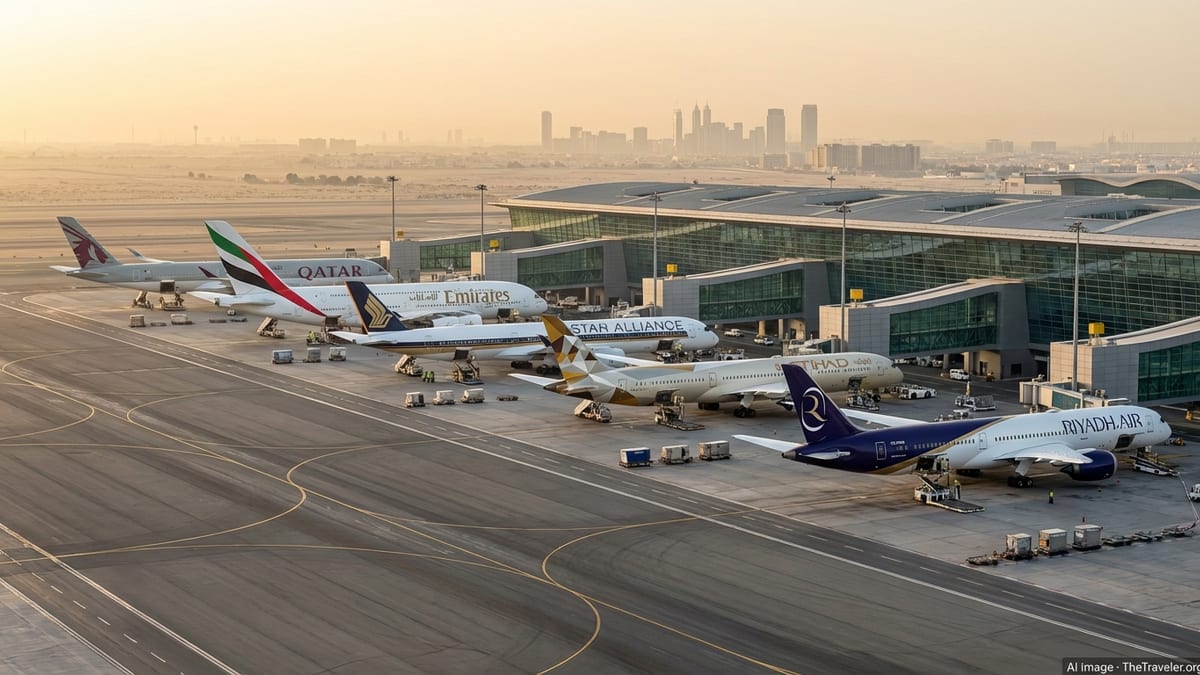
No Confirmed Mega-Alliance, but a Powerful Idea
As of February 22, 2026, there is no formal announcement or binding agreement that unites Qatar Airways, Emirates, Singapore Airlines, Etihad Airways and Riyadh Air into a single global alliance or joint entity. Each of these carriers continues to operate within its own strategic framework, with existing partnerships, codeshares and in some cases membership in one of the three major alliances: oneworld, Star Alliance or SkyTeam. Qatar Airways remains a core member of oneworld, while Emirates, Etihad and Riyadh Air continue to pursue bespoke bilateral partnerships outside the traditional alliance model, and Singapore Airlines is a long-standing Star Alliance member.
The notion of a unified “Gulf super-alliance” has nevertheless gained traction among analysts, frequent flyers and industry commentators, who see growing commercial and strategic links between the Gulf and Asia-Pacific hubs. The idea is being fuelled by a convergence of factors: rapid capacity growth across the Gulf, Riyadh Air’s ambitious global launch plan, intensified competition on long-haul premium routes and a shifting landscape of codeshare and joint venture deals. While a single, integrated alliance joining all five carriers would be unprecedented and faces significant regulatory and competitive hurdles, the underlying trend points clearly toward deeper cooperation and more tightly coordinated networks centered on the Middle East.
For now, what exists is not a signed mega-alliance but a web of partnerships that already gives these airlines extraordinary reach. Any steps toward more formal integration in 2026 would build on that base. Understanding how close they already are in network strategy and geography helps explain why talk of an “ultimate alliance” has become a focal point in aviation discussions.
Overlapping Hubs and Ambitions Across the Gulf
The five airlines under discussion occupy some of the most strategically important aviation real estate in the world. Qatar Airways is anchored at Doha’s Hamad International Airport, Emirates at Dubai International, Etihad at Abu Dhabi International and Riyadh Air at the rapidly expanding King Khalid International Airport in the Saudi capital. Singapore Airlines, while geographically outside the Gulf, connects through its Changi hub into many of the same long-haul markets the Gulf carriers target, especially Europe, Australia and North America.
Over the last decade, Qatar Airways and Emirates have become synonymous with globe-spanning connectivity, using large widebody fleets to funnel passengers from Europe, Africa and the Americas through their hubs to Asia and Oceania. Etihad, after a period of retrenchment and restructuring, has returned to measured expansion, including new long-haul routes such as Calgary, signaling renewed confidence in the Abu Dhabi hub. Riyadh Air, which launched commercial operations in late 2025, has publicly set its sights on serving up to 100 destinations, directly challenging established Gulf hubs on both network breadth and onboard product.
Saudi Arabia’s Vision 2030 economic diversification program is a key driver behind Riyadh Air’s growth plans, with the airline positioned as a flagship for tourism and business development. Its emerging network strategy, built on a series of partnerships with carriers across SkyTeam and Star Alliance ecosystems, is designed to overlay and sometimes intersect with the flows already dominated by Qatar Airways, Emirates and Etihad. In parallel, Singapore Airlines is increasing its own Middle East presence, including planned non-stop flights between Singapore and Riyadh in June 2026, which will further entwine Southeast Asia and Gulf traffic flows.
When viewed collectively, these moves sketch a de facto mega-corridor: a dense, overlapping web of routes and hubs that already dominate premium long-haul travel between Europe, Asia, Africa and increasingly North America. Even without a formal alliance, the combined capacity and connectivity of these five airlines grant them enormous leverage over global flows of high-yield passengers.
Existing Alliances and Partnerships Set the Groundwork
Any discussion of a future super-alliance must start with the current patchwork of alliances and partnerships that shape each airline’s strategy. Qatar Airways is firmly embedded in oneworld, aligning it closely with carriers such as British Airways, American Airlines and Japan Airlines. Its membership delivers powerful feed from North America and Europe into Doha, a position it is unlikely to relinquish lightly given the value of joint marketing, loyalty integration and schedule coordination. Singapore Airlines is equally tied into Star Alliance, with deep commercial ties to carriers like Lufthansa and United Airlines.
Emirates and Etihad have long pursued an alternative path, shunning membership in the traditional global alliances in favor of tailor-made codeshares and equity stakes. Emirates has key partnerships with carriers including Qantas and has become a frequent choice for interline deals that expand its reach without formal alliance commitments. Etihad has restructured its earlier equity investment strategy, but it continues to develop selective partnerships to bolster connectivity while maintaining strategic flexibility. This model of bespoke cooperation has allowed both airlines to navigate shifting regulatory landscapes and competition concerns with greater agility.
Riyadh Air, as the newest entrant, is deliberately building a lattice of partnerships rather than anchoring itself to a single alliance. Agreements with Delta Air Lines, China Eastern, Singapore Airlines, Air China and others give it access to extensive networks in North America and Asia, even before it develops its own long-haul portfolio. This model reflects a broader industry shift: instead of choosing one of the three traditional alliances, some carriers are constructing flexible networks of bilateral and multilateral deals that can evolve more quickly as markets change.
The result is a multi-layered environment where Qatar Airways and Singapore Airlines sit inside formal alliances, while Emirates, Etihad and Riyadh Air weave around them through selective partnerships. Any hypothetical mega-alliance in 2026 would need to reconcile these different philosophies, navigate anti-trust concerns and preserve valuable existing relationships, a tall order that underscores just how speculative the idea remains.
Riyadh Air as Catalyst in a Changing Gulf Landscape
Although Qatar Airways, Emirates and Etihad have been competing and coexisting for years, it is the arrival of Riyadh Air that has injected fresh momentum into debates about Gulf consolidation and cooperation. With strong backing from Saudi Arabia’s sovereign wealth fund and a mandate to transform Riyadh into a global hub, the airline is investing heavily in modern widebody fleets, premium cabin design and digital-first customer experiences intended to rival or exceed its established Gulf competitors.
Riyadh Air has already signaled its intent to be more than a regional player, ordering long-haul aircraft such as the Airbus A350 and Boeing 787, and unveiling a business-class product that aims squarely at the same high-yield corporate and premium leisure segment targeted by Qatar Airways and Emirates. Its strategy is not just to capture domestic Saudi demand, but also to siphon transfer traffic that currently flows through Doha, Dubai and Abu Dhabi.
This has implications for competitive dynamics across the region. With four major hubs within a relatively short flying distance, the Gulf risked becoming overcrowded. Instead, Riyadh Air’s decision to emphasize partnerships with carriers in North America and Asia suggests an emerging pattern of differentiated cooperation. By leveraging Delta’s network in the United States and Singapore Airlines’ reach in Southeast Asia and Australasia, Riyadh Air can position Riyadh as a complementary hub rather than a pure substitute for Doha or Dubai.
As these relationships deepen, they create structural linkages among the very airlines now being discussed in the context of a future mega-alliance. While that does not constitute a formal union, it does mean that, by 2026, passengers could experience an increasingly seamless web of options across these carriers, especially when booking through partners that connect them via Riyadh, Doha, Dubai, Abu Dhabi or Singapore.
Passenger Experience and Loyalty at the Heart of Competition
One of the strongest arguments for closer alignment among Qatar Airways, Emirates, Singapore Airlines, Etihad Airways and Riyadh Air is the premium passenger experience they collectively offer. All five carriers consistently compete for top rankings in business and first class, investing in lie-flat beds, suites with doors, elevated dining and cutting-edge in-flight entertainment to attract high-yield travelers and loyalty program elites.
By 2026, business-class cabins on these airlines are increasingly indistinguishable from traditional first class on legacy carriers, with privacy doors, configurable double beds and large 4K screens becoming standard at the front of the cabin. Riyadh Air’s recently unveiled business-class concept, designed to rival its Qatari and Emirati counterparts, adds another strong contender to a field already crowded with industry-leading products from Qatar Airways’ Qsuite, Emirates’ refreshed cabins and Singapore Airlines’ long-haul business class.
Loyalty programs, however, remain fragmented. Qatar Airways Privilege Club is integrated into oneworld’s tier structure, Singapore Airlines KrisFlyer aligns with Star Alliance benefits and Emirates Skywards, Etihad Guest and Riyadh Air’s emerging program each operate on standalone platforms with selected partner earn-and-burn options. For frequent flyers, the dream of an “ultimate alliance” lies largely in the possibility of harmonised status recognition, lounge access and mileage redemption across all five carriers, irrespective of formal alliance membership.
In practice, 2026 is more likely to bring incremental improvements than a wholesale merger of loyalty ecosystems. Expanded bilateral earning and redemption agreements, deeper lounge-access reciprocity on specific routes or hub-to-hub corridors and targeted status matches for key corporate accounts are plausible steps that would move the market closer to the mega-alliance vision without triggering the regulatory complexities of a full-scale integration.
Regulatory, Competitive and Alliance Hurdles
If the idea of a unified Gulf-Asia super-alliance seems distant, it is largely because of the regulatory and competitive barriers such a move would face. Any attempt to lock together multiple dominant hub carriers across the Middle East and Asia in a single, coordinated alliance would attract close scrutiny from competition authorities in Europe, North America and key Asian markets. Concerns would likely center on market dominance on certain long-haul corridors, potential fare impacts and access to airport slots.
Existing alliance commitments further complicate the picture. Qatar Airways’ oneworld membership and Singapore Airlines’ position within Star Alliance are core to their broader strategies, providing not only additional feed traffic but also joint ventures and revenue-sharing agreements that underpin profitability on key routes. Leaving or diluting those relationships to join a new mega-alliance would be a high-risk move, especially given the current fragility of global demand and the need for stable, predictable revenue streams.
Political and diplomatic considerations add another layer of complexity. The Gulf region has experienced shifting alliances and rivalries in recent years, with airspace closures and diplomatic rifts periodically disrupting traffic flows. Although relations among regional states have generally improved, any long-term, legally binding alliance between state-backed carriers would need to account for geopolitical risk as much as commercial opportunity.
For regulators and competitors alike, the distinction between deep commercial cooperation and outright consolidation will be crucial. Codeshares, metal-neutral joint ventures on specific routes and coordinated schedules on certain corridors may be tolerated, while a sweeping alliance that appears to lock up a critical mass of global long-haul traffic could be challenged. This reality suggests that, in 2026, the industry is more likely to see incremental, route-specific tie-ups among these airlines rather than a single, all-encompassing alliance.
What 2026 Could Realistically Bring
Looking ahead through the remainder of 2026, analysts expect the five airlines to continue expanding their networks and deepening selective partnerships rather than unveiling a fully fledged mega-alliance. Riyadh Air will be in rapid build-out mode as it adds destinations and fleet capacity, leveraging partnerships with Singapore Airlines, Delta and Chinese carriers to accelerate global reach. Emirates and Etihad are focused on product enhancements and new routes, particularly into secondary cities in Europe and North America, while Qatar Airways fine-tunes its network within the oneworld framework.
Singapore Airlines’ upcoming non-stop service to Riyadh will physically link Changi’s Star Alliance hub to Saudi Arabia’s new carrier, creating fresh one-stop options for travelers between Southeast Asia, Australia and the Middle East. At the same time, ongoing investment at Gulf hubs, along with product upgrades like Emirates’ next-generation economy seat, reinforce a broader pattern of competitive escalation in comfort and convenience rather than alliance architecture.
For travelers, the practical impact of this evolving web of relationships will be felt in more routings, more schedule choice and, in many cases, improved onboard experiences. Where cooperation deepens, passengers may see better coordinated connections, shared lounge facilities at certain hubs and easier mileage accrual on partner flights. Yet boarding passes are still likely to bear different alliance logos or none at all, underscoring that the “ultimate alliance” remains more a narrative of convergence and influence than a signed, single agreement.
In that sense, 2026 is shaping up as a transitional year. The gravitational pull of the Gulf and Singapore as global connecting hubs continues to grow, and the combined strategies of Qatar Airways, Emirates, Singapore Airlines, Etihad Airways and Riyadh Air are reshaping competitive dynamics across continents. Whether this trajectory eventually culminates in a formal mega-alliance or remains a sophisticated mosaic of partnerships, the direction of travel for global aviation is clear: more of the world’s long-haul journeys will pass through these carriers’ hubs, placing them at the center of the industry’s next chapter.