

More news on this day
TUI Cruises’ forthcoming Mein Schiff Flow has completed a series of sea trials in the Adriatic, with initial results highlighting low-emission propulsion, refined maneuverability and quiet onboard operations ahead of the ship’s planned 2026 debut.
Get the latest news straight to your inbox!
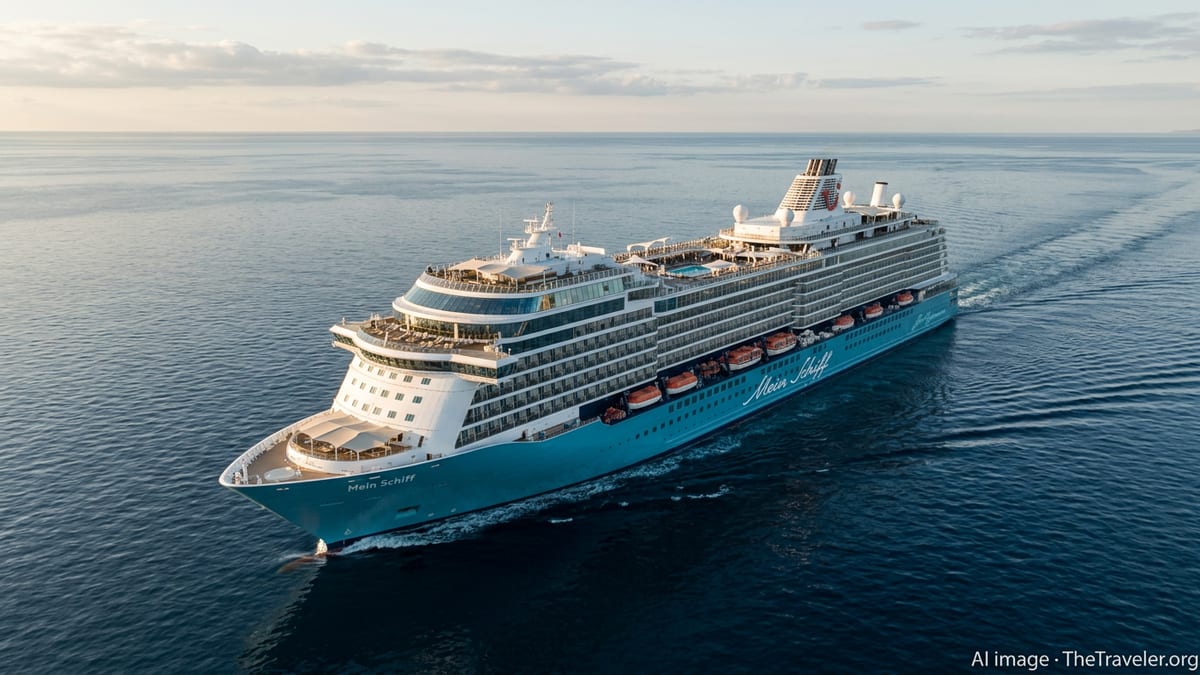
Next-Generation InTUItion Class Vessel Nears Delivery
Mein Schiff Flow is the second vessel in TUI Cruises’ InTUItion class, built by Fincantieri at Monfalcone and scheduled to enter service in summer 2026. Publicly available information indicates that the 160,000-gross-ton ship will follow fleetmate Mein Schiff Relax, delivered in early 2025, as part of a rapid capacity expansion focused on the German-speaking market.
Reports from industry outlets describe the recent sea trials as a key milestone in the final outfitting phase, validating the performance of propulsion, navigation systems and hotel services at sea. The tests took place in open waters off the Italian coast, before the vessel’s return to the shipyard for final interior work and certification.
According to shipbuilder and cruise line material, Mein Schiff Flow will offer capacity for just over 4,000 guests at double occupancy. The design is positioned as a premium, resort-style product, with an emphasis on generous outdoor deck space and wellness-focused amenities intended to appeal to repeat cruisers in Europe.
Published coverage also notes that the ship is expected to begin commercial operations in the Mediterranean from June 2026, with itineraries later expanding into other European regions as the vessel settles into year-round deployment.
Eco-Friendly Dual-Fuel Technology at the Core
The sea trials placed particular emphasis on validating Mein Schiff Flow’s dual-fuel propulsion system, which can operate on liquefied natural gas or marine gas oil. Shipyard information indicates that the engines are compatible with lower-emission alternatives such as bio-LNG and e-LNG when those fuels become more widely available at scale.
Technical specifications released by Fincantieri describe a configuration that combines dual-fuel engines with catalytic converters meeting advanced Euro 6 standards, a waste heat recovery steam turbine and a shore power connection. These elements are designed to reduce local air emissions in port, improve fuel efficiency and support compliance with tightening European environmental rules.
Industry analyses point to LNG-capable ships like Mein Schiff Flow as a transitional step toward climate-neutral cruising. While LNG remains a fossil fuel, it typically reduces sulfur oxide and particulate emissions to near zero and significantly cuts nitrogen oxide and carbon dioxide output compared with conventional heavy fuel oil. The ability to switch to bio- or e-LNG is presented as a pathway to further reductions as fuel supply chains mature.
Within TUI Cruises’ broader sustainability roadmap, Mein Schiff Flow and her sister ship form part of a fleet modernization program that has already introduced marine diesel and methanol-ready vessels. Recent company reports show declining relative emissions in the cruise segment, with newbuilds expected to deepen that trend as they enter service through 2026.
Maneuverability and Passenger Comfort Proved at Sea
During the sea trials, Mein Schiff Flow underwent a series of standard performance tests, including turning circles, crash-stop maneuvers and low-speed handling exercises. Coverage from specialist maritime outlets indicates that these procedures confirmed the responsiveness of the ship’s propulsion and steering systems, which combine traditional propellers with bow thrusters and advanced automation.
The trials also evaluated noise and vibration levels in guest areas under different speed and sea-state conditions. Early reports suggest that the InTUItion class design delivers comparatively quiet interiors, with particular attention paid to cabins and public spaces located above the engine rooms and near the stern.
Comfort-related testing extended to hotel services such as air conditioning, freshwater production and wastewater treatment, all of which must operate reliably under real-world loads. Observers note that the ship’s advanced wastewater systems are configured to meet strict regional standards, an increasingly important factor for access to environmentally sensitive ports.
Successful completion of these tests allows classification societies and flag state authorities to progress with final approvals. For prospective passengers, the results are likely to translate into smoother maneuvering in tight ports, more comfortable overnight sailings and a reduced environmental footprint compared with older tonnage.
Strategic Role in TUI Cruises’ 2026 Growth Plans
Mein Schiff Flow is expected to play a central role in TUI Cruises’ growth strategy from 2026 onward, expanding capacity in core source markets while enabling more varied itineraries. Company announcements over recent years have highlighted a multi-ship expansion pipeline, with the InTUItion class anchoring the premium, all-inclusive segment of the fleet.
Deployment plans outlined on consumer-facing channels show Mein Schiff Flow initially sailing summer programs in the Mediterranean, a region where demand for contemporary, resort-style cruises continues to grow. The combination of LNG capability and shore power readiness positions the ship to meet increasingly stringent environmental conditions at popular ports in countries such as Italy, Spain and Greece.
Travel trade commentary suggests that the vessel will help TUI Cruises compete more directly with other large European brands that are introducing LNG-powered ships around the same time. The additional capacity also offers tour operators and travel agents more options for packaging fly-cruise holidays tailored to German-speaking guests.
By aligning a new hardware platform with evolving consumer expectations around sustainability and comfort, TUI Cruises aims to reinforce its brand positioning at a time when environmental performance is becoming a more visible factor in cruise purchasing decisions.
Implications for Cruise Tourism and Port Destinations
The successful trials of Mein Schiff Flow come as European regulators and destinations tighten environmental standards for visiting cruise ships. Ports in Northern Europe and the Mediterranean are steadily expanding shore power infrastructure and examining restrictions on older, higher-emission vessels, particularly in congested urban harbors and sensitive coastal areas.
Analysts observe that LNG-capable ships with advanced exhaust treatment and shore power connections, such as Mein Schiff Flow, are better positioned to secure berthing priority and long-term access agreements. This dynamic is likely to influence deployment decisions across the industry, encouraging cruise lines to assign newer, cleaner vessels to marquee destinations.
For local tourism economies, the arrival of more efficient ships can support efforts to balance visitor numbers with air quality and climate objectives. Municipal plans often reference newer cruise hardware as a prerequisite for continued growth, suggesting that ships like Mein Schiff Flow may become the default option for peak-season calls in high-profile ports.
The 2026 introduction of Mein Schiff Flow, following a successful testing phase, therefore carries significance that extends beyond a single brand. It offers another data point in the cruise sector’s gradual transition toward lower-emission operations, while signaling to travelers that environmental performance and onboard comfort are increasingly intertwined in the next generation of European cruise experiences.