

More news on this day
Melbourne is moving ahead with a sweeping rail overhaul that combines a new elevated bridge to the airport with the first stages of the Suburban Rail Loop, a package of projects that transport planners say will cut some commutes by around 30 minutes, unclog congested roads and dramatically change the look and feel of several key suburban corridors.
Get the latest news straight to your inbox!
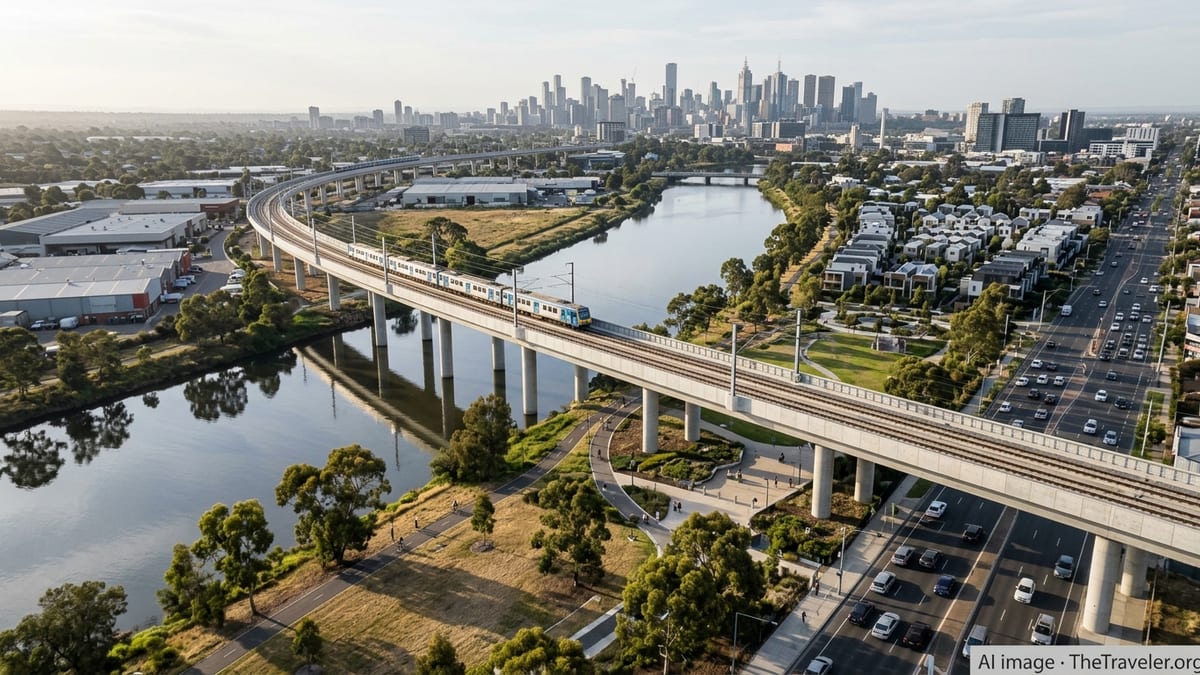
Landmark Rail Bridge to the Airport Redraws the Skyline
A centrepiece of the overhaul is Melbourne Airport Rail, which includes a major new rail bridge soaring across the Maribyrnong River valley in the city’s west. Concept designs released through Victoria’s Big Build program depict a sweeping elevated structure carrying airport services high above the river, road network and existing freight lines, creating a prominent new landmark on the approach to the central city.
Publicly available project information indicates that the bridge and adjoining elevated sections are designed to separate trains from busy arterial roads, reducing the risk of delays caused by traffic intersections and improving timetable reliability. By lifting the line onto a viaduct, planners aim to avoid complex road diversions and lengthy closures that would have been required for rail-in-trench solutions, while also keeping heavy construction largely within the existing transport corridor.
The bridge forms part of a broader package of works that includes new tracks along the Albion to Jacana freight corridor and upgrades around Sunshine, which is being reshaped into a major interchange. These works are intended to allow dedicated airport services to run alongside suburban and regional trains without adding pressure to Melbourne’s already crowded inner-city rail loop.
Design documents describe efforts to integrate the new structure with its surrounds through landscaping and shared paths underneath and beside the viaduct. The approach reflects lessons from earlier elevated rail projects in Melbourne, where the space under the tracks has been turned into parkland, bike paths and community facilities rather than left as inactive, fenced-off land.
Travel Time Savings Set to Reshape Daily Commutes
Government business case summaries and transport modelling released over the past year highlight the potential for combined airport rail and Suburban Rail Loop investments to significantly cut cross-city travel times. Estimates for a completed Melbourne Airport Rail link suggest journeys between the central city and the terminal precinct will take roughly 30 minutes, offering a predictable alternative to road trips that can blow out well beyond an hour in peak traffic.
Separate modelling for Suburban Rail Loop East, the first stage of the orbital line, points to savings of up to 30 minutes for some trips that currently require long, indirect journeys through the central business district. Reports indicate, for example, that travel between key eastern activity centres such as Box Hill and Cheltenham could be reduced from typical car journey times of close to an hour to about half that once fast orbital rail and efficient interchanges are in place.
By allowing people to bypass the city centre entirely, the loop is forecast to relieve pressure on existing radial train lines and busy freeway corridors. Publicly released projections suggest that, once fully operational, the broader Suburban Rail Loop network could remove hundreds of thousands of car trips from Melbourne’s roads each day, with flow-on benefits for bus operations, cycling safety and freight reliability.
For individual commuters, a 30 minute reduction in daily travel can equate to multiple extra hours each week for work, study or leisure. Planning documents note that these time savings are particularly significant for workers and students who live and study in different parts of the middle suburbs, where today’s public transport often requires slow, multi-stage trips involving trams and buses.
Elevated Rail Continues Melbourne’s “Sky Rail” Experiment
Melbourne’s new airport bridge and planned elevated sections in the west build on earlier projects that reimagined how rail can move through dense suburbs. The Caulfield to Dandenong upgrade, completed several years ago, removed nine level crossings by lifting more than eight kilometres of track onto concrete viaducts, creating a continuous series of bridges now commonly referred to as sky rail.
Landscape case studies show how that project opened up more than five kilometres of new parkland, walking and cycling paths, and recreation spaces under and alongside the elevated tracks. Designers used lighting, planting and shared-use paths to transform what had been narrow and noisy rail corridors into a string of linear parks, setting a precedent that is now influencing how new bridges and viaducts are planned elsewhere in the city.
While some communities initially expressed concern about the visual impact of elevated structures, subsequent assessments and local reporting point to growing acceptance as the new open spaces have filled with people walking dogs, exercising and using playgrounds. These outcomes are shaping expectations for the Maribyrnong bridge and adjoining stretches of airport rail, where there is a clear focus on integrating paths and green space beneath the infrastructure rather than leaving it as underused land.
The continued use of elevated solutions also reflects practical constraints. In inner and middle suburbs where roads, pipes and other services are tightly packed, lifting the rail line can be less disruptive than digging deep trenches or tunnels. For the airport corridor, placing the line on a viaduct above major roads and the river is intended to limit property impacts and allow future expansion without wholesale reconstruction of the surrounding street network.
Urban Renewal and Property Markets Along the New Corridor
The combination of new rail infrastructure and faster journeys is expected to trigger substantial urban renewal along key sections of the network. Around Sunshine, which is being developed into a major interchange for suburban, regional and airport trains, local planning documents point to higher-density housing, new commercial space and improved public areas designed to accommodate a surge in passengers and residents.
Similar transit-oriented development patterns are anticipated around Suburban Rail Loop stations in the eastern suburbs, where state-led planning frameworks identify opportunities for mid-rise apartments, new offices and expanded health and education precincts. Analysts of Melbourne’s property market suggest that closer rail access and shorter commutes typically place upward pressure on land values, particularly near new stations with frequent services.
Local councils have flagged the need to balance growth with preservation of neighbourhood character, especially in established residential streets near the airport corridor and future loop stations. Community feedback collected through public exhibitions highlights support for better public transport and open space, alongside concern about overshadowing, parking pressure and the affordability of new housing built close to upgraded rail lines.
Infrastructure agencies argue that concentrating growth around high-capacity public transport is critical as Melbourne heads towards a projected population of around nine million by the 2050s. By enabling more people to live and work near rail, planners aim to reduce car dependence while supporting local shopping strips, schools and services with a larger population base.
Construction Disruption and the Long Road to Completion
Despite the promised benefits, the overhaul will involve years of disruptive works on busy rail and road corridors. Fact sheets issued in early 2026 outline the first construction stages between West Footscray and Albion, including track reconfiguration, bridge works and associated changes to traffic conditions around existing crossings and overpasses. Similar early works are continuing at other sites earmarked for the Suburban Rail Loop and related projects.
Experience from previous level crossing removal and sky rail projects suggests that residents and businesses can expect a mix of temporary station closures, road detours, construction noise and night works as crews install piers, decks and new tracks. Project teams are staging works to keep services running where possible, but some extended line shutdowns and replacement bus services are likely at key milestones, particularly when large bridge spans are lifted into place.
Transport strategists point out that the long construction timeline reflects the scale and complexity of reshaping an operating metropolitan rail system. Tunnelling under built-up suburbs, threading new viaducts through constrained corridors and connecting separate lines into a cohesive network all require careful sequencing to avoid major disruptions to daily travel.
Once completed, however, planners expect the combined impact of the airport rail bridge, new elevated sections and the Suburban Rail Loop to deliver a step change in how Melburnians move around their city. Faster cross-town connections, more reliable services and new public spaces under and around the viaducts are set to redefine both daily commuting patterns and the urban landscape along some of the city’s most important transport corridors.