

More news on this day
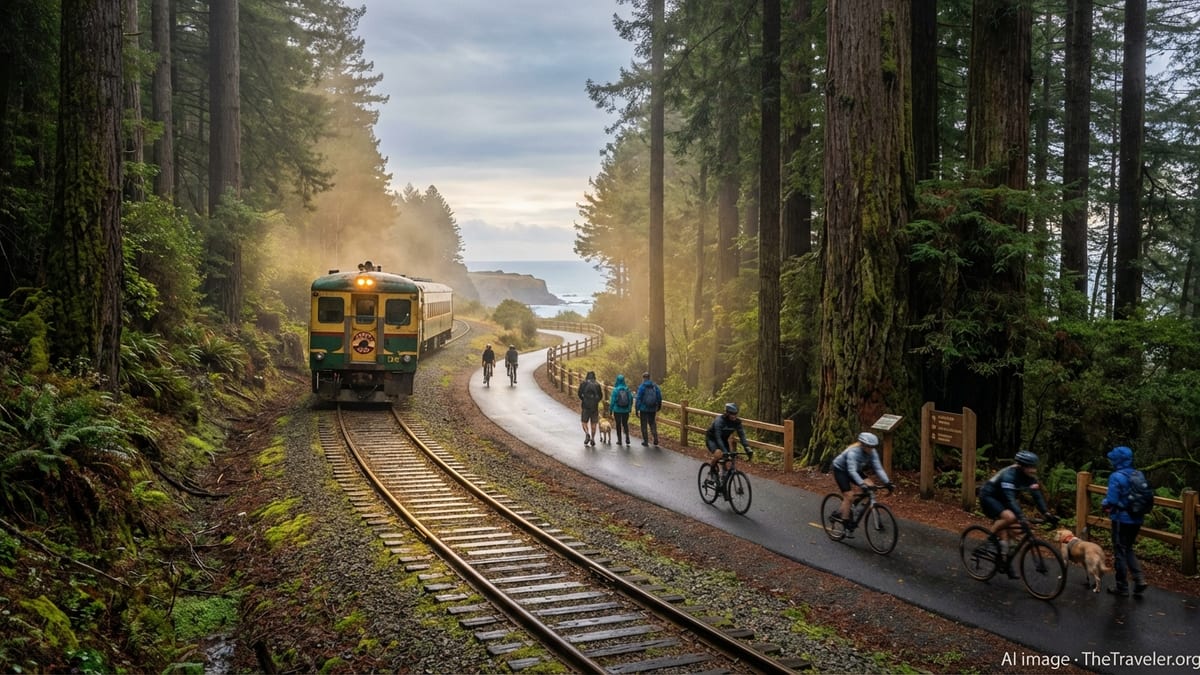
On Northern California’s fog-tinged Mendocino Coast, Mendocino Railway is advancing a bold rail-and-trail vision that would keep trains rolling while inviting cyclists and walkers onto a parallel path, pitching the hybrid approach as the key to future growth for Fort Bragg, Willits and the wider Redwood Coast.
A Heritage Railway at the Center of a Modern Corridor
Best known to visitors as the Skunk Train, Mendocino Railway operates along the historic California Western Railroad, a roughly 40 mile corridor between Fort Bragg on the coast and Willits in the interior. The line threads through dense redwood forests, crosses salmon-bearing streams and passes former logging sites that once powered the region’s economy. Today, heritage excursions and seasonal specials carry most of the traffic, but the company has been steadily positioning the route as a contemporary transportation spine rather than a nostalgic relic.
That repositioning has taken on new urgency as Northern California embraces long-distance trail projects such as the Great Redwood Trail and as coastal communities search for ways to diversify beyond timber and fishing. Mendocino Railway’s leadership argues that the right-of-way can do more than one job at a time, hosting excursion and potential freight services alongside a carefully engineered multi-use path that would give residents and visitors a safe, car-free way to navigate the corridor.
Company officials frame the idea not as a traditional rail-to-trail conversion, which typically removes tracks, but as a “rail and trail” strategy that protects federally regulated rail status while adding recreation and active-transport links. They contend that a dual approach can unlock new funding, increase year round use and support climate goals without surrendering the possibility of expanded passenger or freight operations in the future.
“This corridor has carried Mendocino County’s economy for more than a century,” executives have said in public comments and letters to local officials. “We believe it can carry the next century as well, if we plan it as a shared transportation and recreation asset instead of an either-or choice between trains and trails.”
Riding the Momentum of the Great Redwood Trail
The railway’s push comes as the Great Redwood Trail Agency finalizes a master plan for more than 200 miles of trail on the former North Coast rail line through Mendocino, Trinity and Humboldt counties. That effort, which is expected to receive board approval in early 2026, has drawn national attention as one of California’s most ambitious rail corridor transformations, promising a continuous cycling and hiking route between San Francisco Bay and Humboldt Bay.
While the Great Redwood Trail primarily follows the old Northwestern Pacific Railroad alignment inland, its success is influencing expectations on the coast and in communities like Ukiah and Willits, where local segments of rail-adjacent trail already operate. In Ukiah, for example, a two mile Great Redwood Trail section offers separated pedestrian and bicycle lanes, providing a model for how a trail can share a corridor with active tracks through residential and commercial districts.
Mendocino Railway’s executives point to those inland examples as proof that rail and trail can coexist when designed with adequate separation, fencing and safe crossings. Rather than seeing the Great Redwood Trail as a threat to rail operations, they cast it as a complementary asset that could feed visitors toward the coast and onto Skunk Train excursions, creating a connected network of experiences stretching from redwood canyons to the Pacific Ocean.
Regional tourism advocates have begun to echo that logic, describing a future where long distance cyclists and hikers arriving from the interior link up with coastal rail journeys, downtown Fort Bragg shops and future waterfront promenades on the redeveloped mill site. The idea, they argue, is to think of the corridor not as isolated projects but as a single, evolving travel ecosystem.
New Technology Tests Freight and Climate Potential
Beyond tourism, Mendocino Railway is tying its rail-and-trail narrative to emerging freight and climate technologies. In 2025, the company agreed to host what partners describe as the world’s first autonomous road-to-rail truck pilot, a demonstration intended to show how hybrid vehicles can shift freight off highways and onto steel wheels along the Skunk Train route.
The pilot, developed with sustainable mobility startup Glid, is expected to introduce a suite of vehicles capable of operating on both roads and rails, including hybrid powered units and fully autonomous models. According to the companies, those vehicles would move logistics traffic along the California Western alignment, using existing track for much of the distance between Willits and Fort Bragg, with the goal of reducing truck congestion and emissions on the parallel highway.
Rail advocates say the experiment underscores why retaining and upgrading Mendocino County’s remaining rail infrastructure matters. If the pilot succeeds, they argue, it could offer a replicable model for low volume, rural freight corridors across North America, where conventional rail service may not pencil out but flexible, autonomous systems could keep goods moving with a smaller environmental footprint.
For Mendocino Railway, anchoring a high profile technology trial strengthens the case that its tracks are more than a tourist attraction. The company is already pursuing a federally backed infrastructure loan program to repair tunnels and bridges along the corridor, citing both freight potential and the need for reliable rails to support a parallel trail where feasible.
Legal Wins, Regulatory Scrutiny and the Fort Bragg Mill Site
The push to modernize the corridor and add a trail unfolds against an intricate legal and regulatory backdrop. In a recent declaratory order, the U.S. Surface Transportation Board reaffirmed Mendocino Railway’s status as a federally regulated common carrier, clarifying that the company retains rail carrier rights even in periods when it is not hauling regular freight. The ruling effectively strengthens the railway’s position in disputes with local jurisdictions over land use and permitting along its right-of-way.
That federal status matters most visibly on Fort Bragg’s former Georgia Pacific mill site, a vast oceanfront property where the city, Mendocino Railway and the California Coastal Commission have spent years wrangling over cleanup, access and redevelopment terms. The railway controls key rail alignments crossing the site and has signaled its interest in reconstructing a coastal rail spur and integrating a promenade style trail that would link downtown Fort Bragg to the ocean bluff.
Fort Bragg officials have sought additional time to negotiate a development agreement and coordinate with environmental regulators, but the company has lately pressed for decisions, arguing that prolonged delays threaten both rail and trail investment. With the Surface Transportation Board decision in hand, Mendocino Railway has indicated it is prepared to proceed to trial in mid 2026 if a settlement cannot be reached, even as it continues to pursue a streamlined federal environmental review process for rail related improvements.
Environmental advocates and the Coastal Commission, for their part, have pushed for more robust study of potential impacts, including legacy contamination on the mill site and the cumulative effects of bridge repairs, tie replacement and increased train movements. Those debates will shape where and how a future trail might share space with the railway on some of the most scenic, contested waterfront in Northern California.
Balancing Restoration, Ecology and Community Concerns
One of the central challenges for any rail-and-trail vision along the Mendocino Coast is environmental stewardship. The California Western alignment hugs waterways such as Pudding Creek and the Noyo River, which support sensitive salmon and steelhead populations listed under state and federal protections. Plans to replace tens of thousands of old, chemically treated railroad ties and to rehabilitate dozens of bridges have prompted close scrutiny from agencies and conservation groups.
The California Coastal Commission has already urged a full environmental review of Mendocino Railway’s restoration proposals, citing concerns about how tie removal, bridge work and potential derailments could affect water quality and coastal resources. The commission has also noted what it describes as gaps in earlier environmental documentation, including limited discussion of species protected under the California Endangered Species Act.
Mendocino Railway maintains that its upgrade plans are necessary to bring aging infrastructure up to current safety standards and to support both rail traffic and future trail segments. Company representatives insist that modern best practices can contain contamination risks and that a restored, actively managed corridor is more environmentally secure than a neglected line prone to washouts and illegal dumping.
Local communities add another layer of concern. Public workshops for the Great Redwood Trail and related projects have surfaced worries about fire risk, homeless encampments and policing along long, lightly populated stretches of right-of-way. Any Mendocino Coast rail-and-trail solution will have to address those fears with clear operating plans, funding for maintenance and an approach to social challenges that goes beyond simple exclusion.
Economic Stakes for Fort Bragg, Willits and Beyond
Despite the complexities, the economic upside of a functioning rail-and-trail system is difficult for local officials to ignore. Tourism already underpins much of Fort Bragg’s economy, and the Skunk Train is widely regarded by residents and business owners as one of the town’s signature draws, delivering hundreds of thousands of visitors over the course of a typical year.
Business leaders argue that layering a safe, well connected trail alongside the rail line could extend visitor stays, spread spending into shoulder seasons and encourage more car free travel between attractions such as the historic downtown, Pudding Creek Trestle, Glass Beach and potential new public spaces on the mill site. In Willits and neighboring inland communities, trail links to the rail corridor could draw cyclists and hikers into local shops, lodging and restaurants while giving residents a healthier, low cost transportation option.
Regional planners see additional benefits. In Ukiah, the Great Redwood Trail is already being promoted as a path to emissions free mobility, demonstrating how trail investments can complement public transit and reduce short car trips. Applying similar principles on the Mendocino Coast, where narrow highways and seasonal congestion strain infrastructure, could provide a template for rural communities across the West looking to shift some travel from roads to rails and trails.
Still, not everyone is convinced that rail and trail will deliver the promised payoff. Some taxpayer advocates question whether scarce transportation dollars should support lightly used rural rail lines at all, arguing for full conversion to trails. Others caution that property values, maintenance costs and long term policing of a combined corridor remain wild cards that need clearer answers before major public spending is committed.
Debating the Corridor’s Future: Rail, Trail or Both
These tensions mirror a broader debate playing out across Northern California’s North Coast: whether obsolete or underused rail beds are best preserved as potential freight and passenger routes or fully repurposed as recreational trails. The Great Redwood Trail has become a touchstone for that conversation, with some rail advocates warning that tearing out tracks along key segments will make any future revival of rail shipping vastly more expensive, if not impossible.
Groups such as the Train Riders Association of California have criticized plans that remove rails, particularly in Mendocino County, arguing that railbanking arrangements marketed as temporary have rarely led to restored train service in practice. They point to cities like Ukiah and Arcata, where trails already coexist beside tracks, as evidence that a more cautious, rail-preserving approach is both possible and popular.
Mendocino Railway situates its own rail-and-trail message squarely in that camp, presenting the Skunk Train corridor as a rare opportunity to demonstrate coexistence rather than replacement. Executives say that by keeping federally regulated rails in place while partnering with agencies and local governments on carefully sited trail segments, the county can enjoy the amenities of a world class trail network without permanently foreclosing on freight or expanded passenger possibilities.
Trail only proponents counter that limited right-of-way width, steep cuts and sensitive habitats along parts of the corridor make side by side development unrealistic in places, warning that safety and environmental concerns may ultimately force communities to choose. That fundamental question, whether to share the corridor or redefine it entirely, will drive public hearings and planning processes over the next several years.
Next Steps Toward a Shared Rail-and-Trail Corridor
As 2026 approaches, several milestones will help determine whether Mendocino Railway’s rail-and-trail vision gains traction. The Great Redwood Trail Agency is scheduled to adopt its master plan for interior segments of the corridor, setting regional standards and expectations for design, safety, environmental mitigation and community engagement. Those guidelines are likely to influence how future Mendocino Coast trail concepts are evaluated.
On the coast itself, crucial decisions loom in Fort Bragg, where litigation over the mill site could end in a court judgment or in a negotiated development agreement that spells out the balance between rail infrastructure, public access, cleanup responsibilities and new construction. A favorable ruling for the railway could accelerate its efforts to invest in track rehabilitation and waterfront amenities, while a more restrictive outcome might constrain how and where trains and trails can operate.
Meanwhile, environmental reviews and permitting for tunnel and bridge repairs, tie replacement and the autonomous freight pilot will continue to move through state and federal channels. Each step will test the railway’s contention that modernizing the corridor can be aligned with protecting rivers, forests and wildlife, and that adding a trail will enhance, rather than undermine, that stewardship.
For travelers and locals alike, the outcome will shape how they experience one of California’s most iconic stretches of coastline. Whether via rails, trails or both, the Mendocino corridor is poised to become a closely watched case study in how rural communities reimagine historic infrastructure for a low carbon, recreation driven future.