

More news on this day
Hundreds of travelers heading to and from Mexico’s busiest gateways are facing cascading delays, missed connections and overnight hotel scrambles as ongoing disruption at Cancún and Mexico City airports collides with the peak winter travel rush from the United States, Canada and the United Kingdom.
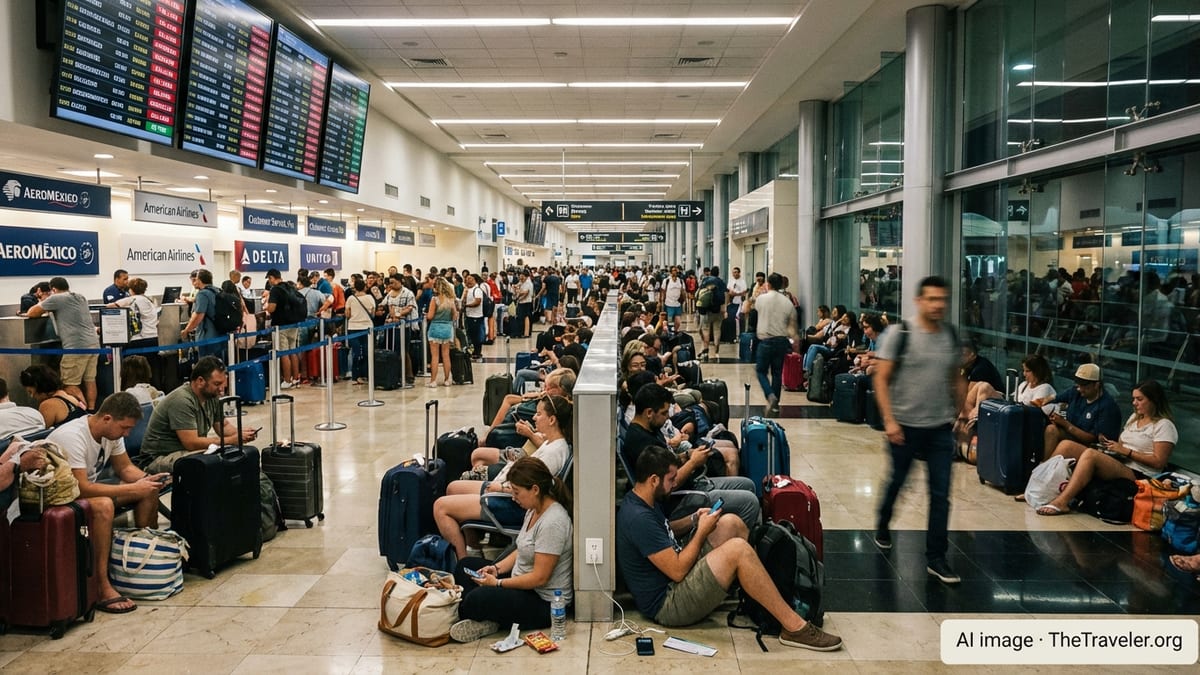
Peak-Season Gridlock Hits Mexico’s Busiest Gateways
Operational strains and volatile winter weather across North America have converged on Mexico’s key hubs just as international arrivals surge to near-record levels. Cancún International Airport, which handled more than 2.15 million foreign travelers in January alone in what operators described as its second-busiest January on record, has little slack in the system when flights begin to stack up on the departure and arrivals boards.
In recent days that margin has vanished. A combination of air traffic congestion, ground handling bottlenecks and knock-on delays from storms further north has driven an unusual volume of late departures and missed arrival slots at both Cancún and Mexico City’s Aeropuerto Internacional Benito Juárez. Airport data and local reports point to waves of disruption: more than 150 delays at the two airports over several days in late January, followed by further spikes around February 20, when Cancún alone logged around 95 delayed flights and at least one cancellation in a single day.
The result on the ground has been familiar but still jarring scenes: departure halls packed with anxious families clutching beach bags instead of boarding passes, snaking lines at airline service counters and gate areas overflowing with passengers refreshing airline apps as aircraft wait for release times. For many, what should have been a straightforward midwinter escape to the Mexican Caribbean or a quick hop to Mexico City has turned into an open-ended airport vigil.
With Mexico positioned as one of the leading sun-and-sand destinations for North American and European travelers during the winter holidays, the timing could hardly be worse. The current wave of delays is landing just as school breaks and long weekends drive demand from the United States, Canada and the United Kingdom, magnifying the impact of every late departure and missed connection across the region’s aviation network.
Aeroméxico, American, Delta and United Bear the Brunt
Major carriers with deep networks into Mexico have been among the hardest hit as operational snarls compound. Aeroméxico, the country’s flag carrier, has faced repeated days of elevated disruption, including dozens of cancellations and delays during severe January storms that battered multiple Mexican states and forced operators to suspend or scale back flights into Cancún and Mexico City. On one January day alone, Aeroméxico and low-cost rival Volaris together scrapped nearly 100 flights and delayed more than a dozen others, leaving thousands of passengers scattered across terminals from Quintana Roo to Nuevo León.
American Airlines, Delta Air Lines and United Airlines, which rely on Cancún and Mexico City as key spokes in their North American networks, have also seen their operations destabilized. Recent tallies from airport and tracking data show American dealing with multiple cancellations and delays on Mexico routes, while Delta and United have reported rolling holdups that snarl itineraries between the United States, Canada and resort destinations such as Cancún and Puerto Vallarta. Even on days when outright cancellations remain limited, clusters of late departures and arrivals can quickly ripple through schedules, particularly when aircraft and crews are operating at or near capacity.
For travelers, that has translated into missed cruise departures, lost nights at all-inclusive resorts and hastily rebooked connections through secondary hubs. Passengers flying from London, Toronto and U.S. cities including Dallas, Houston, Chicago and New York report being forced into overnight stops in gateway cities or being rerouted entirely away from Mexico as carriers try to restore some stability to their schedules. For those starting or ending their trips at Cancún or Mexico City during this period, the odds of a perfectly smooth journey have dropped sharply.
The current turbulence also lands against a wider backdrop of operational fragility across the global airline industry, which has struggled at times to match staffing and fleet resources to post-pandemic demand. High-profile IT outages in recent years, including a massive systems failure that grounded thousands of Delta flights in 2024, have underscored how quickly a single weak link can cascade through an intricate web of routes and rotations. While no comparable technology breakdown has yet been reported in the latest Mexico disruptions, the same tight margins and limited buffers are evident.
Weather, Winter Storms and a North American Cold Wave
Behind the scenes, an unusually disruptive winter has played a major role in setting up the current travel crunch. A prolonged North American cold wave stretching from mid-January into early February delivered bitterly low temperatures to large swaths of the United States, Canada and northern Mexico, pushing the jet stream south and fueling a series of powerful winter storms. One late-January system, informally dubbed Winter Storm Fern by forecasters, sprawled from the U.S. Gulf Coast to the Great Lakes and into Atlantic Canada, triggering states of emergency, widespread power outages and more than ten thousand flight cancellations across the United States in a single day.
Mexico did not escape unscathed. The same system drove strong winds, heavy rain and localized flooding across parts of the Yucatán Peninsula, including Cancún, where nearly a hundred flights were canceled as crosswinds and low visibility made safe operations difficult. Ports were shuttered, roads flooded and ground handling teams struggled to keep up as the storm lashed the coast. The bad weather also disrupted operations at Mexico City’s high-altitude hub, where low ceilings and wind shear frequently force crews to delay departures or divert flights.
The cold wave coincided with some of the busiest travel weeks of the season, leaving airlines with few options to absorb the shock. Aircraft scheduled to run tight rotations between U.S. and Canadian hubs and Mexican resorts were thrown off schedule, and crews suddenly found themselves out of position or approaching duty-time limits. Even after the worst of the weather passed, recovery has been slow, with stranded aircraft and displaced crews continuing to cause scheduling headaches well into February.
Nor has the weather threat entirely abated. Forecasters are tracking additional storm systems targeting major U.S. gateways including New York and Boston, raising the risk of fresh disruption just as airlines work to clear backlogs on cross-border routes to Mexico. For passengers with upcoming trips, that means the potential for renewed uncertainty even if skies appear clear at their final destination.
Airports Under Pressure: Congestion, Bottlenecks and Baggage Delays
While the jet stream and polar vortex explain part of the story, the scenes unfolding inside Mexico’s terminals point to more structural strains. Cancún, in particular, has been straining under the weight of its own success. After investing heavily in faster immigration processing, including automated e-gates that have cut arrival clearance times to under a minute in many cases, the airport has run into a new chokepoint at baggage claim, where limited staffing and ground handling capacity have struggled to keep pace with the surge in passengers.
Authorities in Quintana Roo have acknowledged that baggage waits of 30 minutes to more than an hour have become common during peak arrival waves, adding frustration to already delayed flights. In response, the state’s governor recently announced a package of measures aimed at speeding up baggage delivery, including hiring more ramp workers, reviewing pay and working conditions and tightening performance targets for ground handling contractors. Although these steps are designed to improve the passenger experience over the medium term, implementation will take time, leaving travelers in the near term vulnerable to the current crunch.
Mexico City’s Benito Juárez International Airport faces a different but related challenge. Operating near the limits of its runway and terminal capacity, the airport is acutely sensitive to any disruption in air traffic control flow. Even a relatively small number of late or diverted flights can quickly clog taxiways and gates, forcing arriving aircraft to hold or divert and departing flights to wait for slots. Recent daily tallies showing dozens of delays and at least one cancellation underscore how even modest operational hiccups can snowball into prolonged gridlock at such a constrained facility.
The knock-on effects are magnified by the role these airports play as national and regional hubs. When Cancún and Mexico City strain, the impact is felt across secondary Mexican airports from Monterrey and Guadalajara to Querétaro and Tijuana, as aircraft and crews are delayed or rerouted. For international travelers attempting to connect onward within Mexico, a delay at one of the two main gateways can mean an unplanned overnight stay far from their final resort or business destination.
Hotel Heavyweights Face a Wave of Last-Minute Rebookings
The turbulence in the skies is echoing through hotel front desks and call centers as chains including Marriott, Hilton and Hyatt scramble to accommodate guests stranded or delayed by the flight chaos. With room occupancy already high in beach destinations such as Cancún, Playa del Carmen and Tulum, even a modest uptick in distressed passengers looking for last-minute beds can push properties close to or beyond capacity.
Hotel managers across the Mexican Caribbean and Mexico City report a spike in same-day bookings, frequent changes to arrival dates and an increase in guests asking to extend stays at short notice when return flights are canceled or repeatedly pushed back. For global brands that prize consistency and predictability, this creates a thorny challenge: honoring existing reservations and elite-member guarantees while trying to find space for travelers who suddenly have nowhere to sleep.
Behind the scenes, revenue and reservations teams for the major hotel groups have been working with airlines and tour operators to secure blocks of rooms for stranded passengers, often at negotiated distress rates. However, with demand spread across multiple brands and independent hotels, the process can be uneven. Some travelers arriving with airline-issued hotel vouchers have struggled to find properties still willing or able to accept them, particularly in hotspots where occupancy was already near sold-out before the latest disruptions hit.
The pressure is not limited to leisure properties. Business-focused hotels in Mexico City and Monterrey are also juggling shifting patterns of arrivals and departures as corporate travelers find themselves held up in transit. For Marriott, Hilton, Hyatt and their peers, the current turmoil underlines the importance of flexible booking policies, robust overbooking algorithms and real-time communication tools that can keep guests informed as their travel plans change.
Stranded Passengers Grapple With Long Queues and Unclear Options
For affected travelers, the statistics boil down to lived experience measured in hours spent in line and nights unexpectedly spent in transit hotels. At Cancún, passengers arriving to find their outbound flights delayed or canceled have described scenes of confusion as loudspeakers announce rolling changes and crowds surge toward airline counters. Travelers report waiting for hours just to speak with a representative, only to learn that the next available seats to their home cities may be days away.
Families traveling with children have been particularly hard hit, with many forced to navigate crowded terminals late into the night as they try to secure accommodation or rebook flights through overwhelmed call centers. Some passengers have turned to social media to document rows of people sleeping on the floor of the terminal, huddled around phone-charging stations as they wait for updates. Others have described difficulties in obtaining clear information on their rights to compensation or vouchers under Mexican passenger protection rules.
Language barriers and time-zone differences have added another layer of complexity for visitors from Europe and Asia, who must coordinate with travel agents or insurance providers located thousands of miles away. Even seasoned travelers have found themselves caught out by the pace of change, with flights reclassified from delayed to canceled at short notice as crews time out or aircraft are reassigned.
Consumer advocates are urging passengers to document all expenses related to the disruption, including meals, ground transport and emergency hotel stays, and to keep detailed records of communications with airlines and hotels. Travel insurance providers, meanwhile, are bracing for a surge in claims related to trip interruptions and missed connections, particularly from markets such as Canada and the United Kingdom where long-haul itineraries often depend on tight connections through U.S. or Mexican hubs.
North American Travel Network Feels the Shockwaves
The problems at Cancún and Mexico City are resonating far beyond Mexico’s borders, underscoring how tightly interconnected the North American travel system has become. As major carriers reroute aircraft and shuffle crews to protect core long-haul services, feeder flights between secondary U.S. and Canadian cities and Mexico can be some of the first to see frequency cuts or equipment downgrades.
Airports across the United States and Canada have reported clusters of Mexico-related delays, particularly at gateways with high leisure traffic such as Dallas Fort Worth, Houston, Chicago O’Hare, Toronto Pearson and Vancouver. At the same time, weather-related disruptions along the U.S. East Coast have triggered their own waves of cancellations, further complicating the task of getting travelers to and from Mexico on time. Smaller regional carriers and codeshare partners have been pulled into the vortex as they scramble to cover gaps in schedules left by their larger alliance members.
Across the Atlantic, British holidaymakers traveling on both scheduled and charter services to Cancún have faced an elevated risk of schedule changes and last-minute aircraft swaps as airlines try to juggle fleet availability. Some long-haul flights from the United Kingdom have been forced into diversions or extended holding patterns when congestion at Mexican airports peaked, straining crews and leaving passengers facing tight connections on their onward journeys.
Travel agents and tour operators in all three countries report a sharp increase in customer inquiries and rebooking requests related to Mexico itineraries, with many clients now asking for added buffer days or more flexible ticket conditions in case of further disruption. For a tourism sector that relies on confidence and predictability, the latest chaos has become an unwelcome stress test of just how resilient the North American travel network really is.
Industry Scrambles for Fixes as Travelers Seek Certainty
As airlines and airports work to stabilize operations, attention is turning to what can be done to prevent similar meltdowns in the future. Mexican authorities have already signaled plans to reinforce staffing and infrastructure at Cancún and to keep pressing forward with longer-term capacity projects aimed at relieving pressure on Mexico City’s overburdened main airport. For their part, carriers including Aeroméxico, American, Delta and United are reviewing crew scheduling, aircraft routing and contingency plans for winter weather and security events that can suddenly close access roads or terminals.
Hotel groups are also drawing lessons from the latest turbulence. Executives at Marriott, Hilton and Hyatt have spoken in recent years about the need for tighter integration with airline systems to anticipate surges in distressed-passenger demand and to steer travelers toward properties with available inventory before they even land. The current episode provides a fresh case study in how quickly traditional booking patterns can unravel when a key hub falters, and how important flexible check-in, check-out and cancellation policies can be during regional crises.
For now, however, the burden of navigating the chaos falls largely on individual travelers. Industry experts advise anyone with imminent trips to Mexico to build in extra time for connections, monitor airline and airport updates closely in the 24 to 48 hours before departure, and ensure they have comprehensive travel insurance that covers weather and operational disruptions. They also urge passengers to familiarize themselves with both airline contracts of carriage and Mexican passenger rights regulations, which can determine eligibility for rebooking, refunds or accommodations during extended delays.
As peak-season crowds continue to stream toward Mexico’s beaches and cultural capitals, the hope across the industry is that recent steps to beef up staffing and tighten operational discipline will begin to ease the strain. Until then, travelers heading for Cancún’s turquoise waters or Mexico City’s museums may need to pack an extra measure of patience along with their passports.