

More news on this day
After a weekend of cartel-linked violence that shut down air links and forced tourists to shelter in place, authorities in Mexico say security is stabilizing around Puerto Vallarta and Guadalajara, prompting airlines and officials to begin cautiously restoring flights to the popular Jalisco gateways.
How the Crisis Unfolded in Western Mexico
The disruption began on Sunday, February 22, when Mexican security forces killed Nemesio Rubén Oseguera Cervantes, known as El Mencho, the powerful leader of the Jalisco New Generation Cartel, during a military operation in the mountains of Jalisco state. His death triggered a wave of retaliation across western Mexico, with vehicles set ablaze, highways blocked and reports of armed confrontations in multiple states, including Jalisco, where Puerto Vallarta and Guadalajara are located.
In the hours that followed, panic rippled through both cities. Videos shared on social media showed smoke columns rising near tourist zones, while local authorities activated emergency protocols that brought public transport and taxi service to a halt. Travelers heading to and from the airports found themselves stranded on highways or confined inside terminals as officials tried to assess the risk posed by the unrest.
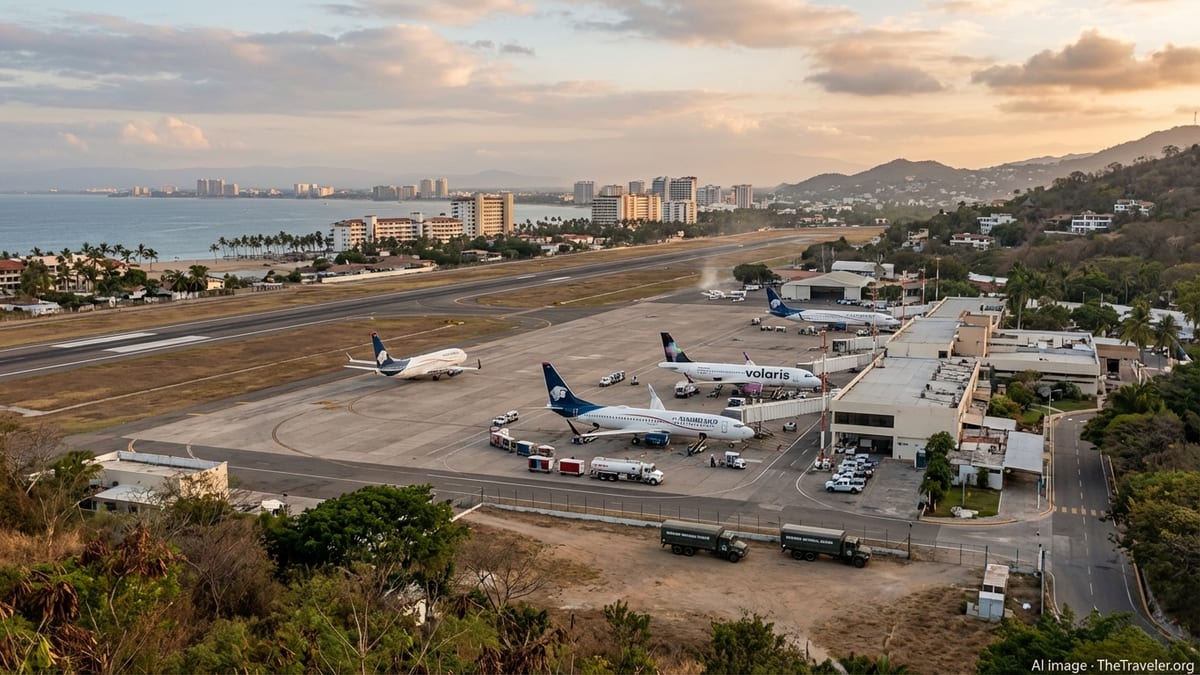
Airport operators in Jalisco were quick to stress that their facilities remained physically secure, even as access roads were affected. The operator of Guadalajara’s international airport reported no incidents inside the terminals, while Puerto Vallarta’s airport authority said that security forces from the National Guard and the army had taken up positions on site as a precaution. The larger danger, officials said, came from blockades and sporadic violence on surrounding roads rather than from inside the airports themselves.
Nonetheless, the combination of transport shutdowns, security alerts and widespread uncertainty prompted airlines to cancel services en masse. By Sunday afternoon, nearly all international flights into Puerto Vallarta had been scrapped, and many departures from Guadalajara were either canceled or operating with reduced staff and significant delays.
Airlines Cancel, Then Begin Restoring Flights
Major North American carriers were among the first to react, canceling flights into the region as reports of roadblocks and burning vehicles emerged. United Airlines, Southwest and American Airlines all suspended Sunday flights to Puerto Vallarta and Guadalajara, citing the unfolding security situation and the difficulty of safely moving passengers and crew to and from the airports.
Air Canada halted operations at Puerto Vallarta, warning customers not to travel to the airport unless their flight was confirmed as operating. Canadian carrier WestJet also canceled dozens of flights into Puerto Vallarta, Guadalajara and Manzanillo, diverting several aircraft that were already en route when the violence escalated. Mexican airlines, including Aeromexico, Volaris and Viva Aerobus, scrapped multiple flights out of Jalisco airports as access roads were blocked and some airport services briefly scaled back.
By Monday, February 23, as authorities reported that order was being restored and roadways were gradually cleared, airlines shifted from blanket cancellations to more targeted schedule adjustments and travel waivers. American Airlines issued a travel alert allowing free changes for customers traveling through Puerto Vallarta and Guadalajara through February 24. United extended its waiver through February 25, and Delta notified passengers that travel through Jalisco could be affected through February 26, with rebooking permitted through early March.
These waivers are designed to give travelers flexibility while airlines rebuild their schedules and local officials confirm that access routes are reliably secure. Carriers are now reinstating flights in phases, with some services returning as early as Monday afternoon and others slated to resume later in the week. Travelers booking new tickets to Puerto Vallarta or Guadalajara in the coming days should expect more limited schedules and remain prepared for last minute timing changes as airlines adjust to evolving demand and security assessments.
Security Measures Tightened as Authorities Reassert Control
As flights begin to return, the visible security footprint around Jalisco’s airports and tourist corridors has expanded significantly. In Puerto Vallarta, the airport is now guarded by personnel from the National Guard and the Ministry of National Defense, who are working in coordination with local and state police to secure access roads and key transport links. Checkpoints have been set up along major routes connecting the airport with hotel zones on Banderas Bay, and military convoys have been seen patrolling coastal highways.
In Guadalajara, authorities have also deployed additional security forces in and around the airport and along key arterial roads into the metropolitan area. Officials there emphasize that no direct attacks occurred inside the airport during the unrest, but they acknowledge that rumors and online images created a perception of chaos that contributed to panic among travelers. State officials have since clarified that several widely shared images purporting to show gunfire on airport tarmacs and fires in central Puerto Vallarta were computer generated, a reminder of how misinformation can accelerate fear during fast moving crises.
Beyond the airports, Jalisco’s transport authorities have announced the restoration of public transit services across the state, including bus routes that serve major tourist districts. Municipal workers in Puerto Vallarta have begun clearing burned vehicles and other debris from roads, a critical step in reopening normal circulation. Schools in Jalisco and the neighboring state of Nayarit will remain closed for at least one day as a precaution, allowing authorities to concentrate resources on transport and security rather than daily commuting traffic.
Despite these signs of normalization, local officials are urging residents and visitors to remain alert and to follow instructions from security forces. While the immediate wave of violence appears to have subsided, analysts warn that internal power struggles within the cartel could produce sporadic flare ups in the weeks ahead. Authorities say they will maintain an elevated security presence in core tourist areas to reassure international visitors and to discourage opportunistic criminal activity.
Updated Travel Alerts from the United States and Other Governments
The United States responded quickly to the violence with a rare shelter in place alert for several Mexican states, including Jalisco. On Sunday, the US Embassy in Mexico City warned citizens in affected regions to remain where they were and to avoid travel due to roadblocks, fires and criminal activity linked to the fallout from the military operation against El Mencho. The alert applied not only to Puerto Vallarta and Guadalajara but also to parts of Tamaulipas, Michoacán, Guerrero and Nuevo León, and was later extended to include portions of Baja California, Quintana Roo, Guanajuato and Oaxaca.
On Monday, US officials shifted the formal travel advice to a Level 2 advisory that calls on citizens to exercise increased caution in western Mexico. While still urging travelers to remain vigilant and to monitor local news, the updated guidance acknowledges that security conditions are improving and that authorities are regaining control of critical infrastructure. US consular staff, who were themselves ordered to shelter in place at the height of the unrest, are now resuming limited services and fielding calls from travelers needing assistance with documentation and emergency travel planning.
Other governments have updated their own advice in line with the evolving situation. European foreign ministries have warned their citizens to avoid unnecessary travel to affected regions until security conditions are more clearly stabilized, while noting that tourist centers such as Puerto Vallarta are not the direct target of the violence. Travel advisories from Canada and the United Kingdom highlight the risk of being caught in roadblocks or clashes rather than attacks on resorts or airports themselves.
For now, the consensus among foreign ministries is that travelers who are already in Puerto Vallarta and Guadalajara can remain in place if they follow local guidance and stay away from protest sites, police operations and isolated roads. Prospective visitors are being advised to stay in close touch with their airlines and tour operators before making final decisions on near term trips, especially if they are scheduled to arrive in the coming days while waivers and partial schedule reductions remain in effect.
What Travelers Flying to Puerto Vallarta and Guadalajara Should Expect
As flights resume, travelers heading to Puerto Vallarta or Guadalajara are likely to encounter a more heavily controlled, slower moving airport experience than usual. Expect visible military and police presence at entrances, on access roads and in terminal public areas. Security screening may take longer, particularly during early phases of reopening when staff are still returning and procedures are being adjusted to the heightened alert level.
Ground transportation will also look different from the pre crisis norm. In Puerto Vallarta, the local government declared a Code Red at the height of the violence, temporarily suspending all taxi and rideshare operations. As that order is lifted, services are being reintroduced gradually, with some resorts prioritizing pre booked private transfers while publicly licensed taxis and app based services ramp back up. Travelers may find fewer options at peak arrival times and should be prepared for wait times that are longer than usual.
Inside the resorts, the atmosphere is calmer than images from outside might suggest. Major beach properties in Puerto Vallarta report that while guests were asked to stay on property during the unrest, there were no incidents of violence within resort grounds. Many hotels maintained core amenities such as restaurants and pools, even as they suspended off site excursions and some beach activities due to the intense security presence along the shoreline. As the situation stabilizes, tour operators are beginning to review when to restart boat trips, city tours and excursions to nearby towns.
In Guadalajara, business and leisure travelers should be prepared for possible detours and extra time getting between the airport and the city’s hotel and commercial districts. Conference organizers and event planners are closely watching security updates, particularly with the city due to host major international sporting events later this year. While authorities insist that preparations remain on track, visiting delegations are being urged to coordinate closely with local partners on transport logistics and contingency planning.
Booking, Rebooking and Refund Options for Affected Passengers
For travelers whose plans have been disrupted, airlines are offering an array of waivers and flexible booking options. American Airlines is allowing customers scheduled to fly through Puerto Vallarta and Guadalajara in the coming days to rebook without change fees, provided they travel within a defined window. United and Delta have rolled out similar policies, with Delta’s advisory covering travel to and from Jalisco between February 22 and 26 and permitting reissued tickets through March 7 without fare penalties under certain conditions.
Canadian carriers are also working with affected passengers. Air Canada and WestJet have both indicated that customers on canceled flights can switch to later dates or alternate routes, though fare differences may apply once the initial waiver periods end. Some Mexico based airlines are offering vouchers or free changes for travelers whose journeys were interrupted by the unrest, particularly on domestic routes linking Puerto Vallarta and Guadalajara with other Mexican cities.
On the ground, many resorts and tour operators in Puerto Vallarta are coordinating their policies with airline waivers, offering date changes that mirror the flexibility provided by major carriers. Rather than issuing blanket security refunds, hotel groups are typically allowing guests to reschedule stays without penalties if their flights were canceled or significantly delayed. Travel agents report that this coordinated approach between airlines and hotels is helping many vacationers salvage trips by shifting dates rather than canceling outright.
Travel insurance coverage varies widely, but policies that include trip interruption and security incident clauses may help reimburse additional accommodation, meals or rebooking costs for travelers who can document that their plans were derailed by the unrest. Travelers are being advised to keep records of airline notifications, local alerts and receipts for unexpected expenses when filing claims.
Practical Safety Tips for Near-Term Travel to Jalisco
For those planning to travel to Puerto Vallarta or Guadalajara in the coming days and weeks, authorities and security experts recommend a cautious but measured approach. They stress that the violence has been primarily directed at rival criminal groups and state security forces, not at tourists, but that visitors can still be indirectly affected by blockades, transport disruptions or stray incidents in public spaces.
Before departure, travelers should check the latest government advisories for Mexico and verify that their flights are operating as scheduled. Airlines are urging customers to use mobile apps or departure boards to confirm flight status on the day of travel, given the possibility of last minute changes. It is also advisable to register contact details with consular services so that alerts can be received promptly if conditions change.
On arrival, visitors are being encouraged to use vetted transport arranged through hotels or well known providers, particularly for late night arrivals. Sticking to main highways and avoiding unnecessary detours can reduce exposure to any lingering roadblocks or police operations. Travelers should avoid joining crowds around incidents, refrain from photographing or filming security forces and immediately follow instructions if authorities order a temporary shelter in place.
Once at a resort or hotel, staying informed through reputable local media and official channels can help visitors distinguish between genuine incidents and misleading social media posts. If a shelter in place directive is reissued, guests should remain inside, follow property protocols and stay in communication with both their travel agent and airline. For now, officials in Jalisco say they are committed to maintaining a high security posture so that international tourism, a critical pillar of the regional economy, can continue even as the state navigates the aftermath of the cartel leader’s killing.