

More news on this day
The decision by Mexico and Brazil to revive and modernize electronic visas for Brazilian travelers, effective February 5, 2026, is reshaping mobility between Latin America’s two largest economies.
By shifting fully to an e-visa model with fast-track processing for tourists and business visitors from Brazil, the governments are betting that a frictionless, largely paperless border will help restore lost tourism flows, deepen corporate ties and signal a new era of regionally integrated travel.
More News
- TSA Rolls Out $45 ConfirmID Fee for Travelers Without REAL ID at Security
- Flying Blue Launches February 25% Promo Rewards on Transatlantic and Regional Routes
- United Fast-Tracks Starlink Wi‑Fi Across Fleet, Free for MileagePlus Members
A Digital Reset After Years of Visa Whiplash
The new scheme represents a clear pivot away from the stop-start visa policies that have defined Brazil–Mexico travel over the past four years. After decades of largely predictable entry rules, Mexico revoked visa-free travel for Brazilians in late 2021 and briefly moved to an electronic authorization system before suspending it in August 2022 amid concerns about irregular migration. That decision forced most Brazilian visitors back into consular queues, with in-person interviews and paper documents becoming the norm once again.
Industry groups in Mexico, especially in the Caribbean resort state of Quintana Roo, have since warned that the shift back to physical visas inflicted heavy damage on one of the country’s most valuable outbound markets. Hoteliers in Cancun and the Riviera Maya reported a collapse in Brazilian arrivals, along with flight cancellations and the loss of direct connections between Brazil and key Mexican beach destinations. Several business travel managers also pointed to longer lead times and higher costs whenever staff needed to attend meetings, site visits or conferences in Mexico.
Those pressures helped drive an intense lobbying campaign by hotel associations, tourism boards and state authorities, who argued that a return to digital processing was essential if Mexico wanted to remain competitive with other destinations courting Brazilian travelers. Their push culminated in a decree published in Mexico’s Official Journal in September 2025 that cleared the way for a renewed e-visa system for Brazilian nationals entering by air for short stays.
From February 5, 2026, that framework becomes operational, with Mexican consulates instructed to phase out new physical visa stickers for most Brazilian short-stay travelers and channel applications into a fully electronic process. Previously issued paper visas will remain valid until their printed expiry dates, but new in-person requests for ordinary visitor visas are expected to taper off quickly.
How the New E-Visa and Fast-Track Entry Will Work
Under the relaunched system, Brazilian tourists and business travelers heading to Mexico will complete a streamlined online application instead of booking consular appointments. Applicants upload passport scans, fill in a short form and submit basic trip details, including intended dates and accommodation information for their visit. Once processed, approvals are sent by email, usually within 48 hours, in the form of a document containing a scannable QR code.
The e-visa will be available to Brazilians traveling by air under the familiar “visitor without permission to engage in remunerated activities” category used by Mexican immigration authorities. Stays can be authorized for up to 180 days, with the understanding that visitors remain prohibited from taking local employment while in the country. The government has built the digital procedure into its existing guidelines for visa issuance, signaling that it is intended as a long-term structural change rather than a short-lived experiment.
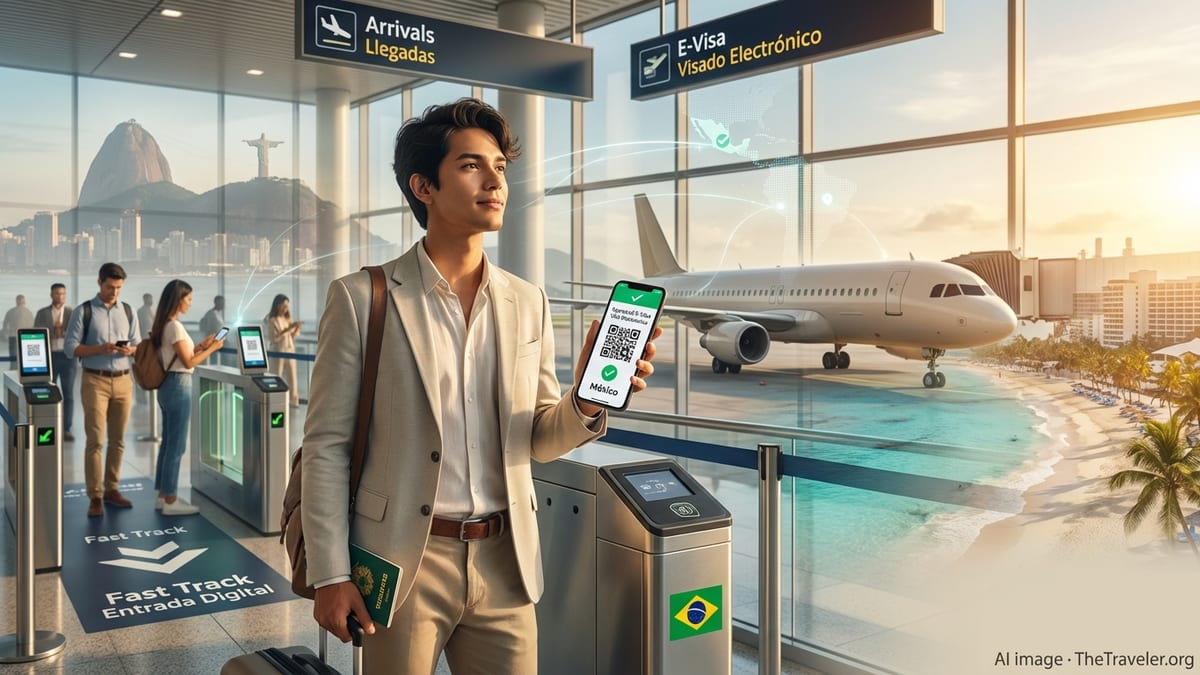
At airports, the QR code can be presented on a smartphone or as a printed document during airline check-in and at immigration control on arrival in Mexico. Airlines have already begun updating their systems and issuing guidance to staff, with Latin American carriers preparing training sessions for check-in teams and corporate travel departments. The objective is to ensure that the digital authorization is validated at the point of departure, reducing the risk of last-minute denials at the border.
Despite the upgrade, officials stress that standard entry conditions remain in place. Border officers retain discretion to request proof of return travel, hotel bookings or financial means and to question travelers about the purpose of their visit. The e-visa is an advance authorization to board and seek entry, not an unconditional guarantee of admission. Nevertheless, both governments and industry stakeholders view the digital model as a faster, more predictable pathway that will remove layers of bureaucracy for legitimate travelers.
Tourism Industry Banks on a Brazilian Comeback
Few sectors have followed the policy reversal more closely than the tourism industry along Mexico’s Caribbean coast. Before the visa restrictions were tightened, Brazil ranked among the top international source markets for Quintana Roo, filling flights to Cancun and packing resorts in the Riviera Maya during peak seasons. When Brazilians were again required to seek in-person visas, hoteliers in the region said the market “collapsed,” with some associations estimating losses in the hundreds of millions of dollars.
Tourism leaders in Cancun, Puerto Morelos, Isla Mujeres and Playa del Carmen repeatedly argued that cumbersome visa rules were discouraging leisure travelers who once viewed Mexico as an easy, sun-and-sand getaway. Travel agents reported that clients were shifting to destinations such as the Dominican Republic, Colombia and Caribbean islands that offered simpler entry requirements or fully online authorizations. Airlines, facing weaker bookings, cut back or suspended several direct routes connecting Brazilian cities to Cancun and other Mexican gateways.
The reinstatement of the e-visa is widely seen as an attempt to reverse that trend and signal that Mexico is once again open to Brazilian holidaymakers. Hotel associations anticipate a gradual recovery in Brazilian arrivals starting with the southern hemisphere’s mid-year holidays in 2026 and accelerating into the northern winter season. Some state officials in Quintana Roo have linked the move to aggressive efforts to restore flight connectivity, negotiating with carriers to resume or increase direct frequencies from hubs such as São Paulo and Rio de Janeiro.
Resorts and tour operators are already drafting promotional campaigns targeted at the Brazilian market, highlighting that the main barrier to last-minute trips is being removed. Packages built around all-inclusive stays, weddings, conventions and beach festivals are expected to feature the simplified e-visa prominently, framing it as a reason to return to destinations that became harder to reach when consular paperwork reappeared.
Corporate Travel and Business Links Stand to Benefit
While tourism is at the center of the new policy, corporate mobility specialists say Brazilian business travelers may be among the biggest beneficiaries of the fast-track e-visa. In recent years, firms based in São Paulo, Rio de Janeiro and other Brazilian cities have deepened ties with Mexican partners in manufacturing, energy, services and technology, often relying on short-notice travel for negotiations, inspections and training sessions.
The reintroduction and modernization of the e-visa is expected to shorten planning cycles for such trips, cutting out the need for employees to secure consular appointments, gather hard-copy documents and wait days or weeks for a visa sticker. Under the new system, travel managers anticipate that approvals will often arrive within two working days, allowing teams to respond more quickly to operational issues or project milestones in Mexico.
For companies, that agility translates into tangible savings. There will be no need to send staff to consular offices in São Paulo, Rio de Janeiro or Brasília, nor to pay for couriers and document translations that were sometimes requested as part of the traditional visa process. Some mobility providers are already integrating the Mexican e-visa option into their digital dashboards for corporate clients, offering status tracking and automated reminders alongside visas for destinations such as the United States, Canada and the Schengen Area.
The timing also intersects with broader changes on the Brazilian side. In 2025, Brazil expanded the range of activities permitted under visitor status, allowing many short-term technical and technology transfer assignments to take place without a full work visa. That adjustment, combined with Mexico’s fast-track e-visa, is expected to make it easier for Brazilian specialists to participate in brief, high-value business engagements across the border, from factory commissioning to software rollouts and joint training programs.
Regional Context: Latin America’s Shift to Borderless Travel
Mexico’s decision to reset its approach to Brazilian visitors comes as multiple countries in the Americas and beyond adopt or refine electronic visa platforms. Canada, Australia, India, Qatar and Cuba are among the states that already offer digital authorization systems to Brazilian nationals, typically emphasizing reduced processing times and minimal paperwork. For many travelers, the ability to apply from a laptop or smartphone, without surrendering a passport or attending an interview, has become an expectation rather than a luxury.
Within Latin America, governments are under pressure to match this level of convenience if they want to remain competitive in attracting both leisure and business segments. Several regional economies are seeking to position themselves as hubs for events, conferences and sports tournaments, with the 2026 FIFA World Cup, which Mexico will co-host with the United States and Canada, serving as a powerful focal point. The prospect of thousands of Brazilian fans flying to Mexico for matches, fan festivals and extended vacations has added urgency to efforts to simplify entry.
At the policy level, the e-visa revival also reflects an ongoing debate over how to balance security and facilitation. Mexican authorities have acknowledged that irregular migration patterns influenced the earlier suspension of electronic authorizations. This time, officials say they aim to pair robust data collection and pre-screening tools with the convenience of online processing. Airlines will play a key role in this model, validating e-visas before boarding and sharing information with border authorities in advance.
Regional analysts suggest that if the Brazil–Mexico arrangement proves successful, it could strengthen arguments for wider use of interoperable digital systems across the Americas. While there are no immediate plans for a shared regional visa, the spread of compatible electronic platforms and biometric tools could gradually lower the barriers to multi-country itineraries, especially for travelers from key markets like Brazil.
Opportunities and Remaining Challenges
The shift to e-visas with fast-track entry processes offers clear upsides for travelers, airlines and tourism operators, but it also presents implementation challenges. A smooth rollout will depend on user-friendly application portals, secure payment mechanisms and clear communication to both applicants and airline staff. Any early technical glitches or slow approval times risk undermining confidence in the system just as Mexico is trying to win back Brazilian visitors.
Travel advisors caution that expectations must be managed around the 48-hour approval target, particularly during peak travel seasons or if additional security checks are required in individual cases. They recommend that passengers avoid booking non-refundable flights or packages until they have received their e-visa, even if processing averages remain fast. Guidance is also expected on whether applicants can correct mistakes in submissions without restarting the process from scratch, a frequent concern with digital platforms.
Another point of attention is awareness. Many Brazilian travelers who have grown accustomed to consular visits or who were discouraged by past policy changes may not immediately realize that a simpler route now exists. Mexican tourism boards and Brazilian travel agencies are likely to invest heavily in messaging that emphasizes the restoration of online applications and clarifies the documentation required to ensure border checks remain swift.
Despite these uncertainties, industry sentiment is broadly optimistic. The move is viewed as a structural signal that both Mexico and Brazil see freer movement of people as integral to their economic partnership and to Latin America’s broader recovery from the pandemic years. If the system performs as promised, the phrase “borderless tourism” could move from slogan to lived reality for hundreds of thousands of Brazilian visitors each year.
FAQ
Q1. When does the new Mexican e-visa for Brazilian travelers take effect?
The reintroduced e-visa for Brazilian citizens traveling to Mexico by air for tourism or business takes effect on February 5, 2026, with applications expected to be handled entirely online.
Q2. Who is eligible to apply for the Mexico e-visa under the new system?
The e-visa is designed for Brazilian passport holders entering Mexico by air as visitors without permission to engage in paid local employment, primarily tourists, business travelers, and transit passengers on short stays.
Q3. How long can Brazilian visitors stay in Mexico with the new e-visa?
Under the guidelines tied to the updated policy, the electronic visa can authorize stays of up to 180 days in Mexican territory, provided the traveler respects the conditions attached to visitor status.
Q4. How long does it take to receive approval after submitting an e-visa application?
Mexican and industry sources indicate that most Brazilian applicants can expect a decision within about 48 hours of completing the online form and uploading the required documents, although processing times may vary.
Q5. Will Brazilian travelers still need to visit a Mexican consulate in person?
For eligible short-stay trips, the goal is to eliminate the need for in-person appointments at Mexican consulates, with new applications submitted and processed digitally instead of through physical visa stickers.
Q6. What documents will Brazilian applicants typically need for the e-visa?
Applicants are generally expected to provide a valid Brazilian passport, personal and contact details, intended travel dates, and basic itinerary information, and may be asked to show proof of return travel, accommodation and financial means upon arrival.
Q7. Do existing physical Mexican visas in Brazilian passports remain valid?
Yes, authorities have signaled that visitor visas already issued as physical stickers will remain valid until their printed expiry dates, even as new applications shift to the electronic channel.
Q8. How does this change affect Brazilian business travelers specifically?
Brazilian business travelers stand to gain from shorter lead times, lower administrative costs and greater flexibility for short-notice trips, as they will no longer need to secure consular appointments or courier documents to obtain a visa.
Q9. Are Brazilians who hold visas or residence permits for other countries still exempt from needing a Mexican e-visa?
Certain Brazilian travelers who hold valid visas or permanent residency for destinations such as the United States, Canada, Japan, the United Kingdom or Schengen Area states may continue to qualify for visa-free entry to Mexico under longstanding exemption rules.
Q10. What impact is the e-visa expected to have on tourism in destinations like Cancun and the Riviera Maya?
Tourism authorities and hotel associations in Quintana Roo expect the simplified e-visa to spur a strong rebound in Brazilian arrivals, help restore direct flights, raise hotel occupancy and support broader economic recovery in Cancun, the Riviera Maya and other Mexican Caribbean destinations.