


Mexico’s Temporary Resident Visa is the primary pathway for non-Mexican nationals who want to live in the country for more than 180 days without immediately committing to permanent residency. Understanding the financial thresholds, eligibility routes, and procedural steps is essential for assessing whether a medium-term relocation to Mexico is feasible. This briefing explains how the visa works, what income and savings levels are typically required, and how the consular and in-country processes are structured in practice.
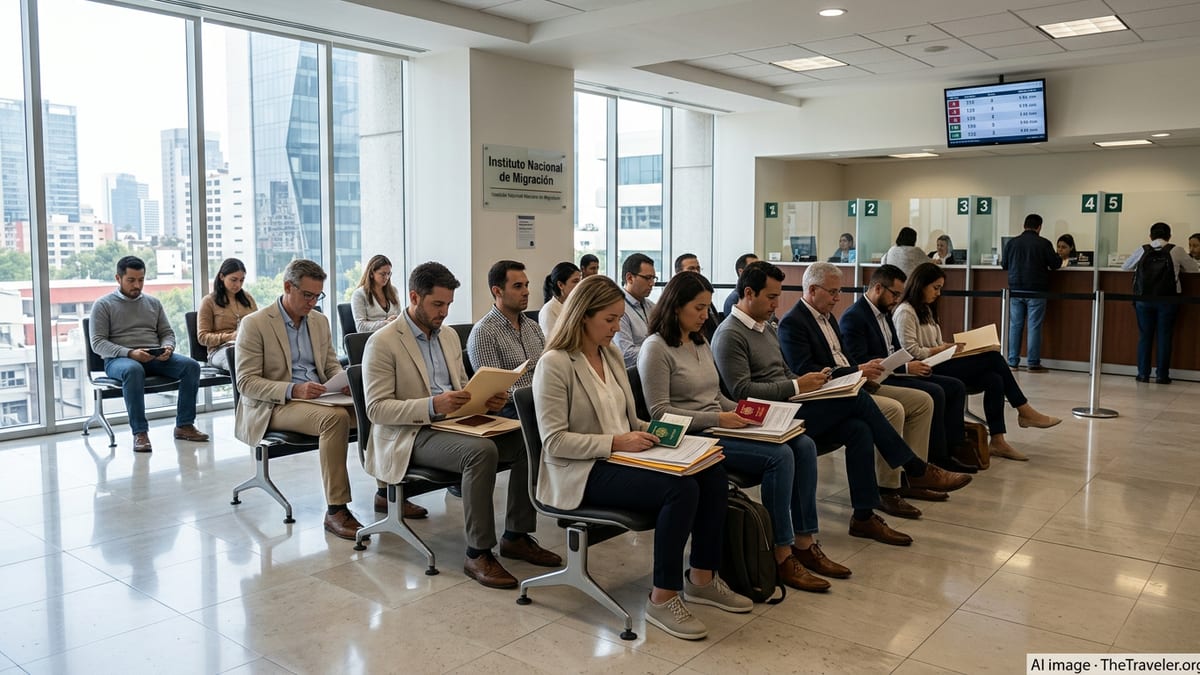
Overview of the Mexico Temporary Resident Visa Framework
The Mexico Temporary Resident Visa allows non-Mexican nationals to reside in the country for longer than 180 days and up to four years, subject to annual or multi-year renewals. It is most commonly used by retirees, remote workers, long-term assignees, and accompanying family members who need a legal basis to remain in Mexico beyond standard visitor status. The visa is issued first as a visa sticker in the applicant’s passport at a Mexican consulate abroad and then converted into a resident card inside Mexico at the National Migration Institute (INM).
The scheme is grounded in the concept of “economic solvency,” which requires applicants to demonstrate sufficient income or savings to support themselves in Mexico without relying on local welfare systems. Although basic criteria are set at federal level, each consulate applies the rules using formula-based thresholds tied to Mexican salary or reference units and then translated to local currency. As a result, applicants face differing nominal income or savings requirements depending on the consulate where they apply.
The Temporary Resident Visa is normally granted for an initial period of up to one year and can be renewed up to a total of four years. After four years of continuous temporary residency, many holders become eligible to transition to permanent residency, again depending on current regulations. For relocation decision-making, the key question is whether an applicant can meet the consulate-specific economic solvency tests and navigate the two-stage process within the validity timelines.
Mexico does not operate a single “digital nomad visa,” but for individuals earning from abroad and not taking local employment, the standard Temporary Resident Visa under economic solvency remains the principal route. This makes the financial criteria and documentation standards particularly critical for remote workers and retirees planning a move.
Core Eligibility Routes to a Temporary Resident Visa
There are several distinct eligibility pathways into the Mexico Temporary Resident Visa category, each with its own evidentiary focus. The most relevant for relocation decisions are economic solvency based on income, savings or investments, family unity with a qualifying sponsor already in Mexico, and employer-sponsored stays through a Mexican entity. Additional subcategories exist for students and certain investment-linked routes, but the underlying visa remains a Temporary Resident Visa.
The economic solvency route is the most widely used. Applicants demonstrate either ongoing monthly income above a consulate-defined threshold or sufficient savings or investment balances over a defined historical period. Current practice at many consulates requires a track record of six to twelve months of qualifying income or an average balance across the previous twelve months for savings or investments. Evidence typically includes bank statements, pension statements, brokerage statements and, where relevant, employer letters confirming remote or foreign-source employment. ([legalclarity.org](https://legalclarity.org/what-are-the-financial-requirements-for-temporary-residency-in-mexico/?utm_source=openai))
Family-based routes allow spouses, common-law partners, minor children, and in some cases parents of Mexican citizens or of foreign residents in Mexico to apply with reduced or differently calculated financial thresholds. In these cases, the economic solvency test is tied to the sponsoring resident’s income or savings, and the applicant must prove the family relationship through marriage, birth, or civil union certificates. Consulates may still apply per-dependent minimums that sponsors must meet to bring accompanying relatives. ([consulmex.sre.gob.mx](https://consulmex.sre.gob.mx/leamington/index.php/non-mexicans/visas/115-temporary-resident-visa?utm_source=openai))
Employer-sponsored temporary residency is typically initiated by a Mexican company with a registered employer number at INM. The employer requests pre-authorization for the foreign national’s stay, and the applicant then completes the visa process at a consulate using the employer’s authorization letter. In practice, even in employer-led cases, consulates may still ask for some financial evidence, though the emphasis is on the employment relationship and corporate documentation rather than private savings.
Economic Solvency: Income and Savings Requirements
The economic solvency rules for the Temporary Resident Visa are set using Mexican salary or reference units, which are adjusted annually. These formulas are then converted by each consulate into local currency figures, which explains why published thresholds differ from one post to another at any given time. Applicants should expect annual increases in nominal requirements in line with adjustments to Mexican minimum wage or the Unidad de Medida y Actualización (UMA) reference. ([mexpath.com](https://mexpath.com/articles/mexico-residency-2026-fees-requirements/?utm_source=openai))
Recent guidance from relocation and immigration advisory sources indicates that for 2025 and into early 2026, many Mexican consulates have been applying Temporary Resident Visa income requirements in the range of roughly 300 days of local reference salary per month. In dollar terms, this often translates into a minimum monthly net income requirement of approximately 2,800 to 4,200 US dollars, depending on consulate and exchange rates. Some detailed 2025–2026 consulate examples show published monthly income thresholds around 2,600 to just over 4,000 US dollars for standard temporary residency under economic solvency. ([dnexpress.org](https://dnexpress.org/es/financial-requirements-temporary-residency-mexico-2025/?utm_source=openai))
An alternative route is to qualify based on savings or investment balances rather than recurring income. In practice, consulates frequently ask to see an average balance across twelve months at or above a threshold derived from around 5,000 to 20,000 days of reference salary. For 2025–2026 this has translated at many posts into indicative balances in the range of roughly 60,000 to 75,000 US dollars in bank or investment accounts, maintained over the previous twelve months. The exact figures vary by consulate and by currency, but the consistent policy trend is that higher and more stable balances are favored. ([legalclarity.org](https://legalclarity.org/what-are-the-financial-requirements-for-temporary-residency-in-mexico/?utm_source=openai))
Consulates also distinguish between principal applicants and dependents. For accompanying family members, the sponsoring applicant may be asked to show additional income or savings per dependent. Some consular examples reference an incremental per-dependent requirement equivalent to several dozen days of reference salary per month. In real terms, spouses and minor children may require the sponsor to demonstrate additional hundreds of dollars per month or a higher savings baseline. Given this variance, families assessing relocation feasibility should model requirements at multiple plausible consulates rather than assuming a single national figure.
Documentation Standards and Consular Variability
Although the core formulas are national, Mexican consulates exercise considerable discretion in how they interpret economic solvency, what types of assets they accept, and how strictly they apply documentation rules. Some posts accept a mix of pensions, salary, rental income, and investment distributions as qualifying income, while others place heavier weight on predictable pensions or salaried roles. Cryptocurrencies, illiquid alternative assets, and precious metals are frequently excluded from consideration. ([legalclarity.org](https://legalclarity.org/what-are-the-financial-requirements-for-temporary-residency-in-mexico/?utm_source=openai))
At a minimum, applicants should expect to provide original or stamped bank statements covering six to twelve months, pension or payroll statements for the same period, and where applicable, employer letters confirming role, remuneration, and the ability to work remotely without providing services to Mexican entities. Several consulates explicitly require stamped or certified statements from financial institutions rather than self-downloaded, unverified digital statements. Inconsistent income across months, large unexplained deposits, or recent one-off transfers into the account may be scrutinized and can lead to refusals even where average balances appear sufficient. ([consulmex.sre.gob.mx](https://consulmex.sre.gob.mx/omaha/images/2025/visasingles/visatemp.pdf?utm_source=openai))
There is also meaningful variability in how consulates treat self-employment, corporate dividends from closely held firms, and retirement accounts such as IRAs or 401(k)-type plans. Some posts are willing to accept retirement investments as savings if they can be clearly documented and valued, while others insist on more liquid assets. This discretionary space means applicants with non-standard financial profiles may find materially different outcomes depending on consulate choice, even where statutory formulas are similar. Reports of applications being denied despite exceeding published thresholds illustrate that economic solvency is a necessary but not always sufficient condition. ([reddit.com](https://www.reddit.com/r/mexicoexpatresidency/comments/1l4047j?utm_source=openai))
Timing is another operational factor. Because Mexico adjusts wage and reference units annually, consulates progressively update their published thresholds during the first part of each year. Applicants planning a move many months ahead should be aware that waiting can increase the nominal thresholds they must meet, especially in years with significant wage hikes. From a planning perspective, earlier application in the calendar year may reduce the risk of facing higher requirements at a later interview date.
Step-by-Step Process: From Consular Application to Resident Card
The Temporary Resident Visa process is two-step. First, the applicant obtains a visa sticker from a Mexican consulate abroad. Second, after entering Mexico using that visa, the applicant exchanges it for a Temporary Resident Card at an INM office within the country. Each step has strict timing and documentation requirements that can affect relocation planning.
Consular processing begins with booking an appointment at a chosen Mexican consulate outside Mexico. Applicants complete a standard visa form, prepare passport photographs, and assemble financial and supporting documents in line with that consulate’s published list. At the in-person appointment, consular staff review documents, conduct a short interview, and either approve, refuse, or hold the application for further review. If approved, the visa is placed in the applicant’s passport as a single-entry document usually valid for up to 180 days to allow entry into Mexico for finalization. ([reddit.com](https://www.reddit.com/r/mexicoexpats/comments/1iui2cs?utm_source=openai))
Upon arrival in Mexico, the traveler must enter as a resident, not as a tourist. This means presenting the consular Temporary Resident Visa at immigration control and making sure it is recorded accordingly. Within a strict period of 30 calendar days from entry, the applicant must visit the appropriate INM office to begin the “canje” process, exchanging the visa for a Temporary Resident Card. Missing this 30-day window can result in fines or the need to restart the process. In practice, many INM offices now operate by appointment, so aligning travel dates with available appointment slots is increasingly important for smooth relocation. ([zisla.com](https://www.zisla.com/en/guide-to-temporary-resident-visa?utm_source=openai))
At INM, applicants submit additional forms, passport copies, photographs, proof of address in Mexico, and payment of government fees that scale with the requested validity period. Processing times vary significantly by office and volume, from a few days to several weeks. During this period, applicants typically receive a processing document and must remain in Mexico or obtain special permission to leave while their resident card is being produced. Once issued, the card functions as proof of lawful temporary residence and allows multiple entries and exits from Mexico during its validity period, subject to compliance with any conditions on work or study.
Validity, Renewal, and Pathway to Longer-Term Stay
A Mexico Temporary Resident Card is generally issued for up to one year on the first issuance, with the possibility of renewal for one, two, or three additional years, not exceeding a cumulative total of four years in temporary status. Government fees are typically lower for shorter periods and higher for multi-year renewals, with adjustments periodically reflecting inflation or policy decisions. Because the underlying financial criteria are reassessed at renewal only in some scenarios, many applicants aim for longer renewal periods when possible to lock in their status and limit repeated administrative steps. ([yucalandia.com](https://yucalandia.com/answers-to-common-questions/new-rules-and-procedures-for-immigration-visiting-and-staying-in-mexico/?utm_source=openai))
After four consecutive years in temporary status, many residents can transition to permanent residency, removing the need for further renewals and in some cases easing travel and work restrictions. However, the precise conditions for transitioning, and whether further financial evidence is required at that stage, depend on contemporary regulations and INM practice. Applicants who anticipate a long-term stay should therefore view the Temporary Resident Visa both as a stand-alone medium-term solution and as a potential precursor to a permanent category, but not assume automatic conversion without review.
It is important to distinguish between the visa sticker’s validity and that of the resident card. The consular visa is generally single-entry and limited to allowing entry and initial processing. Once exchanged, the card becomes the operative document. Leaving Mexico before obtaining the card or without following exit procedures applicable to residents can disrupt or even void temporary resident status. For individuals with time-sensitive relocation schedules, including corporate transferees and families moving on fixed school calendars, careful sequencing of consulate appointments, travel dates, and INM visits is critical.
From a practical planning standpoint, potential residents should allow for several weeks to months from first consulate appointment availability to final issuance of the Temporary Resident Card, with contingency time built in for possible appointment scarcity, document clarification requests, or backlogs at busy INM offices. This lead time can materially influence the feasibility and timing of a planned move.
The Takeaway
The Mexico Temporary Resident Visa is a structured but financially selective route for medium-term relocation. Its core concept is economic solvency, operationalized through monthly income or savings thresholds calculated from Mexican reference values and then translated by consulates into local currency requirements. For 2025 and early 2026, many consulates have applied thresholds that, in dollar terms, fall into mid to high four-figure monthly income ranges or savings balances in the tens of thousands, with notable differences between posts and year-on-year increases.
Beyond raw numbers, consular discretion, documentation quality, and consistency of financial history play a decisive role in approval outcomes. Applicants whose income is irregular, self-employed, or heavily investment-based may experience more scrutiny than retirees with straightforward pensions or employees with stable salaries. In parallel, rigid timelines between visa issuance, entry to Mexico, and the 30-day INM window can introduce operational risk if not planned carefully.
For relocation decision-making, the key assessment is whether the household can sustainably meet the relevant consulate’s income or savings benchmarks, assemble documentation to the standard expected, and accommodate the administrative timelines involved. Those who can do so will generally find that the Temporary Resident Visa provides a predictable legal framework for living in Mexico for up to four years and, potentially, for progressing to a more permanent status in the future, subject to evolving regulations.
FAQ
Q1. What is the main purpose of the Mexico Temporary Resident Visa?
The Mexico Temporary Resident Visa is designed for foreign nationals who intend to live in Mexico for more than 180 days and up to four years, without immediately obtaining permanent residency, and who can demonstrate sufficient economic solvency to support themselves during that period.
Q2. How much income is typically required to qualify for a Temporary Resident Visa?
There is no single nationwide figure, but many consulates currently apply formulas that translate into roughly 2,800 to 4,200 US dollars per month in net income for a single applicant, with exact thresholds varying by consulate, year, and exchange rate.
Q3. Can savings or investments be used instead of monthly income?
Yes, most consulates allow applicants to qualify based on savings or investment balances, typically requiring an average balance over the previous twelve months that often falls in the approximate range of 60,000 to 75,000 US dollars or equivalent, subject to local formulas and currency movements.
Q4. How long a financial history do I need to present?
Consulates commonly require six to twelve months of bank, pension, or investment statements for income-based applications, and around twelve months of statements for savings or investment-based applications, with an emphasis on stable and well-documented funds.
Q5. Can I start the Temporary Resident Visa process after arriving in Mexico as a tourist?
In most cases, the process must begin at a Mexican consulate outside Mexico, where the Temporary Resident Visa is issued in the passport. The in-country step at INM is for converting that visa into a resident card, not for initiating the application from scratch.
Q6. How soon after entering Mexico do I need to apply for the Temporary Resident Card?
After entering Mexico using the Temporary Resident Visa, applicants are generally required to start the canje process at the National Migration Institute within 30 calendar days of arrival to avoid fines or process complications.
Q7. How long is the Temporary Resident Card valid, and can it be renewed?
The card is usually issued initially for up to one year and can be renewed so that the total time in temporary status does not exceed four years. Renewals may be granted for one to three years at a time, subject to current rules and payment of corresponding fees.
Q8. Does holding a Temporary Resident Visa automatically lead to permanent residency?
No, but after up to four years in temporary status, many residents become eligible to apply for permanent residency. Approval is not automatic and depends on satisfying the regulations and evidentiary requirements in force at the time of application.
Q9. Are financial requirements different for family members?
Yes, accompanying spouses, partners, and children typically rely on the main applicant’s or sponsor’s economic solvency, with consulates often requiring additional income or savings per dependent. The precise per-dependent amounts vary by consulate and category.
Q10. Do all types of assets count toward the economic solvency requirement?
No, consulates generally prioritize liquid and well-documented assets such as bank deposits, pensions, and mainstream investments. Cryptocurrencies, precious metals, and certain illiquid or hard-to-verify assets are often excluded or given limited weight, so applicants should not rely on them as primary proof of solvency.