

More news on this day
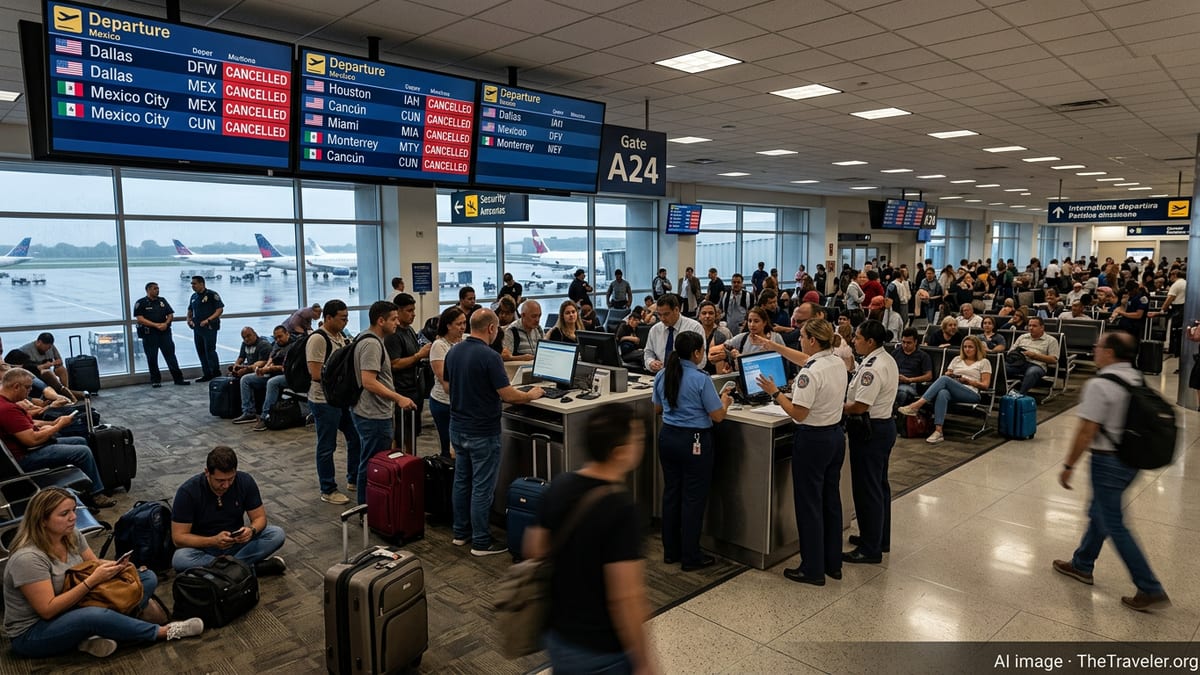
Travel between Mexico and the United States has been thrown into fresh turmoil in recent weeks, as cartel violence, security operations and sudden airspace closures trigger a spike in flight cancellations and delays on key cross-border routes.
Get the latest news straight to your inbox!
Cartel Violence Triggers Wave of Airport Disruptions
The latest round of unrest was sparked on February 22 2026, when Mexican security forces killed alleged Jalisco New Generation Cartel leader Nemesio Rubén Oseguera Cervantes in an operation in the state of Jalisco. In the hours that followed, cartel gunmen mounted highway blockades, burned vehicles and clashed with authorities across western Mexico, particularly around Guadalajara and the Pacific resort of Puerto Vallarta.
While no commercial terminals were directly attacked, the violence quickly rippled into aviation. Puerto Vallarta International Airport reported that all international flights and most domestic services were cancelled at the height of the crisis, effectively cutting off one of Mexico’s busiest winter sun gateways from the United States and Canada. Airlines cited uncertainty over access roads, staff safety and the risk of passengers being caught in nearby confrontations.
Further east, Cancún International Airport also experienced knock-on disruption on February 22 and 23, with dozens of flights delayed or cancelled amid wider security concerns. Although the incidents were concentrated in western states, the images of burning buses and armed patrols circulating on social media unsettled travelers headed for beach resorts across the country and added new friction to already complex winter operations.
Guadalajara International Airport remained technically open, but carriers trimmed schedules as road closures and sporadic violence made it difficult for passengers and crew to reach the terminal. Logistics operators reported suspending bonded trucking links on some cross-border routes, deepening the sense of a transport system under strain.
US Airlines Slash Mexico Services and Issue Waivers
For US airlines, the unrest has translated into an unusual midseason shake-up. Major carriers including American, Delta, United and Alaska temporarily halted or reduced flights to Puerto Vallarta at the peak of the violence, while select services to Guadalajara were also cancelled or consolidated. Low cost operators with strong Mexico networks, such as Volaris, Viva Aerobus and Frontier, scrambled to rebook passengers or reroute them through Mexico City and other hubs.
United Airlines introduced a civil unrest travel waiver for Jalisco, covering tickets to and from Guadalajara and Puerto Vallarta. The policy, extended through late March, allows customers to change dates or shift to alternative Mexican destinations without standard change fees, although fare differences may still apply. Similar though less publicized flexibility measures have been rolled out by other US carriers for affected routes.
Industry trackers estimate that in the three days following February 22, several hundred flights on US and Canadian routes to Mexico were cancelled outright, with many more delayed or rerouted. Puerto Vallarta shouldered the heaviest blow, at one point seeing more than half its scheduled arrivals and departures scrubbed. Travel agents report that some nervous US vacationers have opted to switch to Caribbean islands or domestic beach destinations rather than rebook immediately for Mexico’s Pacific coast.
The cancellations are landing at a sensitive moment for airlines planning capacity around the 2026 World Cup, when Guadalajara and nearby resort areas are expected to play a central role in hosting visiting fans. Security analysts warn that any perception of persistent instability could complicate long term scheduling and pricing decisions on Mexico bound routes.
Border Airspace Closures Add New Layer of Uncertainty
The turbulence is not confined to Mexican territory. In early February, the US Federal Aviation Administration abruptly imposed a temporary flight restriction over the El Paso region of Texas and southern New Mexico, effectively halting commercial and cargo flights for several hours. Officials later linked the extraordinary step to concerns over cartel operated drones that had breached or approached US airspace near the border.
Although the airspace was reopened in less than half a day and subsequent reviews concluded there was no ongoing threat to commercial aviation, the episode underscored how quickly regional security incidents can cascade into large scale disruption. For several hours, passengers on cross border itineraries involving El Paso faced cancellations, diversions and missed connections, adding to the impression of a corridor increasingly vulnerable to sudden shutdowns.
The El Paso closure was one of several recent security related flight restrictions affecting the broader region. In January, the FAA issued advisories urging US operators to exercise caution over portions of the eastern Pacific and the Gulf of California, citing military activity and interference with satellite navigation signals. While regulators stressed that scheduled flights could continue, the warnings added another layer of risk calculations for dispatchers overseeing Mexico and Central America operations.
Taken together, the unrest on the ground in western Mexico and the tightening of security scrutiny along the border have highlighted the fragility of air connectivity between the two countries at a time when demand for leisure and family travel remains robust.
Travelers Face Stranded Holidays, Rising Costs and Confusion
For travelers caught mid journey, the impact has been immediate and deeply personal. In Puerto Vallarta, thousands of tourists found themselves stranded when outbound flights to US cities such as Los Angeles, Dallas, Denver and Seattle were abruptly taken off the boards. Long queues snaked through terminals as visitors competed for scarce rebooking options, with some families turned away from check in counters after overnighting on airport floors.
On the US side, confused passengers at hubs like Los Angeles International and Houston Intercontinental described checking in for Mexico bound flights only to learn, often at the gate, that their services had been cancelled due to events hundreds of miles away. With school holidays underway, last minute replacement tickets to alternative sun destinations quickly climbed in price, making re-routing an expensive proposition for budget conscious travelers.
Even when flights operate, heightened security procedures and uncertainty over access roads have lengthened journey times. Travelers to affected Mexican states are being urged to arrive at airports earlier than usual, monitor airline apps closely and maintain flexible ground transport plans in case of sudden roadblocks or police checkpoints. Consular officials from the United States and Canada have advised citizens to stay in contact through official alert systems and to keep contingency funds for emergency accommodation or alternative routes home.
In resort zones where the violence has been distant, hoteliers and local tourism boards are trying to reassure visitors that beaches and downtown areas remain calm. Yet bookings data shared by agents in the United States suggest a short term dip in new reservations for some Pacific Coast destinations, even as Caribbean favorites such as Cancún and the Riviera Maya work to differentiate themselves from the western unrest.
Outlook: Fragile Normalization and Persistent Security Jitters
By early March, Mexican authorities and airport operators reported that flight schedules to Puerto Vallarta, Guadalajara and other major gateways had largely returned to normal. Roadblocks have been cleared from key access routes and the most visible confrontations have subsided, allowing airlines to restore regular operations and lift some temporary suspensions.
However, the recent chaos has left a lingering sense of vulnerability in a market that has become one of North America’s most important leisure corridors. Aviation insurers, route planners and security consultants are reassessing risk models for western Mexico, weighing the likelihood of further flare ups as rival groups vie for influence in the vacuum left by the Jalisco cartel leader’s death.
With the 2026 World Cup and peak holiday seasons approaching, both Mexican and US authorities face mounting pressure to demonstrate that airports, approach roads and airspace can be secured against spillover from organized crime. Airlines, for their part, are signaling that they will not hesitate to cancel services or adjust schedules again if on the ground conditions deteriorate, even at the cost of short term revenue.
For now, travelers considering trips between the United States and Mexico are being urged to build in flexibility, stay informed about local developments and recognize that, despite the restoration of flights, the corridor remains susceptible to sudden and sometimes dramatic disruption.