

More news on this day
Post-Easter travel turbulence extended into Monday at Miami International Airport, where a total of 206 flight disruptions on April 7 rippled through already strained U.S. air travel networks.
Get the latest news straight to your inbox!
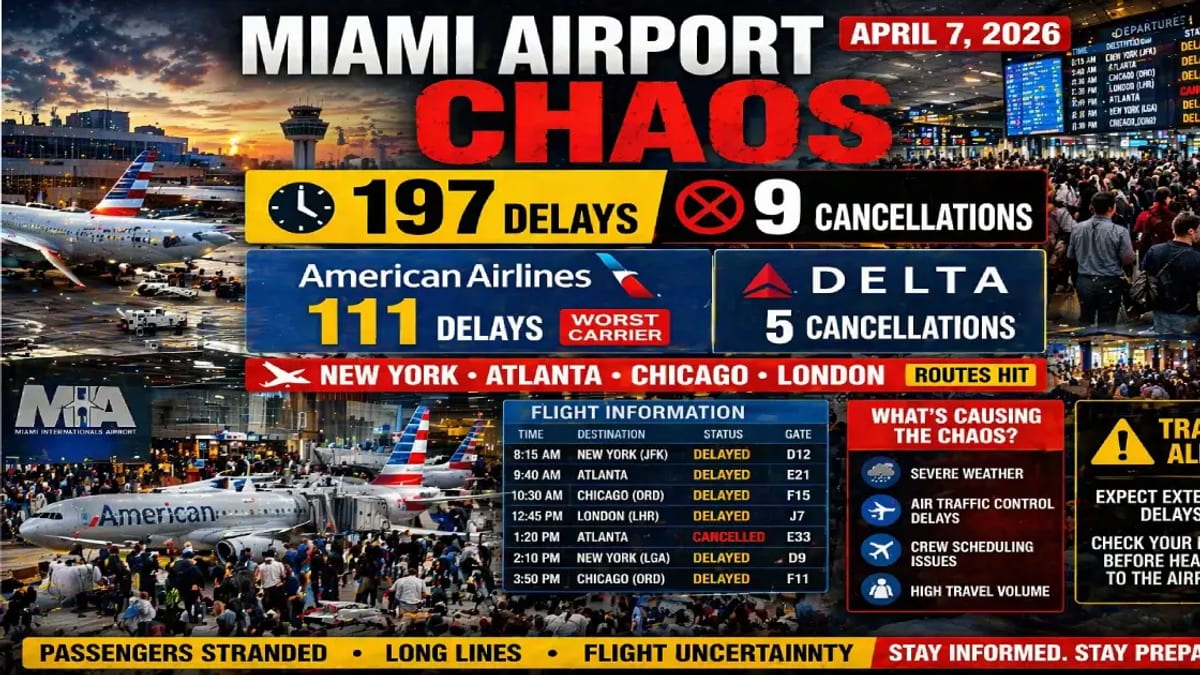
Disruption Tally: 197 Delays and 9 Cancellations
Publicly available flight-tracking data compiled in industry coverage indicates that Miami International Airport recorded 197 delays and 9 cancellations on April 7, bringing the disruption count to 206 movements affected in a single day. Those figures placed the airport among a cluster of busy U.S. hubs still working through the operational hangover from the Easter holiday rush.
The disruptions were spread across both domestic and international operations. American Airlines reportedly accounted for the largest share, with more than one hundred delayed departures and arrivals and a handful of cancelled flights. Delta Air Lines, Frontier, Spirit, Southwest and United also reported measurable slowdowns, alongside European and Latin American carriers that logged shorter but still noticeable delays.
Although the majority of affected flights eventually departed, the volume of schedule changes translated into rolling queues at gates, crowded hold rooms and longer waits for baggage. For many travelers, the visible outcome was less about outright cancellations and more about incremental delays that stacked up across the day.
Industry reports suggest that, in percentage terms, Miami’s disruption rate on April 7 remained moderate compared with some weather-hit airports over the long weekend. However, the combination of high passenger volumes and a tightly timed schedule meant that even modest delays created an outsized sense of congestion inside the terminal complex.
Fallout From a Turbulent Easter Weekend
The problems at Miami formed part of a wider pattern that emerged over the Easter travel period, when severe spring storms and holiday crowds strained the aviation system across the United States. National flight-tracking summaries for the Easter weekend pointed to tens of thousands of delays and several thousand cancellations as carriers struggled with weather, air-traffic constraints and crew positioning.
By Easter Monday, many airports were still clearing backlogs. Data compiled in international travel and aviation reports shows that more than 13,000 flights were delayed globally on April 6, with hundreds of those affecting services within, into or out of the United States. Disruption lingered into April 7, particularly at high-traffic hubs where bad weather and congestion had already stretched schedules thin.
Miami’s role as a major connecting point for Latin American and Caribbean routes amplified the effect. When storms or congestion elsewhere in the network throw off arrival times, knock-on delays often show up at MIA hours later, as inbound crews and aircraft arrive behind schedule. Industry analysis of the weekend’s performance points to this cascading effect as a key driver of the 206 disruptions logged at the airport.
Despite this, federal aviation status boards on April 7 still described operations at Miami as broadly “on time,” underscoring the gap that can exist between headline system indicators and the more granular reality experienced by travelers navigating full flights and compressed turnaround windows.
Airlines, Routes and Passengers Most Affected
Within the overall disruption count, certain airlines and routes drew particular attention. American Airlines, the dominant carrier at Miami International Airport, recorded the largest absolute number of delayed flights, reflecting its dense schedule of domestic and international operations from the hub. Delta registered close to two dozen delays and several cancellations, while low-cost operators such as Frontier, Spirit and Southwest each posted a smaller but still meaningful tally.
Coverage of the day’s operations points to wide-ranging impacts on routes linking Miami with New York City, Atlanta, Chicago and other major North American gateways, as well as key European and Latin American destinations served by Air France, Lufthansa, Iberia and LATAM. While most of these services operated eventually, late departures pushed some connections uncomfortably close to their booked times and forced rebookings for passengers who missed onward flights.
Travelers on early morning departures appeared to fare slightly better, with fewer knock-on effects from late-arriving aircraft. As the day progressed, however, the accumulation of minor schedule slips made delays more common, particularly in the busy late-afternoon and evening waves. For passengers, that translated into longer dwell times in crowded concourses and uncertainty at departure gates as new estimates were posted.
Reports from aviation data analysts indicate that the pattern at Miami mirrored conditions at other large U.S. hubs, where the end of a peak holiday period left airlines with little slack to absorb weather or air-traffic-related interruptions. The result was a patchwork of inconvenience that stopped short of a full-blown meltdown but still disrupted travel plans for thousands of people moving through South Florida.
Staffing, Infrastructure and a Strained Ground Experience
The flight disruptions unfolded against a backdrop of broader operational pressure at Miami International Airport. In recent weeks, national coverage has highlighted the impact of a partial federal government shutdown on Transportation Security Administration staffing, with screening officers at large hubs stretched by high volumes and pay uncertainty. Although publicly reported wait times at MIA on the day after Easter pointed to sub-15-minute averages at checkpoints, travelers have described uneven experiences depending on time of day and terminal.
Beyond security, Miami’s own infrastructure challenges continue to shape the passenger journey. Local reporting in early April detailed how a software glitch affecting the airport’s parking payment system earlier in the year stranded drivers at self-service kiosks and forced staff to temporarily open exit gates. While that issue has since been resolved, it underscored the sensitivity of the airport’s landside operations to even limited technical failures.
Inside the terminal, Miami-Dade County is in the midst of a multibillion-dollar modernization program that includes upgrades to boarding bridges, concourses and more than two hundred restrooms. Official planning documents describe this work as essential to handling projected passenger growth over the coming decade, but the construction activity can also contribute to congestion when crowd flows are rerouted or facilities are temporarily offline.
On a day like April 7, when more than two hundred flights are disrupted and passenger volumes remain high after a holiday period, these infrastructure and staffing factors intersect. The end result is longer walks along busy concourses, fuller waiting areas and a general sense of overcrowding that amplifies the impact of every gate change or delay announcement.
What the April 7 Chaos Signals for Summer Travel
The 206 flight disruptions recorded at Miami on April 7 offer an early glimpse of the challenges that could resurface during the upcoming summer peak. Aviation industry commentators note that even as airlines refine schedules and federal agencies adjust staffing, the underlying pressures of high demand, volatile weather and limited spare capacity remain in place.
Travel performance data from previous years shows that Miami International Airport consistently handles millions of passengers each month during the spring and summer, with traffic reports indicating robust growth through 2024 and 2025. As more carriers add capacity and new international routes, the system becomes more complex and more vulnerable to shock when storms, technical issues or labor constraints emerge.
For now, the operational picture at Miami appears to be stabilizing after the Easter surge, with flight-status boards on April 7 and 8 showing a predominance of on-time movements. Yet the lingering impacts felt by travelers caught up in Monday’s delays are likely to influence how people plan trips in the coming months, from arriving earlier at the airport to building longer connection windows through major hubs like MIA.
Travel-industry analysts suggest that the April 7 chaos is less an isolated incident and more a preview of how tightly wound the aviation network has become. When demand is strong and buffers are thin, a single stormy holiday weekend can echo through airports such as Miami long after the Easter eggs are gone from departure lounges.