

More news on this day
Miami International Airport is moving ahead with a sweeping expansion and modernization drive that places it firmly in the same league as Dallas Fort Worth and Los Angeles International, where multibillion-dollar capital programs are reshaping how some of the nation’s busiest hubs handle soaring passenger demand.
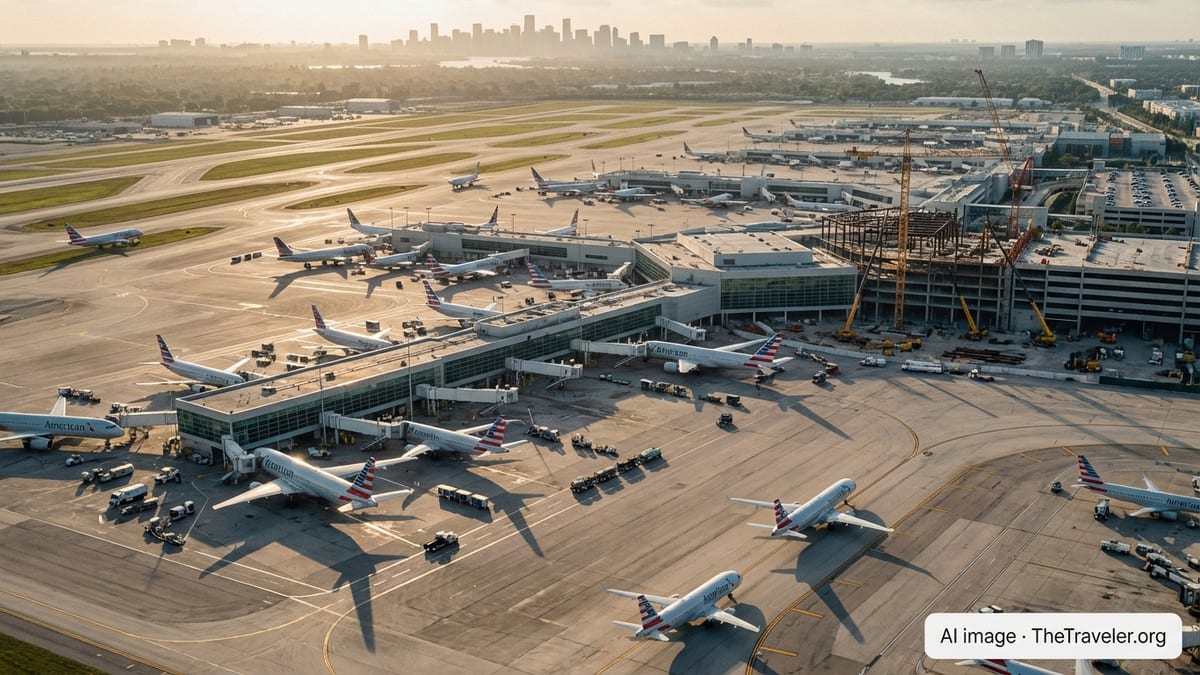
Miami Bets Big on Gates, Hotels and Ground Access
Miami International Airport is in the midst of one of the most ambitious overhauls in its history, backed by a capital program that now totals about 9 billion dollars in planned improvements. Airport officials expect traffic to reach roughly 56 million passengers once full 2024 figures are tallied, up from a record 52.3 million in 2023, straining facilities that were largely designed for a different era of air travel.
New projects are proliferating across the airport campus. A 136 million dollar Flamingo Garage expansion, adding 2,240 parking spaces, is under construction and scheduled to open by the end of 2025, aimed at easing congestion at one of the most parking constrained major hubs in the country. A 350 million dollar on airport Westin hotel, slated to break ground at the terminal entrance and open in 2027, is designed to capture high yielding business and international transit traffic that currently disperses into the wider Miami market.
Inside the terminal complex, Miami Dade County leaders are advancing a recommendation for a 750 million dollar Concourse K on the South Terminal, which would be the first terminal expansion since 2012. If approved this year, the three level concourse would add six new contact gates by 2029, giving the airport more flexibility to accommodate both domestic and long haul international aircraft. Officials frame these projects as essential to keeping pace with Miami’s transformation into a year round global gateway rather than a purely seasonal sun destination.
American Airlines Drives a New Wave of Gate Expansion
The latest and most eye catching development at Miami centers on Concourse D, the beating heart of American Airlines’ operation. Airport officials have unveiled a 1 billion dollar project that will completely remake a portion of the concourse currently used for ground level boarding of regional jets, converting it into 17 full contact gates capable of handling larger mainline aircraft. Each gate will feature its own hold room and modern boarding facilities, replacing a single shared boarding area that has long been a pinch point in the customer experience.
The Concourse D expansion is closely tied to American’s growth strategy at its largest Latin America and Caribbean gateway. The carrier already operates close to 400 daily flights and accounts for more than 60 percent of the airport’s traffic, and it has been steadily increasing seats with new routes to Europe, Mexico, the Caribbean and Central America. Industry filings show that the new gates are expected to support a record summer schedule and future long haul additions that require more jet bridge capable positions and efficient aircraft turns.
Construction on the Concourse D project is targeted to begin in 2027 with completion around 2030, aligning with Miami’s broader modernization timelines and phasing plans. Combined with the proposed Concourse K and a suite of smaller terminal refurbishments under the Modernization in Action initiative, Miami is effectively replatforming its hub operation to offer the kind of seamless connections and premium facilities travelers increasingly associate with the country’s most competitive mega hubs.
Dallas Fort Worth Builds a Sixth Terminal to Match Regional Growth
While Miami densifies its existing terminal footprint, Dallas Fort Worth International is physically expanding the size of its campus with a new sixth terminal. Construction of the 1.6 billion dollar Terminal F is under way, marking the first entirely new terminal at DFW since Terminal D opened in 2005. The facility’s 400,000 square foot concourse will initially house about 15 gates, with a layout that allows the airport to add more in future phases as demand warrants.
DFW officials have embraced an innovative modular construction strategy to keep the fast tracked project on schedule and minimize disruption in one of the world’s busiest connecting hubs. Six massive prefabricated modules, some approaching the length of a football field, have already been built off site and moved across the airfield using specialized transporters to form the framework of the new concourse. With the modules now in place, the project has shifted into a more traditional build out phase focused on interior systems and finishes.
The Terminal F program also includes more than 100,000 square feet of new check in, security and baggage claim space as part of an expansion of Terminal E that will support passengers flying in and out of the new facility. Combined with growing lounge offerings, including new independent clubs slated to open in 2026, the expansion underscores how DFW is scaling up to serve both North Texas population growth and rising connecting traffic across the central United States and beyond.
Los Angeles International Pushes Ahead With Multi Billion Dollar Overhaul
On the West Coast, Los Angeles International is several years into a multibillion dollar modernization program that rivals or exceeds the investment levels seen at Miami and Dallas Fort Worth. The program includes a new automated people mover train system, a consolidated rental car facility and major terminal projects that will add more than two million square feet of passenger space, highlighted by a planned Terminal 9 and an additional Concourse 0.
The automated people mover, whose guideway structure has been completed, is a keystone of the effort to untangle LAX’s famously congested road system. Once fully in service, the train is expected to link terminals with off airport parking, rental car and transit facilities in a way that reduces curbside traffic and shortens connection times. Airport managers view this as the necessary backbone for the terminal expansions that follow.
Terminal 9 and Concourse 0, scheduled to be phased in through the latter half of this decade, will give LAX new clusters of gates dedicated to both domestic and international flights. These additions come on top of earlier work on the Midfield Satellite Concourse and ongoing renovations of nearly every existing terminal. Together, the projects are intended to maintain LAX’s standing as Southern California’s primary long haul gateway while answering local concerns about congestion, air quality and noise through more efficient operations and updated infrastructure.
Competing Mega Hubs Reset the Bar for Travelers
The rapid pace of construction at Miami, Dallas Fort Worth and Los Angeles points to a broader trend in how major U.S. hubs are positioning themselves for the next decade of air travel. Each airport is experiencing a rebound and then some from the pandemic era downturn, with passenger volumes returning to or surpassing previous records, and with airlines eager to capture premium customers and long haul connectivity.
For travelers, the payoff will come in the form of more gates, more flights and a smoother end to end journey, from parking and hotel check in to security screening and boarding. Miami’s new concourses and hotel are designed to improve the experience for international connections to Latin America and the Caribbean. DFW’s Terminal F will give carriers more flexibility to bank departures and arrivals across time zones. LAX’s rail and terminal projects promise to make it easier to navigate what has historically been one of the country’s most challenging airport layouts.
At the same time, these mega projects highlight the competitive pressures facing large hubs, which must balance construction impacts, financing costs and evolving airline strategies. Miami’s aggressive expansion of American’s fortress hub, DFW’s bet on modular building for scale and speed, and LAX’s push to reconfigure ground access all illustrate different approaches to the same challenge: keeping some of the busiest gateways in the United States aligned with the expectations of passengers and airlines in a period of sustained growth.