

More news on this day
Miami International Airport is pushing ahead with one of its most ambitious modernization projects yet, unveiling a $1 billion expansion of Concourse D that will add 17 new gates, elevate the passenger experience, advance sustainability goals and position the hub for strong long-term growth.
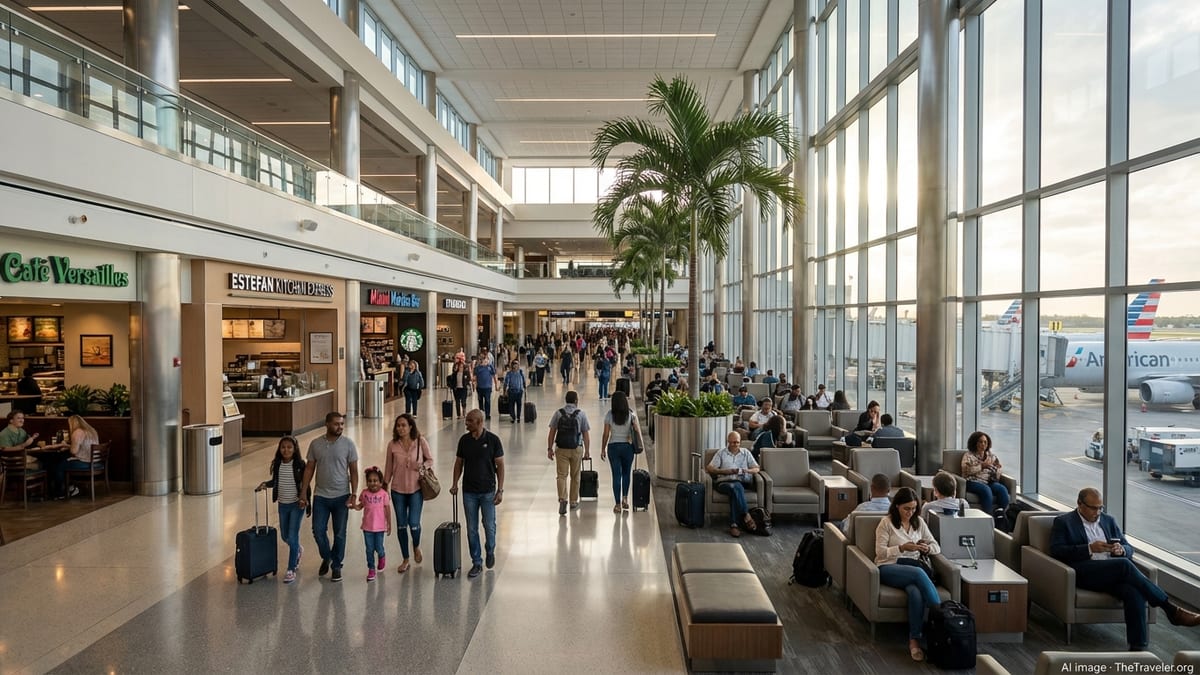
Transforming Concourse D for a New Era of Travel
The Concourse D project centers on the D60 area at Miami International Airport’s North Terminal, long viewed as one of the airport’s most constrained gate zones. Today, the space primarily serves smaller regional aircraft using ground-level boarding and shared waiting areas. Under the newly announced plan, that footprint will be transformed into a three-level extension built to handle larger regional jets and single-aisle mainline aircraft.
The redesigned concourse will introduce 17 fully equipped gates with traditional jet bridges, effectively eliminating outdoor boarding in this section of the terminal. Each gate will have its own dedicated waiting area, replacing the single shared hold room that often led to crowding and operational bottlenecks during peak periods. Airport officials and American Airlines executives say this change will streamline boarding, reduce delays linked to ramp congestion and improve the overall flow of passengers through Concourse D.
Construction is expected to begin in 2027, with completion targeted around 2030, aligning with Miami International Airport’s broader multiyear Modernization in Action capital program. The project is being presented not as a cosmetic refresh, but as a structural reconfiguration of one of the airport’s most critical operational nodes, designed to meet rising demand across both domestic and international markets.
Elevating the Passenger Experience From Curb to Gate
Beyond increasing gate capacity, the Concourse D expansion is being framed as a major passenger experience upgrade. New gate areas will feature higher ceilings, abundant natural light and open sightlines, aiming to ease congestion and give travelers more room to move, relax and work. Renderings highlight indoor palm trees and warm finishes that echo South Florida’s environment, signaling a push to make the concourse feel more like a welcoming civic space than a purely functional processing area.
The extension will add substantial concession and lounge space, including around 30,000 square feet each for retail and food and beverage, according to early planning figures. That will support a new mix of shops, restaurants and premium lounges, building on recent airport-wide agreements that call for a significant refresh of MIA’s dining and retail line-up. Airport leaders say they want Concourse D to showcase a blend of global brands and local Miami concepts, giving passengers a stronger sense of place even on short connections.
Technology will also feature prominently. Plans call for expanded self-service options, including bag-drop, check-in kiosks and biometric screening in partnership with federal agencies. These tools are intended to shorten lines at key choke points, particularly during the busy morning and evening bank of departures that define Miami’s role as a major connecting hub for Latin America and the Caribbean.
Building in Sustainability and Smarter Infrastructure
The Concourse D expansion is being developed in line with Miami International Airport’s broader sustainability ambitions, which include replacing aging infrastructure with more energy-efficient systems and materials. The new three-level facility is expected to incorporate advanced insulation, efficient glazing and modern lighting and climate-control technologies designed to reduce energy use while keeping terminal spaces cooler in Miami’s subtropical climate.
Behind the scenes, the project will introduce a modern baggage handling system and updated support infrastructure that should cut down on maintenance-intensive legacy equipment. This ties into the airport’s wider effort to renew hundreds of elevators, escalators and moving walkways and to upgrade boarding bridges with newer designs that are lighter, more durable and more energy efficient than older steel structures.
Officials have linked the Concourse D work to the airport’s long-term goal of accommodating more passengers without proportionately increasing its environmental footprint. By consolidating regional operations into a more efficient vertical layout, the expansion is expected to make better use of apron space and reduce the need for bus transfers and other ground movements that add emissions and complexity.
Strategic Hub Growth and Economic Impact
For American Airlines, which operates the vast majority of flights at Miami International Airport, the Concourse D project is a strategic bet on the long-term strength of its Miami hub. The carrier already runs close to 400 daily departures at the airport and serves more than 150 destinations across over 40 countries, with Miami acting as one of the primary gateways between the United States, Latin America and the Caribbean.
By converting ground-level regional stands into fully capable jet bridge gates for larger aircraft, American gains new flexibility to upgauge routes and adjust its schedule as demand grows. The expansion is expected to improve turnaround reliability, provide more resilience during irregular operations and support additional long-haul and high-frequency services that depend on tight connection windows.
Miami International Airport itself continues to post robust traffic growth, with passenger volumes climbing well above pre-2019 levels and cargo tonnage hitting repeated records. Local officials view the Concourse D investment as part of a broader economic development story, citing the airport’s role as a major employer and an engine for tourism, trade and business across South Florida. The new concourse is projected to support thousands of construction and permanent jobs, while helping secure Miami’s status as one of the country’s leading international gateways.
Part of a $9 Billion Roadmap for Miami’s Future
The Concourse D expansion slots into a sweeping, roughly $9 billion program to modernize Miami International Airport over the next decade. That plan includes replacing or refurbishing passenger boarding bridges across the airfield, renovating nearly 200 public restrooms, upgrading conveyance systems and adding new parking and terminal capacity, including a future Concourse K project later in the decade.
Recent moves, such as a long-term retail and dining contract extension with a major concessions operator, are intended to ensure that commercial offerings keep pace with terminal upgrades. As more areas of the airport are refreshed, leaders say passengers should see a more consistent standard of design, cleanliness and service from the moment they arrive at the curb, through security and onto their flights.
With the D60 project now formally unveiled, Miami International Airport and American Airlines are signaling that the next phase of growth will be built around more comfortable spaces, smarter infrastructure and a stronger sustainability profile. If construction stays on schedule and demand continues to rise, the reimagined Concourse D is set to play a central role in how millions of travelers experience Miami by the end of the decade.