

More news on this day
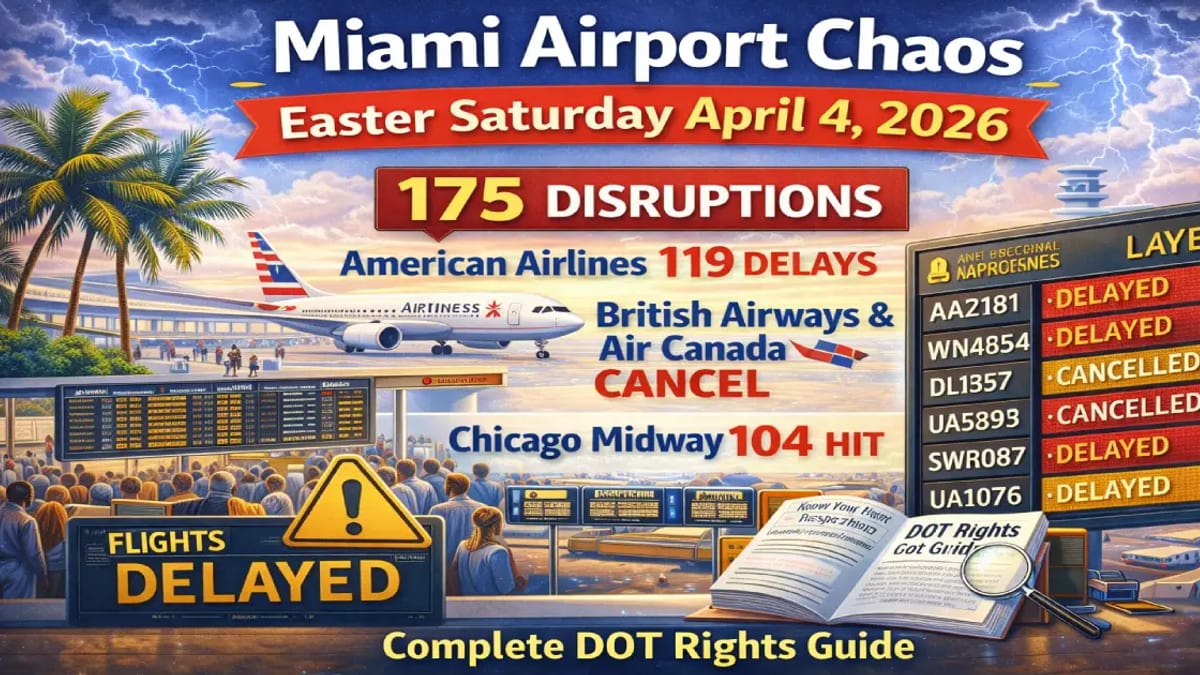
Miami International Airport passengers faced a fraught start to Easter weekend on Saturday, April 4, 2026, as publicly available flight-tracking data pointed to about 175 combined cancellations and delays, triggering crowded concourses, rolling schedule changes and mounting frustration for travelers moving through one of the nation’s busiest holiday gateways.
Get the latest news straight to your inbox!
Holiday surge meets fragile spring operations
The Easter Saturday disruption unfolded against a backdrop of elevated holiday traffic and a spring travel system already operating near capacity. Miami International Airport typically handles millions of passengers in April, and early-season traffic reports indicate volumes trending close to or above recent years, leaving little slack when schedules begin to slip.
National aviation coverage in recent days has highlighted how a mix of unsettled weather patterns, tight aircraft rotations and lingering staffing constraints has translated into rolling pockets of disruption across the United States. When those pressures intersect with a peak holiday weekend at a major hub such as Miami, even a few dozen problem flights can rapidly multiply into more than a hundred affected services.
Aggregated tracking dashboards for April 4 show that the approximately 175 disrupted flights at Miami represented only a fraction of nationwide issues, but the concentrated impact at a single hub meant long lines at check-in counters and customer-service desks, as passengers sought rebooking options or tried to salvage tight connections.
While Miami itself avoided severe local storms on Saturday, operational analysts often point to how conditions at distant hubs can ripple through coastal airports. Aircraft and crews arriving late from weather-affected or congestion-prone cities can quickly push outbound Miami departures behind schedule, particularly for carriers that rely on complex hub-and-spoke networks.
Carriers juggle cascading delays and cancellations
According to publicly available arrival and departure boards for April 4, the disruption at Miami International involved a cross-section of domestic and international services, with morning irregularities spilling well into the afternoon. Several major U.S. and foreign carriers appeared on delay lists, reflecting the interconnected nature of airline networks rather than a single-operator failure.
Reports from national travel and consumer outlets in the lead-up to Easter described airlines across the country already working through residual delays from earlier spring weather and operational snags. That fragile recovery meant that Saturday’s issues at Miami did not remain isolated, as late-arriving aircraft forced airlines to reshuffle equipment, adjust crew pairings and, in some cases, cancel rotations outright.
Industry commentary in recent months has underscored how even seemingly modest schedule shocks can become difficult to absorb when fleets are tightly utilized. With aircraft spending more time in the air and less time on the ground, there is reduced margin to recover from an early-morning delay before the busy evening departure banks that are typical at a south Florida hub.
For travelers, the practical effect on Easter Saturday was a familiar pattern of rolling departure-time revisions, gate changes and, for those on canceled flights, extended waits in booking queues as agents worked through large backlogs of disrupted itineraries spanning multiple airlines and alliance partners.
Passenger experience: long queues and missed connections
Social media posts and anecdotal accounts shared via travel forums on Saturday described crowded departure halls, with some passengers reporting extended waits at airline counters as they tried to secure alternative routings. Families traveling for the holiday weekend and international flyers connecting to the Caribbean and Latin America appeared particularly affected by the cluster of cancellations and long delays.
Miami’s role as a key bridge between North America and destinations across the Americas meant that a delayed inbound flight could jeopardize onward connections, even when the local delay in Florida lasted only an hour or two. Travelers arriving from hubs that had already experienced weather or congestion earlier in the week sometimes found that their onward Easter Saturday segments were overbooked or had been reassigned to different aircraft.
Travelers also had to navigate the routine but stressful logistics of disrupted days at a large airport: re-checking baggage, adjusting ground transportation, and updating hotel or cruise departures. With many flights already heavily booked for the holiday, some passengers reportedly accepted rerouting through secondary hubs or overnight stays to reach their destinations.
Consumer advocates have repeatedly urged travelers facing significant delays or cancellations to review their airline’s published customer-service commitments and any recent changes to federal refund rules. Publicly available guidance clarifies that when a disruption is within a carrier’s control, affected passengers may be eligible for refunds or other remedies if they choose not to travel after a major schedule change.
Miami’s strategic role magnifies knock-on effects
The scale of Saturday’s disruption also reflects Miami International Airport’s strategic importance in the U.S. network. Recent traffic reports show Miami ranking among the country’s busiest international gateways, with a heavy concentration of flights to Latin America and the Caribbean. High utilization of gates, taxiways and runways during holiday peaks means that once backup begins, recovery can be slow.
Analyses published by aviation and government sources in recent months identify large coastal hubs, including Miami, as especially vulnerable to ripple effects because they sit at the intersection of domestic and international flows. When issues arise at connecting hubs in the Northeast, Midwest or West Coast, the resulting aircraft and crew imbalances frequently surface hours later in south Florida departure boards.
At the same time, Miami’s schedule mix gives it some resilience. A strong base of domestic point-to-point traffic and multiple carriers operating similar routes can create additional options for rebooking, even when original flights are significantly delayed or canceled. On Easter Saturday, some affected travelers reportedly secured alternative flights via nearby airports or accepted routings that added a connection but preserved same-day arrival.
However, for passengers traveling to smaller Caribbean islands or secondary Latin American cities, options remained more limited. With fewer daily frequencies and longer stage lengths, a missed flight on a busy holiday weekend can easily translate into a full-day or multi-day delay before the next available seat opens.
What Easter travelers can expect next
With Easter Sunday and the remainder of the holiday period still ahead, aviation analysts are watching closely to see whether Saturday’s 175-flight disruption at Miami marks a peak or simply an early flashpoint in a prolonged stretch of irregular operations. Broader national projections for April 4 suggest several thousand delays across the United States, indicating that Miami’s experience is part of a wider strain on the system.
Industry trackers note that spring weather patterns remain an ongoing wildcard, particularly for hubs in the Northeast and Midwest that feed significant traffic into Miami-bound routes. Any renewed storms or airspace constraints at those airports could once again reverberate through south Florida schedules, even if conditions around Miami itself remain relatively calm.
Travel experts widely recommend that passengers flying through Miami during the rest of the Easter period build extra time into their plans, monitor airline apps and flight-tracking dashboards closely, and consider early departures where possible to reduce the risk of missed connections. Flexible travelers who can accept alternative routings or nearby airports may have more options if Saturday’s turbulence on the departure boards continues into Sunday and Monday.
For now, the 175 disruptions logged at Miami International on Easter Saturday stand as a reminder of how quickly a crowded holiday timetable can unravel, and how dependent smooth travel has become on a vast and finely balanced national flight network that leaves little room for error when demand and operational pressures collide.