

More news on this day
Miami International Airport is facing a fresh wave of disruption as 265 flights were delayed and nine canceled, snarling travel plans on American Airlines, United Airlines, Frontier and other carriers serving key routes to New York, Chicago, London, Dallas and Los Angeles.
Get the latest news straight to your inbox!
Wide Ripple Effects From a Single Day of Disruption
According to published coverage on Monday, the disruption at Miami International Airport involves a total of 265 delayed departures and arrivals, alongside nine outright cancellations. The problems are concentrated among large network carriers and low cost operators that use the airport as a gateway between North America, Latin America and Europe.
Publicly available flight-tracking data and industry reports indicate that American Airlines, United Airlines and Frontier are among the hardest hit, with schedules to New York, Chicago, London, Dallas and Los Angeles experiencing rolling delays. Many of the affected flights are part of complex connection patterns, meaning a late turnaround in Miami has knock-on impacts at onward hubs.
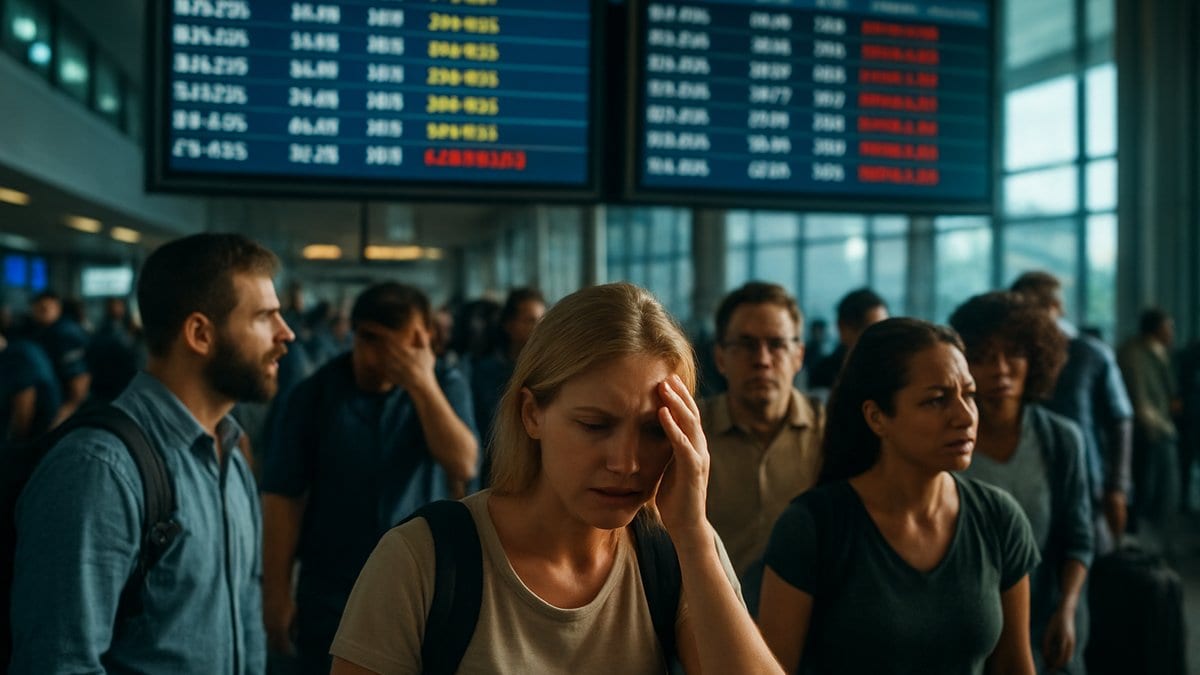
The scale of disruption has quickly translated into crowded terminals, long queues at customer service counters and gate areas filled with passengers waiting for updated departure times. While the overall number of cancellations remains limited compared with broader nationwide meltdown events, the volume of delayed operations highlights how quickly conditions can deteriorate at a single major hub.
Travel news outlets note that the disruption at Miami is unfolding during a busy spring travel period, adding pressure to airlines already operating near capacity on popular domestic and transatlantic routes.
Key Routes to New York, Chicago, London, Dallas and Los Angeles Affected
Miami’s role as a major connecting point means that disruption there can reach far beyond South Florida. Reports indicate that flights between Miami and the New York area, including services to John F. Kennedy and LaGuardia, have faced repeated rolling delays as aircraft and crews arrive late from earlier legs.
Connections to Chicago and Dallas, both critical hubs in the American Airlines and United networks, are also experiencing extended ground times. Late arriving aircraft in Miami can delay departures northbound, which in turn complicates evening schedules in the Midwest and across the central United States.
On the long haul side, some services linking Miami with London have been affected by earlier delays within the daily rotation. Industry analyses often highlight that when an aircraft dedicated to a transatlantic route departs late from a hub, the resulting delay can cascade across multiple time zones and into the following day’s operations.
Flights between Miami and Los Angeles have similarly been caught in the disruption, with westbound departures pushed back as airlines work to reset aircraft positioning and comply with crew duty-time regulations. For travelers, this has meant missed connections at onward West Coast and international gateways.
Operational Strain Highlights Vulnerabilities at Busy U.S. Hubs
Miami International Airport ranks among the busiest airports in the United States, and publicly available performance benchmarks show that large hubs like Miami, Chicago and Dallas typically operate with tight scheduling margins. When irregular operations occur, even a modest spike in delays can quickly overwhelm available buffers.
Aviation performance data from federal analyses and industry dashboards frequently point to a combination of factors behind such disruptions, including weather systems across regional air corridors, congestion in national airspace and staffing pressures in airline and ground operations. While the precise mix of causes behind the latest Miami event continues to be detailed in news coverage, the result is familiar to frequent flyers: extended gate holds, aircraft waiting in departure queues and missed slot times on departure and arrival.
Observers note that Miami has particular exposure because it supports a dense bank of connections to Latin America and the Caribbean in addition to domestic services. When northbound flights to New York, Chicago, Dallas and Los Angeles are delayed, the disruption can also interfere with the timing of southbound departures that rely on those same aircraft and crews.
This latest incident follows a broader pattern of periodic congestion at major U.S. airports, where strong travel demand intersects with increasingly complex schedules and limited spare capacity. Even when cancellations remain relatively low, the cumulative impact of hundreds of delayed flights can be substantial for both airlines and passengers.
Impact on Travelers and What Passengers Can Do
Travelers passing through Miami on Monday have faced longer than expected waits, involuntary schedule changes and in some cases overnight stays after missed connections. News and social media reports describe crowded concourses and rebooking lines, with some passengers attempting to reroute through alternative hubs to reach New York, Chicago, London, Dallas or Los Angeles.
Publicly accessible passenger rights guidance notes that, in the United States, compensation and care policies for delays and cancellations vary by airline and by cause of disruption. Travelers are typically encouraged to review their carrier’s policies regarding meal vouchers, hotel accommodations and rebooking options when flights are significantly delayed or canceled.
Consumer travel experts often recommend that passengers facing irregular operations focus first on securing a confirmed alternative itinerary, whether via an airline app, website, airport kiosk or call center. In rapidly evolving situations like the one in Miami, available seats on later departures or different routings can disappear quickly as airlines consolidate operations.
Travel planners also point out that maintaining real-time awareness of flight status across all legs of a journey is critical when hubs such as Miami experience disruption. Monitoring both the departing and inbound aircraft, where possible, can give early indications of potential problems and provide a narrow window to adjust plans before delays become severe.
What the Miami Disruption Signals for Upcoming Travel
The latest wave of delays and cancellations at Miami International Airport serves as a reminder of how interconnected global air travel has become. A single day of operational challenges at one hub can affect flights to cities across the United States and overseas, especially on routes linking multiple key airports such as New York, Chicago, London, Dallas and Los Angeles.
Industry commentary suggests that with strong demand forecast for the coming months, airlines and airports will remain under pressure to maintain reliability even as they operate near pre-pandemic capacity levels. Large carriers serving Miami have invested in technology, staffing and schedule adjustments to improve resilience, but recent events indicate that shock points remain.
For travelers planning trips that pass through Miami, the current disruption underscores the value of building extra connection time, especially when linking to long haul flights or last departures of the day. Booking earlier departures, avoiding tight layovers where possible and keeping flexible backup options in mind can reduce the risk of significant itinerary upheaval.
As operations gradually stabilize, attention is likely to focus on how quickly airlines clear the backlog of delayed flights and reposition aircraft and crews to restore normal schedules. The pace of that recovery will shape not only the experience of passengers currently in transit but also the reliability of flights scheduled from Miami over the next several days.