

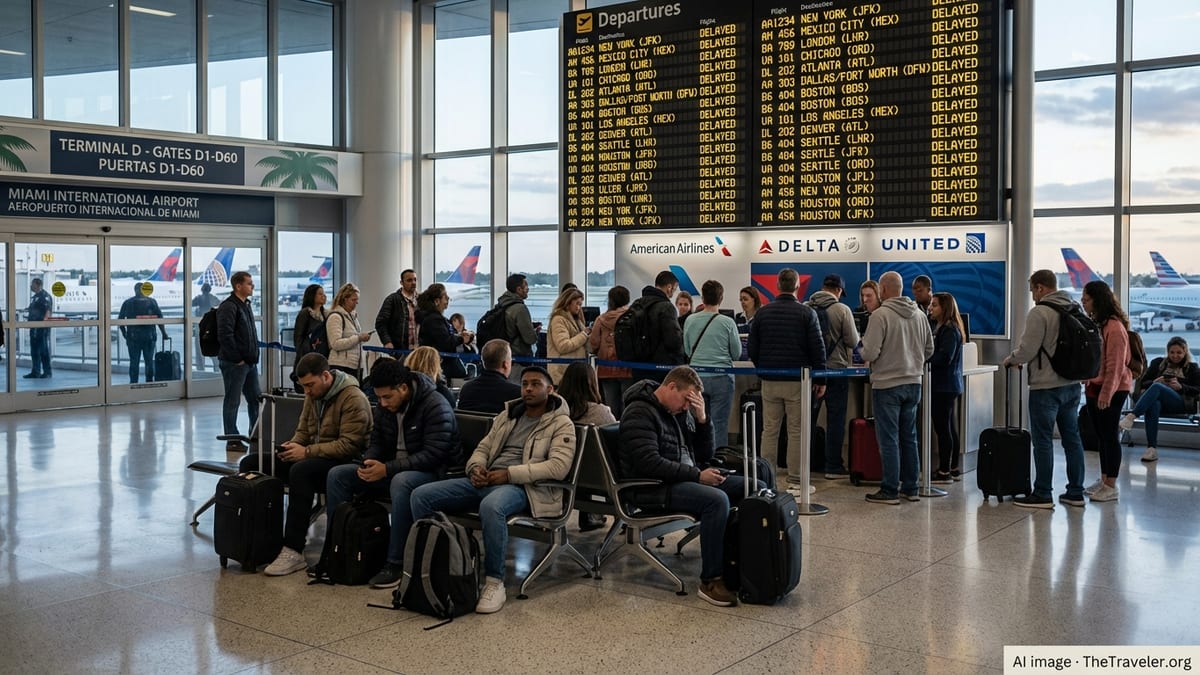
Travelers passing through Miami International Airport on Tuesday faced a fresh wave of disruption, as American Airlines, Delta Air Lines and United Airlines logged around 90 delayed services and eight cancellations, affecting passengers on heavily traveled routes to New York, Mexico City, London and major U.S. cities.
Weather, Congestion and Staffing Strains Converge Over Miami
Operational data from Miami International Airport on February 17 indicates an unusually high proportion of delayed flights, with roughly one in three departures running late and a smaller but significant share scrubbed outright. While Miami is no stranger to operational hiccups, a combination of unstable winter weather patterns across the eastern United States, lingering staffing strains and knock-on congestion from other hubs has pushed the system under fresh pressure.
Airport analysts point to a familiar pattern: storms sweeping through the mid-Atlantic and Northeast, constrained airspace and busy holiday-period traffic amplifying even small disruptions. When a large coastal hub such as New York or a major transit point like Dallas or Chicago experiences ground stops or flow restrictions, the impact ripples quickly to Florida gateways, where high-frequency routes leave little slack in the schedule.
For American, Delta and United, which all run dense networks from Miami to major domestic and international cities, the timing of delays can be particularly problematic. Morning and early afternoon setbacks tend to cascade into the evening bank of departures, meaning a relatively modest number of cancellations and delays at the start of the day can snowball into missed connections and overnight disruptions for passengers traveling long-haul or onward to smaller U.S. markets.
Compounding the issue, airlines are still operating close to pre-pandemic capacity on prime routes while maintaining leaner staffing and aircraft reserves. That leaves limited flexibility to swap aircraft, rotate crews or add recovery flights on short notice when Miami’s operations are strained by weather and airspace controls elsewhere in the network.
American, Delta and United Among the Hardest Hit Carriers
By mid‑day Tuesday, airport statistics showed approximately 90 delayed departures and arrivals tied to the three largest U.S. network carriers at Miami, alongside eight cancellations spread across their schedules. American Airlines, the dominant carrier at the airport, accounted for the largest share of the disruptions, reflecting both its heavy schedule at Miami and its strong presence on trunk routes to the Northeast and Latin America.
Delta Air Lines and United Airlines, while smaller players at Miami compared to American, also reported clusters of delayed flights, particularly on services connecting Miami to their home hubs and to congested northern airports. In several cases, an aircraft arriving late from weather‑affected regions forced a late turn‑around in Miami, triggering further schedule slippage for passengers departing to other destinations.
Miami International has seen elevated disruption numbers in recent weeks, with airport performance data for January already showing hundreds of late arrivals and dozens of cancellations across all carriers. Within that context, the latest round of 90 delays and eight cancellations is less an isolated incident than part of a sustained period of operational stress across the U.S. air travel system, where winter storms, a tight labor market and high demand have combined to test airline resilience.
Airline representatives have emphasized that safety remains the overriding priority, even as they work to minimize the scale and duration of disruptions. Delays tied to ground stops, de‑icing operations at northern airports, and air traffic control restrictions can sometimes be adjusted, but they cannot be eliminated when weather and airspace conditions deteriorate along key corridors linking Miami with major domestic and international hubs.
Key Routes Impacted: New York, Mexico City, London and Major U.S. Hubs
The disruption at Miami International has been especially visible on some of the airport’s busiest and most strategically important routes. Flights between Miami and the New York City area, including services to John F. Kennedy International, LaGuardia and Newark Liberty, saw schedule changes and rolling delays as storm systems moved across the Northeast and air traffic controllers imposed flow constraints to manage safety in crowded airspace.
Further south, passengers traveling between Miami and Mexico City reported extended waits at departure gates and disrupted connections to other Mexican and Central American destinations. Mexico City’s own congestion and altitude‑related performance constraints can make its operations particularly sensitive to late‑arriving aircraft and narrow connection windows, leaving little room for schedule recovery when inbound flights from Miami are delayed.
Transatlantic travel was not spared. On Miami’s high‑profile route to London, the timing of delays carries heightened consequences, as late departures can push arrivals into restricted night‑time hours or into peak morning congestion at already stretched European hubs. Even when flights ultimately depart, missed connections onto onward European services and rail links can leave travelers scrambling to rebook and adjust their plans.
Beyond these marquee routes, major domestic hubs such as Atlanta, Chicago, Dallas, Los Angeles and Washington have also featured prominently on lists of delayed flights. Because many of these airports are central nodes in the U.S. network, a delay out of Miami does not simply inconvenience point‑to‑point travelers, it can also disrupt a chain of connections reaching smaller cities across the country.
Scenes at the Terminal: Long Lines, Tense Connections and Frayed Nerves
Inside Miami International’s terminals, the operational statistics translated into familiar scenes: growing queues at airline customer service counters, passengers crowded around gate podiums for updates, and departure boards filled with yellow and red time changes. For some travelers, the impact was limited to an inconvenient but manageable delay, while others faced missed weddings, business meetings and vacation departures as connection windows evaporated.
Families returning from Caribbean and Latin American holidays reported spending hours in the terminal, juggling tired children and luggage as they waited for revised departure times. Business travelers heading to New York and other financial centers weighed whether to abandon same‑day meetings and switch to virtual options, while some international passengers faced the prospect of unexpected overnight stays in Miami when onward flights to Europe or South America fell outside legal crew duty limits.
At ticket counters, airline staff worked to rebook passengers onto later flights or reroute them through alternative hubs. That process has become more complicated in a high‑demand environment where many flights are already operating near capacity. Even when seats are available, rebooked travelers may lose their original seating assignments or be split from companions, adding to the stress.
Concessions and lounges were noticeably busier as delayed passengers searched for a quiet place to work, rest or feed their families. For those on tighter budgets, the cost of extra meals and airport amenities added a financial sting to the disruption, especially when delays extended into the late evening and hotel stays became necessary.
Operational and Economic Ripple Effects for Airlines and Tourism
The immediate impact of 90 delays and eight cancellations is measured in disrupted travel plans, but the broader consequences reach deeper into airline operations and the regional economy. For carriers, irregular operations mean additional crew costs, repositioning of aircraft, compensation for eligible passengers and potential knock‑on effects to the following day’s schedule as aircraft and crews end up out of position.
Miami’s role as a gateway between the United States, Latin America and Europe amplifies those impacts. When a single Miami to New York or Miami to London flight runs late, it can disrupt multiple downstream legs, from European connections to smaller U.S. cities to early‑morning departures the next day. Airlines may need to swap larger aircraft onto heavily affected routes or delay maintenance events to keep their schedules intact, decisions that have long‑term implications for fleet reliability.
For South Florida’s tourism and convention sectors, irregular operations at Miami International risk dampening traveler confidence during what is traditionally a busy season. Hoteliers and tour operators rely on predictable arrival patterns to manage check‑ins, ground transfers and excursions. When large numbers of guests arrive hours late or not at all, staffing and inventory planning become more difficult, and some travelers may hesitate to book last‑minute getaways or short business trips that rely on tight flight schedules.
Local businesses in Miami and across Florida also feel the strain when goods shipped by air are delayed. While passenger airlines have focused primarily on moving people, belly cargo on long‑haul flights plays a crucial role in high‑value supply chains, from pharmaceuticals and electronics to fresh flowers and seafood. Flight cancellations and extended delays can disrupt delivery commitments, forcing shippers to seek alternative routes or modes of transport.
How Affected Passengers Are Coping and What They Can Do
Facing uncertainty at the gate, many travelers out of Miami on Tuesday turned to airline mobile apps and text alerts as their first line of information. These tools can provide faster updates than crowded gate podiums, but they are only as accurate as the latest operational decisions, and rapid shifts in weather or air traffic control directives can render earlier messages obsolete within minutes.
Passenger advocates recommend that travelers whose flights are significantly delayed or canceled document all communications from the airline, including revised departure times and any written statements regarding the cause of the disruption. These records can be useful when seeking refunds, vouchers or other forms of compensation where airline policies or local regulations provide for them, particularly in cases of controllable disruptions such as technical failures or crew scheduling issues.
In practical terms, experts advise that travelers departing Miami or connecting through the airport build extra buffer time into their itineraries when severe weather or widespread disruptions are in the forecast. That can mean choosing earlier flights in the day, allowing longer connection times, and avoiding tight back‑to‑back bookings that leave no room for delay. For long‑haul and international trips, booking on a single ticket rather than separate point‑to‑point segments can also offer stronger protection, as airlines are generally more obligated to assist with rebooking when all legs are under one reservation.
Some passengers have also begun to factor airline performance records into their booking decisions, favoring carriers and routes with stronger on‑time statistics at Miami. While no airline can fully escape the impact of severe weather and airspace restrictions, historical data on delays and cancellations can point to patterns that might help frequent travelers reduce their exposure to routine disruption.
Miami’s Challenge as a High‑Volume, Weather‑Sensitive Gateway
The latest disruptions highlight the structural challenges facing Miami International as it juggles its role as both a major U.S. domestic hub and a critical international gateway. With nearly 1,200 flights per day and a complex mix of short‑haul and long‑haul services, even relatively modest shifts in weather, staffing or airspace availability can push operations to the brink.
Miami’s location makes it particularly vulnerable during the winter and summer peaks. In the colder months, it depends heavily on connections to cities in the Northeast and Midwest that are prone to snow and ice, while in hurricane season it must navigate tropical storms and intense convective weather over the Caribbean and Gulf of Mexico. In both periods, air traffic control initiatives can slow the flow of arrivals and departures, forcing airlines to adjust schedules at short notice.
Airport authorities and airlines have invested in improved forecasting tools, collaborative decision‑making platforms and ground infrastructure upgrades in recent years to build resilience into the system. These measures are designed to help operators respond more quickly to disruptions and recover schedules faster once conditions improve. However, in a tightly coupled national airspace system, the reality is that Miami’s performance will always be partly dependent on factors well beyond its own perimeter fence.
For passengers traveling through Miami, the events of this week serve as a reminder that even in an era of advanced technology and sophisticated logistics, air travel remains susceptible to weather and operational shocks. While airlines, regulators and airport operators work on long‑term improvements, travelers will continue to need patience, flexibility and good information to navigate periods of disruption at one of the country’s busiest and most strategically important airports.