

More news on this day
Miami-Dade transportation planners are weighing a new non-stop rail link between Miami International Airport and PortMiami, aiming to relieve mounting congestion as cruise passenger numbers and flight volumes continue to climb.
Get the latest news straight to your inbox!
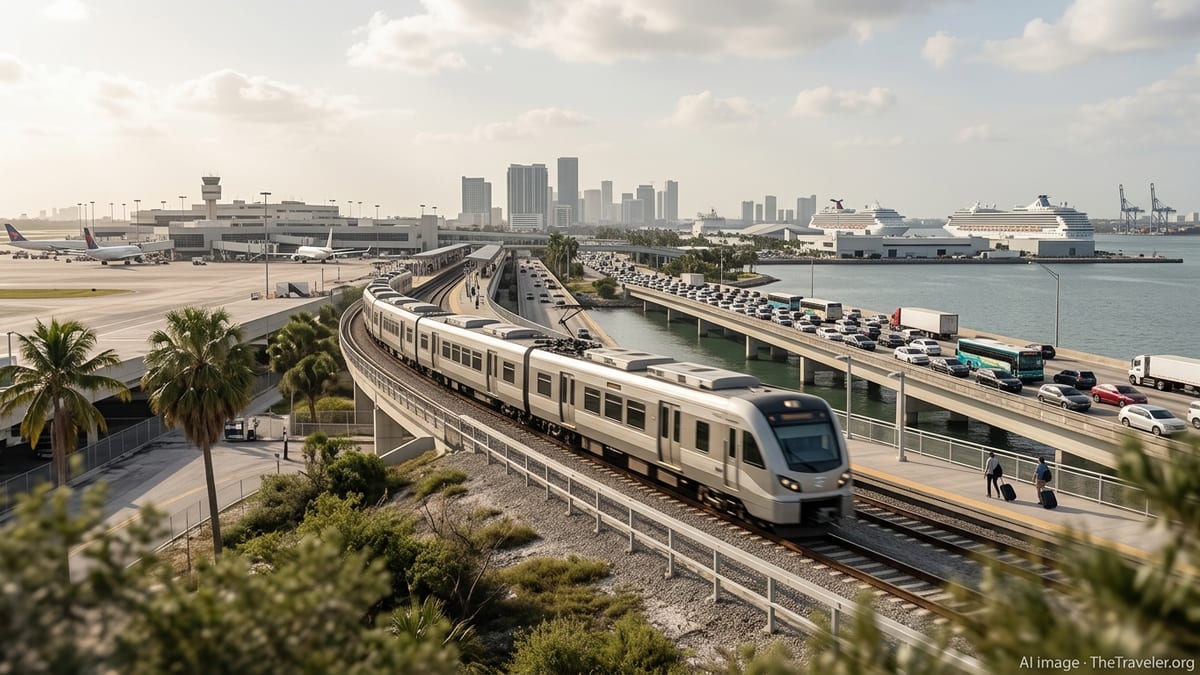
What Is Being Considered for the Airport–Port Link
Publicly available planning documents and recent coverage indicate that Miami-Dade is examining a dedicated rail connection providing a one-seat ride between Miami International Airport (MIA) and PortMiami. The concept would give airline passengers and cruise guests a direct, transfer-free option in place of the current patchwork of shuttles, taxis, ride-hailing services and multiple-transfer rail journeys.
The rail link is being discussed within the Strategic Miami Area Rapid Transit, or SMART, program, which lays out a long-term network of commuter and rapid transit corridors across the county. A PortMiami–MIA connection appears in a recent PortMiami–MIA transit feasibility study as a priority corridor, reflecting the sharp growth in both cruise and air travel and the strain that growth is placing on roads leading to the port.
Early discussions describe the service as non-stop between the airport area and the port, but transportation enthusiasts following the project note that planners may ultimately focus on a “direct” or “transfer-free” service rather than a high-speed express. That distinction will shape how the line interfaces with existing tracks and stations already used by Tri-Rail, Metrorail and Brightline.
The proposal is still at a study stage, with technical teams reviewing route options, capacity needs and how a new line could fit into the wider regional rail network that now stretches from Miami to Orlando and will soon serve the new Nu Stadium near the airport.
How Travelers Currently Get Between MIA and PortMiami
Today, travelers moving between Miami International Airport and PortMiami rely primarily on road-based options. Cruise lines contract motorcoaches, while taxis, ride-hailing vehicles and private shuttles fill the roadways along State Road 836, Interstate 395 and the causeways serving the port. On peak cruise days, those corridors experience heavy congestion, often compounded by construction and special events in the downtown and waterfront areas.
On the rail side, there is no single-seat service between the airport and the port. The MIA Mover links the airport terminals to the Miami Intermodal Center, where passengers can board Metrorail’s Orange Line, Tri-Rail services and various buses. From there, travelers heading toward cruise terminals typically connect to downtown Miami’s rail stations and then transfer again to road transport serving the port’s island.
Regional services have improved in recent years. Tri-Rail opened its Downtown Miami Link in January 2024, bringing commuter trains directly into MiamiCentral, and Brightline extended its higher-speed intercity trains to Orlando in 2023. Even so, cruise passengers arriving by air still need at least one transfer and a final road leg to reach their ship, adding time and complexity at the start or end of a vacation.
The proposed non-stop rail link is intended to close this gap by giving both air and cruise passengers a clearly signed, “airport to ship” connection that avoids highway bottlenecks and reduces the number of transfers required with luggage in tow.
Why Miami-Dade Sees a Need for a Direct Rail Connection
PortMiami markets itself as the Cruise Capital of the World, with major lines homeporting some of their largest vessels there. Each new generation of ship brings higher passenger counts, which translates into more buses, vans and private vehicles converging on a limited number of access roads and terminal curbs in short time windows.
At the same time, Miami International Airport has recovered from the pandemic downturn and continues to grow as a hub for both domestic and international travel. Forecasts cited in local transportation planning show steady increases in passenger numbers in the coming decade, driven by new routes and Miami’s status as a gateway to Latin America and the Caribbean.
Countywide climate and resilience policies are also pushing agencies to prioritize mass transit options that can reduce vehicle emissions and improve air quality. A rail connection between the airport and the port aligns with those goals by encouraging visitors to choose shared transport over private cars or individual ride-hailing trips.
Planners involved in the PortMiami–MIA transit study are evaluating not only potential time savings for travelers but also broader benefits such as reduced roadway wear, improved reliability during peak cruise turnovers and better integration with regional rail lines that could bring passengers from Broward, Palm Beach and even Orlando directly into the cruise gateway.
How the New Service Could Work in Practice
The emerging concept would likely route trains from the airport area toward downtown using existing or upgraded rail corridors, then connect eastward to a new or expanded station at PortMiami. Prior rail system plans for Florida and Miami-Dade have referenced the possibility of rail access into the port, and Brightline has already identified PortMiami as a future station location for its intercity service.
One scenario under review, based on recent planning documents, would see a shuttle-style service operating at frequent intervals between an airport rail hub and a PortMiami station, with no intermediate stops. Another approach would integrate the non-stop segment into a longer corridor, allowing some trains to run express between the airport and the port while others continue north as part of a broader commuter network.
Any new service would need to fit alongside existing rail operations. The Metrorail Orange Line already runs into the airport, Tri-Rail connects the airport station to the wider South Florida commuter system, and Brightline and Tri-Rail share infrastructure near downtown. Aligning schedules, track access and station design so that the airport–port trains can move without delay will be a critical technical challenge.
Accessibility and wayfinding are expected to be central design considerations. Travel industry observers anticipate high demand from cruise passengers with luggage, families and older travelers who value step-free transfers, clear signage and predictable travel times more than marginal differences in speed.
Timeline, Funding Questions and What Travelers Should Expect Next
The airport–PortMiami rail link remains in the planning phase, and there is no confirmed construction schedule or opening date. The current work focuses on feasibility, including ridership forecasts, engineering constraints, environmental review needs and how to coordinate with other major projects such as the Nu Stadium development near the airport and the SMART network corridors elsewhere in the county.
Funding will be a central question. Large rail infrastructure projects in the United States typically require a mix of local contributions, state support and federal grants. Reports indicate that Miami-Dade is examining how an airport–port line could compete for federal infrastructure funds while also leveraging revenue generated by cruise and airport activity.
For now, travelers should not expect immediate changes to how they move between the airport and the cruise terminals. The project being considered would take years of design, funding, permitting and construction before entering service. In the interim, passengers will continue to rely on the existing combination of shuttles, taxis, ride-hailing and multi-step rail connections via the Miami Intermodal Center and downtown stations.
However, the fact that a non-stop rail service is under active review signals that county leaders and transportation planners see long-term value in a stronger link between the region’s primary air gateway and its globally significant cruise port. If the project advances, it would place Miami among a small group of cities offering dedicated rail connections tailored to cruise travelers, reshaping how millions of visitors experience the start and end of their voyages.