

More news on this day
Escalating air and missile strikes across the Middle East are triggering sweeping airspace closures, forcing airlines into costly detours and mass cancellations as governments rush out urgent travel advisories for citizens across the region.
Regional Air Campaign Closes Key Skies
An intensifying air campaign involving the United States, Israel and Iran has turned vast swaths of Middle Eastern airspace into a conflict zone, with multiple states either fully or partially closing their skies. Iran, Iraq, Israel and Jordan have implemented near-total shutdowns to civilian overflights as missile and drone exchanges continue, while Gulf states including Qatar, Kuwait, Bahrain and the United Arab Emirates have limited access to tightly controlled corridors.
Analysts say the closures amount to the most abrupt shock to global aviation since the early days of the Covid pandemic, effectively removing some of the world’s busiest crossroads from long-haul routing. Data firms tracking operations report thousands of cancellations since late February, with Dubai, Doha and other Gulf hubs brought to an almost complete standstill for regular passenger traffic.
Although some special repatriation and cargo services are beginning to operate on a case-by-case basis, aviation authorities across the region are prioritising air defence activities and risk management over commercial access. Operators are being told to stay clear of active conflict areas and to treat any remaining approved corridors as subject to sudden change.
The loss of these airspace segments is already reverberating well beyond the Middle East itself, undermining the carefully calibrated schedules that for years have relied on Gulf hubs as connective tissue between Europe, Asia, Africa and Australasia.
States Urge Citizens to Leave as Advisories Escalate
Governments are matching the aviation disruption with hardening travel advice. The United States has issued a sweeping advisory urging its citizens to depart a broad swath of Middle Eastern countries immediately, warning that the deteriorating security environment could curtail remaining commercial options with little notice. Officials describe the guidance as a high-alert directive, closer in tone to wartime evacuation language than routine caution.
European governments, including the United Kingdom and Germany, have published similar notices, advising against all but essential travel to conflict-adjacent states and beginning limited assisted departure flights where airport access still allows. Diplomatic missions are encouraging travellers to register contact details and to have contingency plans if scheduled flights are cancelled en route.
Consular officials stress that travellers already in the region should not assume that partial openings at hubs like Dubai or Abu Dhabi signal a return to normal operations. Instead, they describe a fragile patchwork of exemptions designed mainly to clear stranded passengers and reposition aircraft, with the underlying security calculus remaining volatile.
Travel industry lawyers note that the upgraded advisories also have implications for insurance coverage. Many standard policies restrict benefits once a formal government warning against travel to a destination is in place, potentially leaving late-booking travellers with limited protection if they ignore official guidance.
Airlines Divert Through Narrow Corridors
With Iranian, Iraqi and large portions of Gulf airspace effectively off limits, airlines that continue to operate between Europe and Asia are being funnelled into a handful of narrow, approved corridors. A critical northbound route over the Caucasus via Armenia, Georgia and Azerbaijan has emerged as one of the few viable options that does not violate Russian or Middle Eastern conflict zones.
Carriers that can access this passage report markedly longer flight times, higher fuel burn and acute operational complexity as traffic density spikes in a corridor in places less than 100 miles wide. Dispatchers are having to rework crew schedules, add contingency fuel and factor in constrained alternates, eroding already thin margins on competitive long-haul routes.
Some Asian airlines face a compounded challenge. Operators that were already avoiding Russian airspace due to sanctions now find themselves simultaneously shut out of traditional Middle East pathways, forcing even more circuitous routings via southern detours or intermediate fuel stops in Europe or Central Asia. Industry groups warn that if the closures persist, certain city-pairs may become temporarily uneconomical to serve at all.
Despite the pressure, safety regulators and pilot associations insist that strictly observing conflict-zone guidance is non-negotiable. They point to previous shootdowns and near misses in other regions as stark reminders of the risks of overflying active theatres, arguing that commercial imperatives cannot outweigh aircrew and passenger security.
Hubs From Dubai to Doha Struggle With Chaos
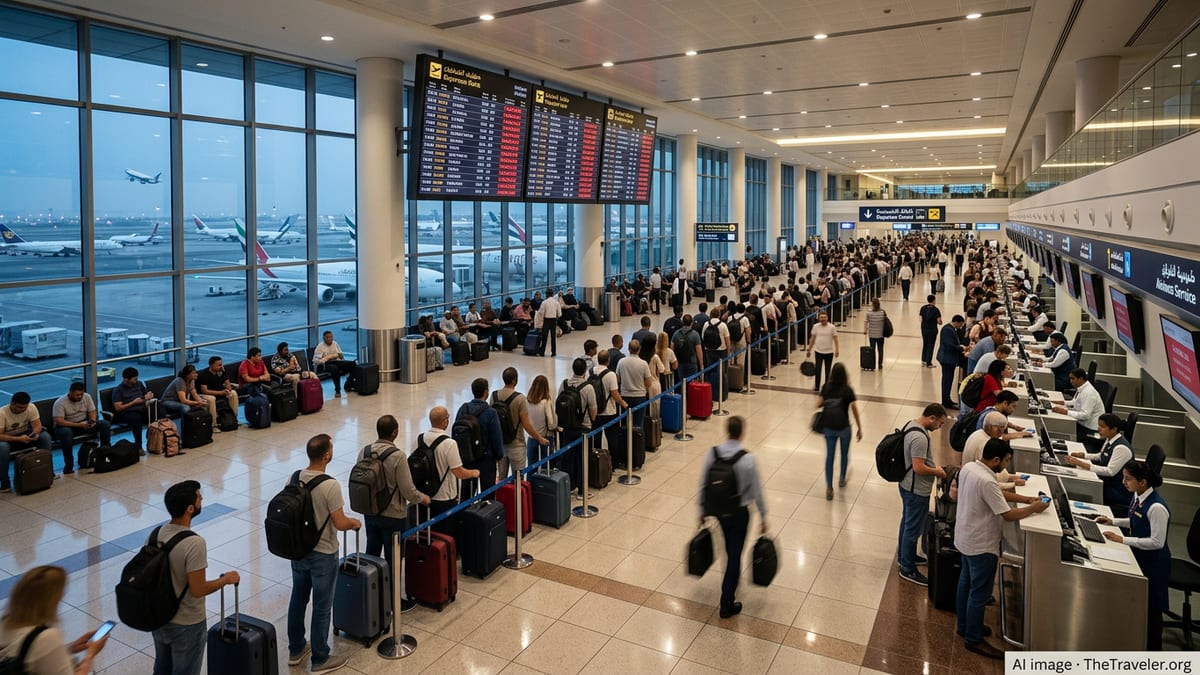
Major Middle Eastern hubs built to handle seamless global connectivity are now struggling with unprecedented disruption. Dubai International, long the world’s busiest airport for international passengers, has halted normal operations on several occasions in recent days, with terminals crowded by transit passengers whose onward flights have vanished from departure boards.
Airlines including Emirates, Etihad Airways and Qatar Airways have temporarily suspended the bulk of their passenger networks, focusing instead on limited relief services and essential cargo. Passengers report spending nights in terminal seating as hotels in and around hub airports fill with stranded travellers awaiting confirmation of new itineraries.
Ripple effects extend far beyond the Gulf. European and North American carriers have cancelled or rerouted services to and through the region, with some suspending direct links to Tel Aviv, Dubai, Doha, Abu Dhabi and other cities for at least several days. Flexible waiver policies have been introduced to allow travellers to postpone or reroute trips without additional fees, but available inventory on alternative routings is tight.
Tour operators are also scrambling. Package holidays built around stopovers in Dubai or Doha, or cruises embarking from Gulf ports, have been upended, leaving companies negotiating refunds, future travel credits and complex re-accommodation plans during what was expected to be a buoyant spring travel period.
Guidance for Travellers With Upcoming Itineraries
For travellers with tickets touching the Middle East over the coming weeks, industry experts describe the situation as highly fluid and emphasize the need for constant monitoring. They advise checking airline apps and official channels multiple times a day, as timetable changes are being implemented in rolling waves rather than through a single definitive schedule update.
Passengers are being encouraged to accept rebooking on earlier flights where offered, rather than waiting for original departure dates that may fall within tightening closure windows. Those with non-essential travel are urged to consider cancelling or postponing altogether, particularly if their plans involve lengthy connections at affected hubs or travel to destinations under heightened security advisories.
Travel agents recommend carrying printed and digital copies of all confirmations and any written airline guidance on waivers or rule relaxations, as airport staff are sometimes working with incomplete information during fast-changing events. Allowing extra time for check-in and security, and preparing for the possibility of overnight delays, is now considered prudent for any itinerary that skirts the region.
For now, aviation analysts say the trajectory of the air campaign will determine how long the travel disruption persists. If missile and drone activity continues at current intensity, the combination of government warnings, operational risk assessments and constrained routing options is likely to keep much of the Middle East’s once-bustling sky unusually quiet, even as planes are forced to crowd into narrow, distant detours to keep global traffic moving.