

More news on this day
Escalating regional tensions and widespread airspace closures have triggered at least 1,452 flight cancellations and 55 significant delays across the Middle East, as Emirates, Qatar Airways, FlyDubai and Etihad battle mounting passenger chaos at their key hubs in Dubai, Doha and Abu Dhabi.
Conflict Fallout Shutters Key Gulf Hubs
The latest round of strikes and counterstrikes involving Iran, the United States and Israel has rapidly spilled into the aviation sector, with multiple Middle Eastern countries closing or severely restricting their airspace since February 28, 2026. Authorities in the United Arab Emirates, Qatar, Kuwait, Bahrain, Iraq, Syria and Iran have all imposed varying degrees of closures, effectively shutting down some of the world’s busiest connecting corridors between Europe, Africa, Asia and Australasia.
Dubai International, Abu Dhabi’s Zayed International and Doha’s Hamad International have been among the hardest hit. Data from aviation analytics firms and flight-tracking services over the weekend and into Monday, March 2, show more than a thousand cancellations centered on these three hubs alone, contributing to global disruption described by industry observers as the worst since the Covid-19 shutdowns.
While exact tallies are still being updated, cumulative regional figures since the first airspace closures indicate at least 1,452 cancellations and dozens of extended delays tied directly to the conflict. With airspace over large parts of the Gulf and Iran still constrained, airlines have been forced either to cancel outright or route aircraft on lengthy detours that add hours to flight times and strain already tight schedules.
The result is a cascading operational crisis: aircraft and crew are out of position, turnaround times have ballooned and departure banks that normally move tens of thousands of passengers a day through the Gulf super-hubs have been largely dismantled, at least temporarily.
How Emirates, Qatar Airways, FlyDubai and Etihad Are Responding
Emirates moved quickly to suspend all operations to and from Dubai as airspace closures took effect, later extending the halt into March 2 while it reassesses security conditions. The carrier is prioritizing safety and has offered affected passengers the option to rebook within a limited window or request refunds, with change fees generally waived for travel in the coming days.
FlyDubai, Dubai’s low-cost carrier, similarly halted its schedule, first canceling all flights on February 28 and then prolonging the suspension in line with evolving government directives. Both airlines have warned that some flights still visible in booking systems may not operate, urging passengers to rely on real-time status updates rather than advance timetables.
In Abu Dhabi, Etihad Airways has paused most departures from Zayed International Airport at least through the early afternoon of March 2, while using a handful of positioning flights to return aircraft and crew to base. Qatar Airways, based in Doha, remains constrained by Qatar’s own airspace restrictions and widespread regional closures, with most regular services suspended and only limited special operations under government coordination.
Together, these four carriers normally handle around 90,000 transiting passengers a day and serve hundreds of global destinations. Their curtailed schedules have ripple effects far beyond the Middle East, forcing partner airlines in Europe, Asia, Africa and North America to adjust connections, swap aircraft types and, in many cases, cancel long-haul services that depend on Gulf hub connectivity.
Scenes of Chaos for Stranded Passengers
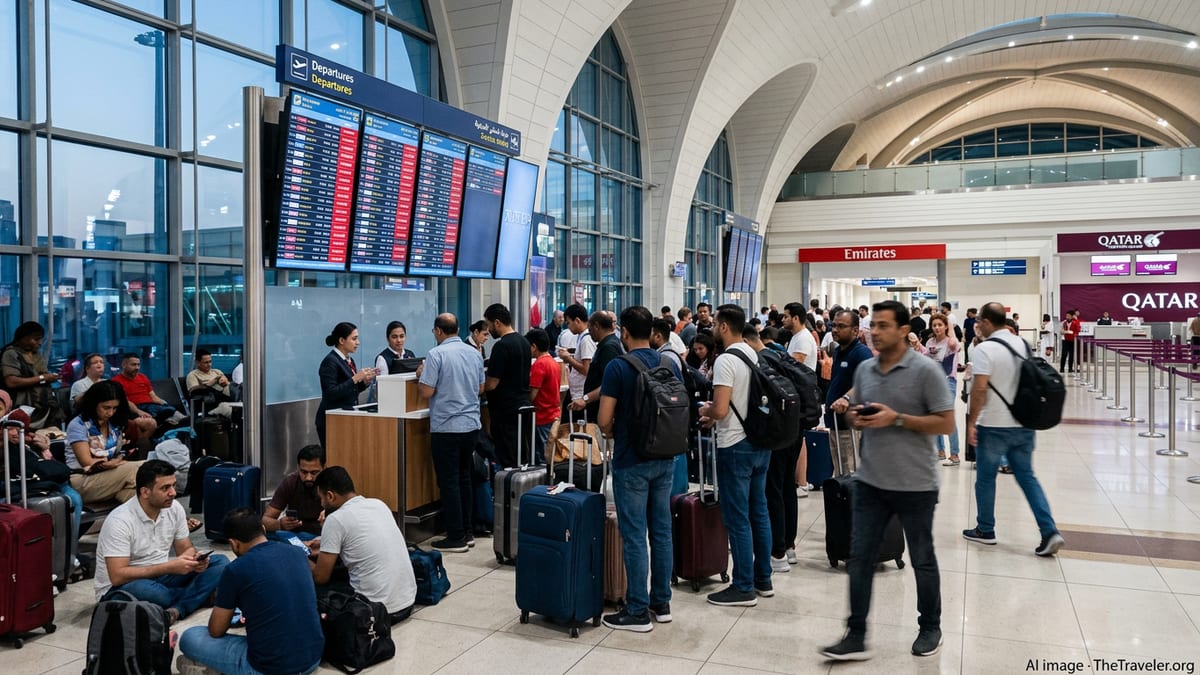
For travelers on the ground, the disruption has translated into packed terminals, long lines at service desks and improvised overnight stays in airports and nearby hotels. With departure boards dominated by red "canceled" and "delayed" notices, many passengers have now spent multiple days in limbo, rebooked several times as airlines shuffle limited remaining capacity.
At Dubai International, one of the world’s busiest airports for international traffic, terminal concourses that usually flow with continuous waves of connecting passengers instead saw crowds clustered around airline counters, waiting for news of special flights or the reopening of key corridors. Similar scenes have been reported at Doha and Abu Dhabi, where ground staff are struggling to rebook travelers onto scarce seats while also handling baggage backlogs and crew duty-time limitations.
Families returning from holidays, migrant workers transiting between contracts, and business travelers en route to meetings have all been caught out by the speed of the shutdowns. Many passengers only learned of cancellations after arriving at the airport, despite airlines’ efforts to push notifications through apps, email and text messages.
Compounding the uncertainty is the fact that governments are also organizing their own evacuation or repatriation services from the region. These limited flights, often operating at short notice and under special clearances, are creating an additional layer of complexity as airport authorities juggle commercial, charter and government movements in a constrained airspace environment.
What Affected Travelers Need to Know Right Now
Passengers with upcoming itineraries that touch Dubai, Abu Dhabi or Doha over the next several days should assume that disruption will continue, even if formal airspace closures are partially lifted. Airlines will need time to reposition aircraft, rebuild schedules and work through several days of accumulated backlogs before something resembling normal operations returns.
Most major Middle Eastern carriers are currently offering fee-free rebooking or refund options for tickets due to be used in the immediate term. However, the precise rules vary by airline, ticket type and route, and some travelers on separate connecting tickets may find fewer protections. Those who booked through online travel agencies or third-party platforms are often being redirected back to those intermediaries for changes.
Travel insurance is proving to be an additional pain point. Many standard policies explicitly exclude disruptions caused by war or military conflict, meaning that some passengers cannot claim reimbursement for accommodation, alternative transport or missed connections that arise directly from the current security crisis. Travelers are being advised to scrutinize policy wording carefully and to keep receipts for any out-of-pocket expenses in case partial claims are possible under delay or trip-interruption clauses.
In parallel, numerous governments have upgraded their travel advisories for parts of the Middle East, including guidance to reconsider nonessential trips or avoid specific countries altogether. Travelers should monitor both their airline’s operational updates and their home government’s latest advice before setting out, as conditions and official recommendations are changing rapidly.
Planning Ahead: Practical Steps if You Are Booked to Transit the Gulf
For those yet to begin their journeys, the strongest advice from aviation and travel experts is not to cancel independently without first checking what your airline is offering. Self-canceling can, in some cases, reduce your entitlement to rebooking rights or refunds, especially if your flight later operates or if the airline introduces more generous waivers after your decision.
Instead, travelers are urged to monitor their booking status frequently in the 24 to 72 hours before departure, use airline apps to receive push notifications and proactively update contact details in reservation profiles. If your flight is canceled, many carriers are automatically reassigning new dates or routes, which can often be confirmed or modified online without queuing at airport counters.
Those with critical travel needs, such as medical appointments or time-sensitive work commitments, may wish to explore alternative routings that bypass the Gulf altogether, using hubs in Europe, Turkey or South Asia where feasible. However, global knock-on effects mean that availability is tight and fares on remaining routes may be elevated.
Ultimately, the pace of recovery will hinge on both the regional security picture and the speed at which airspace restrictions are eased. Until then, anyone planning to fly through Dubai, Doha or Abu Dhabi in the coming days should build in extra flexibility, prepare for sudden changes and remain alert to real-time updates from both airlines and authorities.