

More news on this day
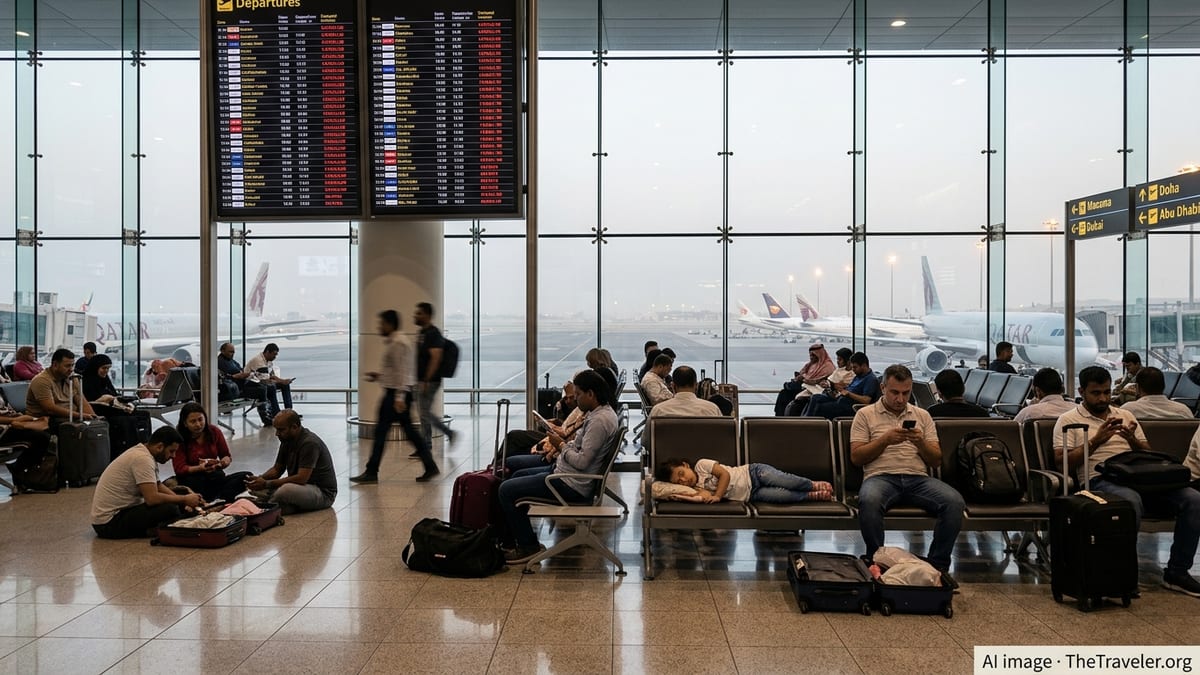
Severe airspace restrictions and security tensions across the Gulf region have triggered a fresh wave of disruption for Middle East air travel, with 47 flights reportedly grounded and 18 postponed across Bahrain, Qatar and the United Arab Emirates, leaving passengers stranded in Manama, Doha, Dubai and Abu Dhabi and scrambling to rearrange critical connections.
Get the latest news straight to your inbox!
Regional Airspace Closures Push Gulf Carriers to a Standstill
Published advisories from aviation and travel-management firms indicate that since late February 2026, airspace over Bahrain, Qatar and much of the United Arab Emirates has faced severe restrictions, resulting in widespread suspensions of commercial services. Bahrain’s airspace remains effectively closed to routine passenger traffic, while Qatari operations have only partially reopened under limited emergency conditions. The United Arab Emirates has imposed significant constraints on arrivals and overflights, particularly affecting routes transiting Dubai and Abu Dhabi.
These closures are part of a broader regional security crisis linked to ongoing conflict involving Iran and several Arab states, which has prompted precautionary shutdowns of key flight corridors. Operational updates circulated in early March describe a patchwork of suspensions, restricted corridors and ad hoc approvals for evacuation and cargo movements rather than a return to normal scheduled flying. For travelers using Gulf hubs as gateways between Europe, Asia, Africa and Australasia, the result has been cascading disruption across multiple time zones.
Within this environment, Gulf Air, Qatar Airways and FlyDubai have all reduced operations through their respective hubs. Gulf Air’s network has been heavily curtailed by Bahrain’s airspace closure, while Qatar Airways has been constrained by the shutdown of Qatari airspace and limited, tightly controlled reopenings. FlyDubai, operating from Dubai, has had to navigate temporary suspensions and schedule thinning as Dubai International Airport responds to both security concerns and operational challenges.
Across these three carriers alone, 47 flights on key regional and long-haul routes have been grounded outright, with a further 18 pushed back or re-timed. Although exact tallies continue to shift as airlines adjust timetables day by day, the pattern is clear: passengers booked through Manama, Doha, Dubai and Abu Dhabi are facing repeated cancellations, rolling delays and sudden rerouting.
Where Passengers Are Stranded and Which Hubs Are Hit Hardest
Manama, Doha, Dubai and Abu Dhabi, normally among the most reliably connected hubs in global aviation, have become choke points. Social media posts and traveler forums over recent weeks describe passengers stuck for days in Manama after Gulf Air services were repeatedly withdrawn, and travelers in Doha reporting no onward commercial flights as they await further reopening of Qatari airspace. Similar accounts from Dubai and Abu Dhabi highlight long queues at rebooking desks and hotel desks as passengers seek accommodation while they wait for outbound options.
In Bahrain, Gulf Air’s grounding has meant that passengers with onward itineraries to South Asia, Europe and North Africa have lost their primary link out of the kingdom. Many have been offered later dates in mid to late March or been advised to seek rerouting via other Gulf or regional airports if they can secure seats. With Bahrain’s airspace closure still in force, alternative routings often involve surface transport to neighboring countries that retain partial air connectivity.
Doha’s Hamad International Airport, a major global transfer point, has also seen extensive disruption. Publicly available information shows that Qatar Airways has focused limited capacity on repatriation flights to a handful of key European cities, leaving many transit passengers unable to complete multi-leg journeys. Travelers stranded since the initial wave of cancellations in late February continue to report uncertainty over when regular services to Asia, Africa and the Americas will resume at scale.
Dubai and Abu Dhabi, typically used as backup options when other hubs falter, are themselves operating under constraints. Reports indicate that FlyDubai operations have been trimmed, with some short-haul services into higher-risk airspace cancelled or consolidated, while Abu Dhabi departures on several carriers, including regional partners, have been suspended or sharply reduced. That has left visitors in the United Arab Emirates relying on a shrinking list of long-haul departures and facing longer waits for confirmed seats.
Affected Routes, Connections and Typical Itineraries
The 47 grounded flights and 18 postponed services span a mix of intra-Gulf sectors and high-demand long-haul connections. On Gulf Air, cancellations and postponements are concentrated on Bahrain’s links to major South Asian cities such as Delhi and Mumbai, as well as popular regional destinations including Dubai, Abu Dhabi, Kuwait City and Doha. Some Europe-bound flights from Bahrain have also been pulled from schedules or shifted to later dates, breaking common one-stop itineraries between Europe and India via Manama.
For Qatar Airways, the most affected itineraries are those relying on Doha as a single-connection bridge between Europe and Asia-Pacific. Passengers traveling from London, Paris, Frankfurt or Rome to destinations such as Bangkok, Manila, Sydney and Johannesburg have found their Doha connections cancelled or repeatedly postponed. While limited repatriation flights have been mounted on certain European routes, many connecting sectors onward to Asia and Africa remain suspended, forcing travelers to attempt rerouting via alternative hubs.
FlyDubai’s disruptions are more heavily weighted toward regional and medium-haul services operating from Dubai into contested or heavily restricted airspace. Flights to selected Gulf and Levant destinations have faced cancellations or significant delays, affecting travelers who rely on low-cost connections via Dubai to reach cities not served non-stop by larger network carriers. Knock-on effects are being felt among passengers who had combined FlyDubai segments with long-haul services on partner airlines, resulting in misaligned itineraries and missed onward flights.
Even where flights are still technically operating, schedule thinning and shifting departure windows are complicating connections. Some passengers report that while a long-haul leg into Dubai or Abu Dhabi may run, the short-haul onward segment into Bahrain, Qatar or neighboring states has disappeared from the timetable, forcing last-minute changes in routing and, in some cases, complete trip cancellations.
What Impact Travelers Can Expect on Rebooking, Refunds and Travel Time
For passengers caught in the current wave of disruption, extended travel times and complex rebookings have become routine. Advisory notices from airlines and travel management companies emphasize that many changes are being handled on a rolling basis, with priority often given to passengers already stranded in the region. Travelers with bookings later in March are being asked to monitor their itineraries closely, as schedules are subject to adjustment with little notice while airspace restrictions evolve.
Publicly available information from Gulf Air, Qatar Airways and FlyDubai shows that most affected travelers are being offered a combination of free date changes, rerouting where possible, or refunds on unused tickets. However, the practical ability to rebook is constrained by limited alternative capacity. With many carriers across the region cutting frequencies or suspending routes altogether, seats on remaining services via alternative hubs such as Riyadh, Jeddah, Muscat or Istanbul are in high demand, often selling out quickly.
Travelers connecting from long-haul markets face particular challenges. Those originating in North America, Europe or East Asia may find that even if their first leg to a Gulf hub is still operating, their connecting service has been scrubbed, resulting in involuntary stopovers and the need to secure emergency accommodation. Travel insurers and credit card benefits are being tested as passengers seek reimbursement for extra hotel nights, meals and last-minute replacement tickets.
Experts in corporate and leisure travel management are advising clients to avoid non-essential transits through Bahrain, Qatar and the most affected airports in the United Arab Emirates until there is clearer guidance on airspace reopening. Where travel is unavoidable, they recommend allowing additional buffer time, maintaining flexible tickets, and preparing for the possibility of being re-routed at short notice through secondary hubs that still retain more stable operations.
Planning Ahead: Advice for Current and Upcoming Trips
For travelers already in Manama, Doha, Dubai or Abu Dhabi, the most critical step is to stay closely aligned with the operating airline through official channels such as booking portals and mobile apps. Schedules are being updated frequently as regulatory notices on airspace use are extended or adjusted, and seat availability on relief or repatriation flights can change within hours. Many airlines are prioritizing rebooking for passengers who were mid-journey when the disruptions escalated, so those with flexible travel dates may wish to defer departure until the situation stabilizes.
Passengers yet to start their trips are widely being encouraged by publicly available advisories to consider rerouting around the most affected hubs. This can involve booking itineraries that bypass the central Gulf entirely, even if that adds extra flight time or requires an additional connection. Alternate routes via hubs in Turkey, Egypt, Saudi Arabia or Europe may offer more predictable operations in the short term, though they too can be subject to crowding and occasional disruption.
Travelers with essential business or family commitments in Bahrain, Qatar or the United Arab Emirates should verify not just flight status but also any local movement restrictions, as some jurisdictions have paired airspace controls with guidance to limit non-essential travel on the ground. Hotel availability in key cities remains generally adequate, but room rates and demand patterns can shift quickly when large numbers of passengers are forced into unplanned overnight stays.
With no firm public timeline yet for a full reopening of Bahrain and Qatari airspace and only gradual normalization expected in the United Arab Emirates, industry observers suggest that volatility in Gulf flight schedules is likely to persist in the coming weeks. Travelers planning to transit the region are being urged to build in flexibility, maintain up-to-date contact details with their airlines, and prepare contingency plans for alternate routings should further waves of cancellations and postponements arise.