

More news on this day
Hundreds of travelers have been left stranded across the Middle East as large-scale flight cancellations and delays ripple through key hubs in Egypt, Bahrain, Qatar, Saudi Arabia and the United Arab Emirates, disrupting journeys between Europe, Africa and Asia.
Get the latest news straight to your inbox!
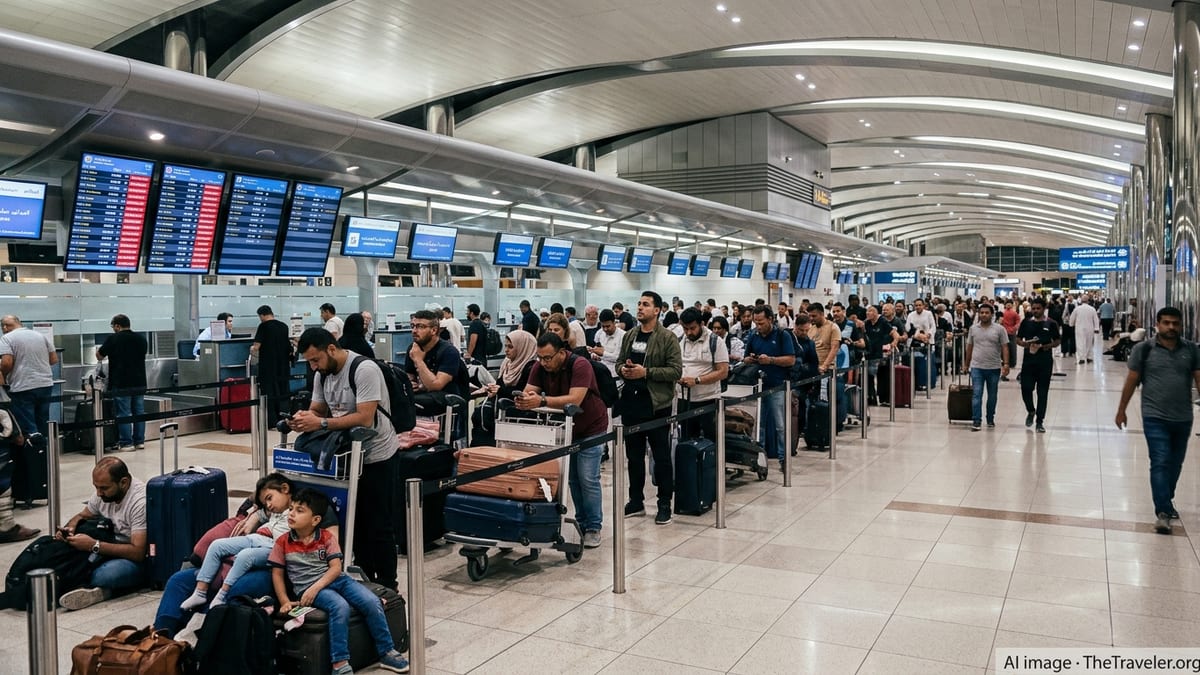
Major Hubs Hit by Wave of Cancellations and Delays
Flight-tracking data and regional media coverage indicate that more than 180 flights have been cancelled and at least 125 delayed across Cairo, Bahrain, Hamad, King Fahd and Dubai international airports over recent days, as airlines grapple with fast-changing airspace restrictions and security concerns. The disruptions are concentrated at some of the Middle East’s most important connecting hubs, magnifying the impact on long-haul routes linking Europe and Asia.
At Dubai International Airport, one of the world’s busiest international gateways, publicly available information shows that departure boards have recorded an elevated volume of cancellations and heavily delayed services, particularly on routes that normally cross contested airspace to Iran, Iraq and the eastern Mediterranean. Reports from passengers and local coverage describe long queues, rebooking backlogs and extended waits for updated departure times.
In Qatar, operations at Hamad International Airport have been repeatedly reshaped by evolving airspace closures and limited safe corridors. According to published coverage, some services have been cancelled outright, while others are being rerouted via longer pathways that skirt restricted zones, adding hours to flight times and resulting in late arrivals and missed connections.
Cairo, Bahrain and King Fahd International Airport near Dammam have also seen schedules thinned or reshuffled, with regional and international carriers consolidating frequencies, cancelling rotations and prioritizing selected long-haul links. The cumulative effect has left hundreds of travelers stranded or facing overnight stays, as aircraft, crews and available seats fall out of sync with normal timetables.
Airspace Closures and Security Fears Drive Operational Decisions
The latest disruption comes against the backdrop of heightened geopolitical tension in and around Iran, which has triggered a patchwork of airspace closures and restrictions across parts of the Middle East. Publicly available aviation notices and news reports show that several states have temporarily limited or closed segments of their skies to civilian flights, forcing airlines to abandon or redraw traditional high-traffic corridors.
Carriers serving Cairo, Bahrain, Doha, Dammam and Dubai have had to re-evaluate routings on a rolling basis, often with only hours of warning before new restrictions take effect. Some services that once transited directly over conflict-adjacent areas have been suspended, while others now operate on circuitous tracks over Saudi Arabia, the Arabian Sea or North Africa, increasing fuel burn and squeezing already tight scheduling buffers.
According to regional press coverage, the knock-on effects extend far beyond point-to-point traffic. Because the affected airports function as major transfer hubs, even a relatively small number of cancelled departures can strand large numbers of connecting passengers, particularly those bound for South and Southeast Asia, Africa and secondary European markets that rely on Middle Eastern airlines for one-stop itineraries.
Airlines are publicly describing the situation as fluid, with timetables being updated frequently as security assessments evolve. Many have issued general advisories urging passengers to check their flight status before setting out for the airport, and to expect significant crowding at check-in counters and customer service desks as disrupted travelers seek rebooking options.
Travelers Face Long Queues, Limited Options and Rising Costs
For passengers caught in the middle of the disruption, the most immediate challenges are uncertainty and limited alternatives. With 180 flights cancelled and 125 delayed across the five airports, the usual safety valve of rebooking onto later departures or routing via nearby hubs has become more difficult, as spare capacity is quickly absorbed.
Accounts shared on social platforms and in local news reports describe travelers bedding down in terminal seating areas or nearby hotels, waiting for reissued tickets or standby slots. Families on multi-leg journeys, including migrant workers and tourists returning from holidays, appear to be among the hardest hit, as missed connections cascade into further delays and additional visa or accommodation costs.
Published analysis of the broader aviation situation in the region suggests that fares on some remaining routes have risen as airlines adjust pricing and capacity in response to longer flight times and operational risk. For stranded travelers attempting to thread together alternative itineraries via less-affected hubs, this can translate into significantly higher last-minute ticket prices.
Travel companies and online booking platforms are advising affected customers to stay flexible about routing, dates and even destination airports, noting that seats may open first on indirect or overnight connections. However, for many travelers already in transit at Cairo, Bahrain, Hamad, King Fahd and Dubai, options remain constrained by the same airspace and security limits that triggered the cancellations.
Airlines Adjust Schedules as Disruption Spreads Beyond the Region
The operational consequences of the Middle East disruptions are now being felt on other continents, as carriers retime or cancel services that depend on aircraft and crews cycling through the affected hubs. According to publicly available schedule data and international coverage, European and Asian airports have begun to report late arrivals or last-minute cancellations on flights that originate or connect in the Gulf and wider region.
Some long-haul airlines are temporarily suspending specific rotations to Cairo, Bahrain, Doha, Dammam or Dubai rather than risk recurrent last-minute schedule changes that ripple through their networks. Others are substituting smaller aircraft, combining lightly booked services, or operating “ferry” flights with minimal passengers to reposition equipment and crews.
Industry analysts quoted in published commentary note that the Middle East sits at the crossroads of major east west traffic flows, meaning that any sustained restriction on its airspace or hub operations can quickly erode timetable reliability worldwide. Longer routing distances also consume additional crew duty hours, further limiting how many flights carriers can realistically operate each day.
While some airlines have indicated that they can maintain a skeleton service using alternative routings, there is growing concern that prolonged instability could affect summer schedules, advance bookings and broader tourism flows to and through the region’s major airports.
What Travelers Can Do If Their Flight Is Affected
For those scheduled to travel through Cairo, Bahrain, Hamad, King Fahd or Dubai in the coming days, travel advisers and publicly available airline guidance suggest a cautious and proactive approach. Passengers are widely encouraged to monitor their booking status closely via airline apps or customer portals, as timetables may change multiple times before departure.
Where flights are cancelled or subject to significant delays, many carriers are offering fee waivers for date and route changes, or full refunds for unused tickets. Published airline policies indicate that these options may be time limited or subject to eligibility rules, making it important for travelers to register their preferences quickly once disruption is confirmed.
Travel insurance documents should also be reviewed carefully. Some policies include coverage for delays, missed connections and additional accommodation costs resulting from large-scale operational disruptions, though conflict-related events can fall under special exclusions. Policy wording and claims procedures vary, so travelers are advised in public guidance to keep receipts and documentation related to extra expenses.
With conditions in Egypt, Bahrain, Qatar, Saudi Arabia and the United Arab Emirates still evolving, analysts and travel industry observers expect further adjustments to flight schedules in the near term. For now, the priority for both airlines and passengers remains navigating a highly dynamic operating environment that has turned some of the world’s most efficient transit hubs into choke points, leaving hundreds of travelers in limbo.