

More news on this day
Thousands of passengers across the Middle East and beyond were stranded on March 9 as at least 1,044 flights were cancelled and 309 delayed, with Qatar, Bahrain, the United Arab Emirates, Saudi Arabia, Kuwait, Jordan and other states sharply curbing air traffic amid escalating regional conflict and ongoing airspace closures.
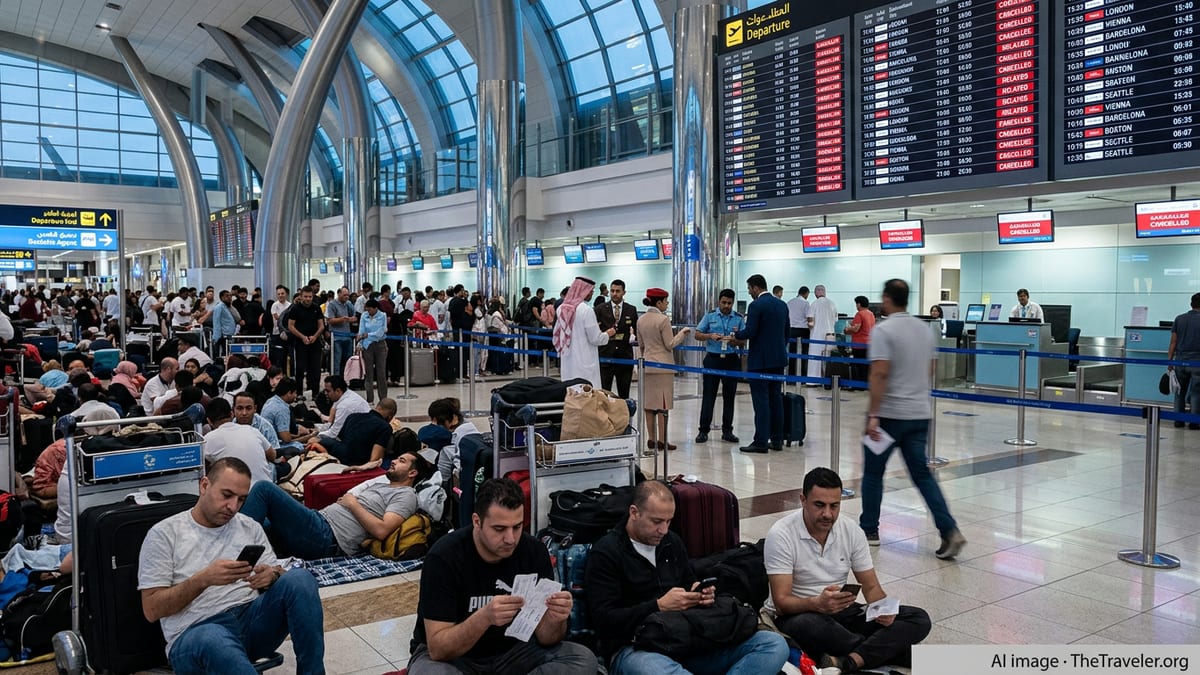
Airspace Shutdowns Ripple From Gulf Hubs to Global Gateways
Regional aviation has been in crisis since late February, when Iranian missile and drone strikes and subsequent U.S. and Israeli operations prompted swift airspace closures across much of the Gulf. Authorities in Qatar, the UAE, Bahrain, Kuwait, Saudi Arabia and Jordan moved to restrict or shut skies, forcing mass cancellations and diversions and bringing some of the world’s busiest hubs to a near standstill.
Data compiled from airport authorities and flight-tracking platforms on March 9 points to 1,044 cancellations and more than 300 delays linked to Middle East airspace disruption alone, as carriers struggled to reconfigure networks. While some countries, including Saudi Arabia and Oman, have partially reopened corridors, operators warn that permissions remain volatile and subject to abrupt withdrawal.
Dubai International, normally one of the world’s most dependable transfer hubs, is operating on a reduced schedule following a complete halt earlier in the crisis. In Doha, home base of Qatar Airways, authorities have authorized only limited operating corridors and a pared-back timetable, leaving hundreds of flights removed from schedules and terminals crowded with passengers waiting for scarce outbound seats.
The cumulative effect is a global shockwave. Long-haul services that depend on Gulf connections to bridge Europe, Asia, Africa and North America have been particularly hard hit, with schedules from London, Vienna, Barcelona, Boston, Seattle and other intercontinental gateways reshaped overnight.
Major Carriers Slash Schedules as Restrictions Bite
Flag carriers across the Gulf and key international airlines have been forced into emergency retrenchment. Emirates resumed only a fraction of its usual program from Dubai over the weekend, advising passengers not to travel to the airport without a confirmed, operating booking and warning that short-notice cancellations remain possible as security assessments evolve.
Etihad Airways, based in Abu Dhabi, has rolled out a limited commercial schedule focused on a handful of core routes, while warning that flights to and from heavily restricted markets such as Bahrain, Doha, Dammam, Kuwait and Amman remain suspended. Qatar Airways, operating under strict airspace constraints, is moving ahead with a narrow operating window from March 9 to 11, prioritizing repatriation and high-demand corridors.
The turmoil is not confined to regional brands. Gulf Air in Bahrain has been forced to ground services into and out of the kingdom on many routes, while European carriers including KLM and Air France face rolling disruptions as their Middle East rotations are cut or forced into lengthy detours around closed skies. U.S. airlines, among them United, have cancelled or rerouted services touching Gulf gateways, contributing to knock-on delays at hubs as far-flung as London, Paris, Amsterdam and New York.
Network planners describe an unprecedented operational puzzle. With traditional overflight paths across Iran and large parts of the northern Gulf off-limits or heavily restricted, airlines are burning more fuel on longer routings via the Arabian Sea or the eastern Mediterranean, shrinking the margin for error and tightening aircraft and crew availability for already stressed fleets.
Passengers Face Long Delays, Rapidly Shifting Options
For travelers caught in the middle, the numbers translate into long queues, unexpected hotel nights and fraying nerves. At South Asian gateways such as Dhaka and Lahore, passengers headed for Gulf labor markets and onward connections have seen wave after wave of cancellations in recent days, with entire families camping out in terminals while they wait for word of new departure times.
Inside major Gulf airports, authorities have tightened access, in some cases limiting terminal entry to passengers with verified, operating flights to prevent overcrowding. Airline staff report scenes of confusion as departure boards refresh multiple times an hour, reflecting the fine line between authorized and suspended routes under real-time security reviews.
On Europe and North America routes, delays are increasingly common even when flights do operate. Services linking Dubai and Doha with cities such as London, Vienna, Barcelona, Boston and Seattle are leaving hours behind schedule, in part due to complex rerouting around restricted airspace and in part due to late-arriving aircraft from previous disrupted sectors.
Travel agents and corporate travel managers say they are spending much of their time rebooking stranded customers via alternative hubs in Muscat, Istanbul, Cairo and South Asian cities, even as availability tightens and fares spike. Many travelers have been forced to accept itineraries with multiple connections, overnight layovers and indirect routings that would have been unthinkable just two weeks ago.
Global Aviation Network Strains Under Middle East Shock
The Middle East crisis has underscored just how central Gulf hubs have become to the global aviation ecosystem. Prior to the current conflict, more than 4,000 flights a day connected through the broader region, with Emirates, Qatar Airways and Etihad alone carrying millions of passengers a month between continents. With a large share of that capacity now offline or rerouted, pressure is mounting on alternative transit points.
European hubs such as Amsterdam Schiphol and Paris Charles de Gaulle have already recorded hundreds of additional delays and dozens of cancellations in recent days, as airlines attempt to rethread disrupted Middle East rotations through already busy schedules. Disruptions radiating from Dubai and Doha have been felt in Oslo, Frankfurt, Manchester, Montreal and New Delhi, as aircraft and crews struggle to be in the right place at the right time.
The cargo sector is also reeling. A significant portion of global air freight normally moves as belly cargo on wide-body passenger jets operating to and from the Gulf. With many of those services grounded or forced onto longer paths, freight forwarders report longer transit times, higher rates and a scramble for capacity on surviving lanes via alternative hubs.
Industry analysts warn that even if security conditions stabilize in the coming days, the recovery of regular schedules could take weeks. Airlines will need time to reposition aircraft and crews, clear passenger backlogs and realign fleet plans that were built around high-density Gulf connecting traffic.
Authorities Urge Caution as Limited Flights Resume
Despite the bleak picture, there are tentative signs of stabilization. The UAE has allowed a gradual resumption of flights at Dubai International and Al Maktoum International, and Abu Dhabi’s Etihad is steadily adding back selected routes. Qatar’s civil aviation authorities have created narrow operating corridors to allow controlled departures and arrivals over the next several days, though they continue to emphasize that permissions can be revoked quickly if the security outlook worsens.
Governments including the United States, the United Kingdom and several European Union members are maintaining strict travel advisories for the region, urging citizens to defer non-essential trips and, in some cases, to leave affected countries while commercial options remain available. Consular staff are working with airlines on ad hoc evacuations and prioritizing vulnerable travelers, but have cautioned that capacity is limited.
Regulators and airport operators across the Gulf are meanwhile focused on managing crowds and maintaining security. Entry controls at terminals, enhanced screening and visible military or police presence have become common at airports in Dubai, Abu Dhabi, Doha, Manama, Kuwait City, Jeddah and Riyadh, reinforcing the sense that normal travel patterns are unlikely to resume quickly.
For now, passengers with upcoming itineraries touching the Middle East or transiting via Gulf hubs are being urged to monitor airline alerts closely, keep contact details updated in bookings and be prepared for abrupt changes to routes and timings. With 1,044 cancellations and 309 delays recorded in a single day and more turbulence expected, the region’s aviation recovery is set to be a slow and uncertain journey.