

More news on this day
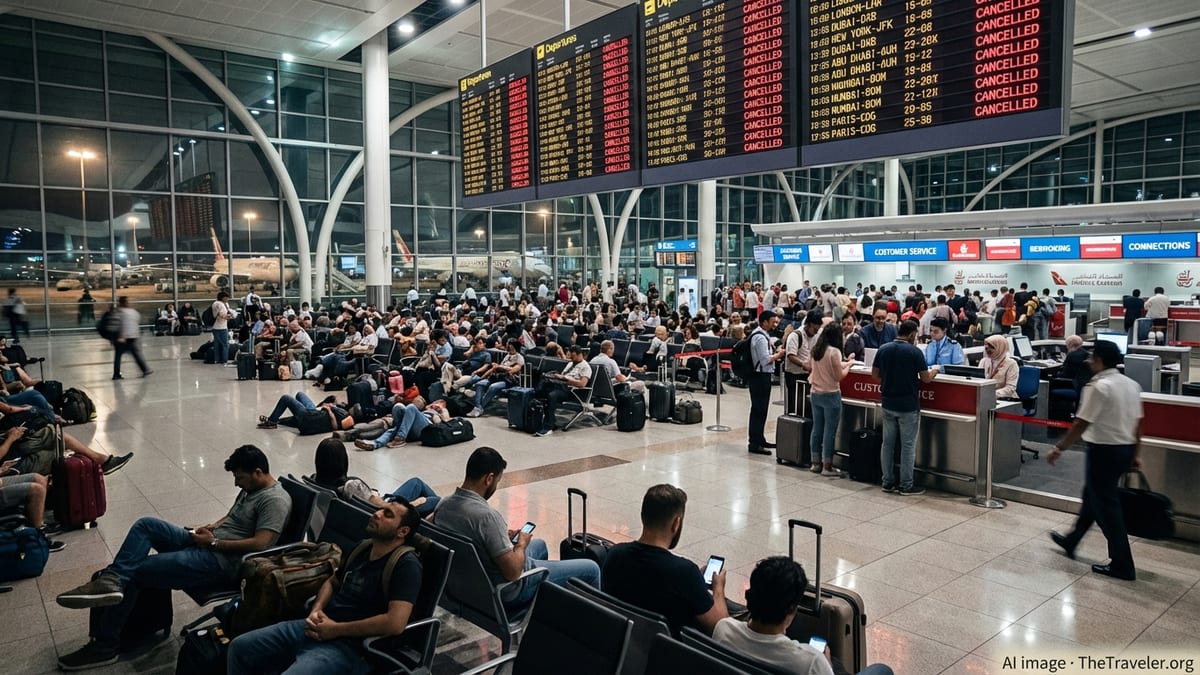
Thousands of travelers across the Middle East, Europe and North America are stranded or rerouted this week after a rapid shutdown of key Gulf air corridors triggered 1,216 flight cancellations and 516 delays, disrupting operations at major hubs from Dubai and Muscat to London, Paris, New York and Miami.
Conflict-Linked Airspace Closures Ripple Across Global Hubs
The latest wave of disruption follows the escalating conflict involving Iran and Israel, which has led to widespread airspace closures over Iran, Iraq, Israel, Jordan, Qatar, Bahrain, Kuwait and the United Arab Emirates, with parts of Syrian airspace also restricted. Commercial overflights on some of the world’s busiest east west routes have been forced to divert or halt entirely, severing vital links between Europe, Asia, Africa and Australia.
Dubai International Airport and other airports in the UAE have only partially reopened after earlier full suspensions, while Doha remains largely shut as Qatar Airways keeps regular passenger services grounded. Oman’s Muscat International Airport, serving the capital region that includes Seeb, has become a pressure valve for limited relief flights as carriers attempt to bypass closed airspace.
The knock on effects have cascaded far beyond the Gulf. Long haul services into London Heathrow, Dublin, Berlin, Paris Charles de Gaulle, New York and Miami have been trimmed or redirected as airlines recalculate flight paths around the restricted zone, adding time, fuel burn and complexity to already stretched schedules.
With capacity sharply reduced and aircraft and crews out of position, even airports not directly affected by airspace closures are now grappling with rolling delays and cancellations, leaving passengers facing missed connections, overnight stays and uncertain rebooking options.
Major Airlines Slash Schedules and Reroute Long-Haul Services
Gulf heavyweight Emirates has been operating a significantly reduced network from Dubai, prioritizing a limited set of trunk routes to cities such as London, New York and Sydney while cancelling or consolidating dozens of regional services. Sister carrier flydubai has also cut a large share of its regional flights after the closure of neighboring airspace and suspension of overflight rights on key corridors.
Etihad Airways, based in Abu Dhabi, suspended regular commercial flights for several days and is now cautiously rebuilding a slimmed down schedule, focusing on essential long haul routes while keeping many frequencies to the Middle East and South Asia offline. Qatar Airways, which normally runs one of the world’s densest global networks through Doha, remains largely grounded except for a small number of relief and repatriation flights staged via airports in Oman and Saudi Arabia.
European and US carriers have also been forced to adapt. Air France and KLM have suspended or curtailed flights to Dubai, Riyadh and other Gulf destinations and are avoiding Iranian and Iraqi airspace on remaining services, while British Airways has halted flights to several cities across the region and warned passengers not to travel to the airport without a confirmed booking. US airlines including United and Delta have adjusted routings on services linking Europe and North America that would normally overfly the Gulf, leading to extended flight times and equipment swaps.
Industry data providers report that across these and other carriers, at least 1,216 scheduled flights touching the wider Middle East region have been cancelled over a matter of days, with a further 516 departures and arrivals operating with significant delays as new routings and crew duty limits are worked out in real time.
Travelers Stranded in Dubai, Muscat, London, New York and Beyond
For passengers caught in the middle, the impact has been immediate and deeply personal. At Dubai International, where authorities earlier urged people not to come to the airport unless they had written confirmation that their flight was operating, terminals have swung between eerie quiet during full shutdowns and crowded scenes when limited departures resume and backlogs of travelers converge at once.
In Muscat, which sits just outside the most heavily restricted airspace, departure boards tell the story of the crisis, with clusters of special services to European capitals and a smattering of onward flights as airlines try to use Oman as an alternate gateway between Europe, Asia and Africa. Hotel lobbies near the airport are packed with transit passengers awaiting word from airlines on when they can continue their journeys.
Knock on disruptions are visible across Europe and North America. Passengers arriving at London Heathrow, Dublin and Berlin on rare operating flights from the region report paying high last minute fares or making complex detours via secondary airports just to get out. In Paris, one government charter intended to evacuate nationals from the UAE had to turn back after reports of missile activity, adding to uncertainty for those still trying to leave.
In New York and Miami, the most immediate impact has been seen on connections from Europe and the Gulf. While airports remain open, schedules have been thinned, and passengers report multihour delays and missed onward domestic flights as long haul aircraft arrive outside their planned slots, straining ground operations and rebooking desks.
Governments Issue Warnings as Airlines Offer Flexibility
Governments have responded with blunt travel advisories. Several Western countries have urged citizens already in the region to depart on any available commercial flight and advised others to defer nonessential travel. Consular officials have warned that options could narrow further if the conflict escalates or if remaining air corridors become unsafe or unavailable.
Airlines, meanwhile, are trying to balance safety, operational constraints and customer service. Emirates, Etihad, Qatar Airways and other Gulf carriers are offering free rebooking and refunds for passengers whose flights have been cancelled, though availability on alternative services is limited. European carriers such as Air France, KLM and British Airways have issued broad waivers for tickets to and from affected destinations, allowing date and routing changes without penalty within specified travel windows.
US airlines have also activated flexible policies for itineraries involving the Middle East or flights that must be rerouted around the region. However, with aircraft and crews heavily out of position and remaining air corridors congested, there is no quick fix. Many passengers are being told it could take several days before they can be rebooked on viable itineraries, especially to and from smaller cities.
Travel insurance providers report a spike in claims and inquiries, though coverage varies by policy and may depend on whether airspace closures are categorized as a security event, act of war or force majeure. Travelers are being urged to document expenses and keep all receipts while they wait for clearer guidance.
What Travelers Should Do Now
With the situation evolving day by day, aviation analysts say the most important step for affected travelers is to stay closely connected to their airline through official apps, text alerts and customer service channels. Schedules are being adjusted frequently as airspace permissions shift, and a flight that appears cancelled one day may reappear as part of a limited rescue operation or rerouted service the next.
Experts advise against heading to airports in the Gulf, especially Dubai and Doha, without explicit confirmation that a flight is operating and a seat is confirmed, as terminal access and check in may be restricted during shutdown periods. Where possible, travelers are encouraged to consider alternative routings that avoid the Middle East entirely, such as transatlantic or transpacific options, even if they add extra hours in the air.
For those already stranded in hubs such as Dubai, Muscat, London or Paris, documenting all communication with airlines and keeping records of hotel and meal expenses will be critical in any later claim for refunds or compensation. While most carriers are waiving change fees, statutory compensation rules may not apply because the disruption stems from security and airspace decisions outside the airlines’ control.
With more than a thousand flights already cancelled and hundreds more delayed, industry officials warn that the global aviation system will feel the aftershocks for weeks, even if airspace restrictions begin to ease. For now, travelers heading anywhere near the affected corridors are being urged to brace for uncertainty and to build in extra time, flexibility and patience.