

More news on this day
Thousands of air travelers across the Middle East are facing days of disruption after widespread airspace closures led to hundreds of flight cancellations and delays, crippling operations at hubs in Doha, Dubai, Cairo, Jeddah and other major cities.
Get the latest news straight to your inbox!
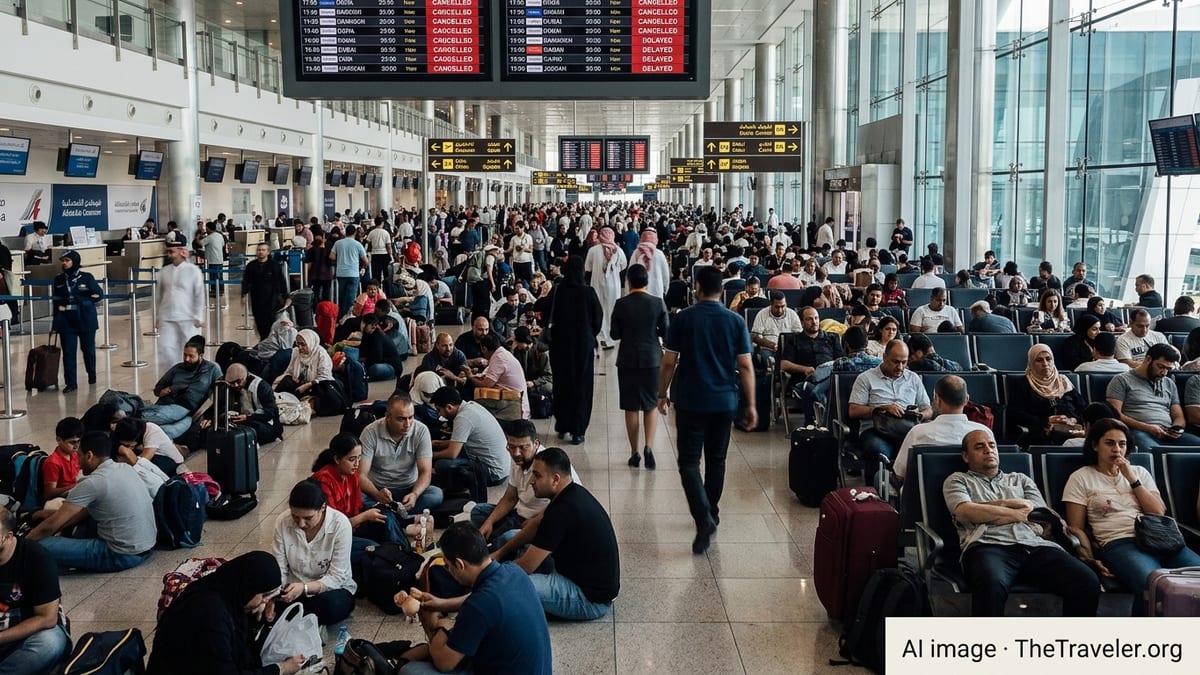
Conflict-Linked Airspace Closures Ripple Across the Region
Publicly available aviation data and recent travel advisories indicate that escalating conflict involving Iran, Israel and several Gulf states has forced large portions of Middle Eastern airspace to close or restrict civilian traffic. Airspace in Qatar, the United Arab Emirates, Bahrain, Israel and neighboring states has been subject to rolling shutdowns and tight capacity limits in recent weeks, triggering severe knock-on effects for regional and long-haul routes.
Operational updates shared by corporate travel managers and aviation trackers on March 2 and 3 describe near-total suspensions of regular passenger services at key hubs such as Doha’s Hamad International Airport and Dubai International Airport. Airlines have pivoted to emergency-style operating corridors and limited repatriation flights, but normal commercial schedules remain far from restored.
Traffic statistics circulating among industry analysts suggest that, across affected markets, at least 233 flights were cancelled and more than 1,100 were delayed in a short window as restrictions took hold, with totals rising steadily as the crisis extended. These figures capture only a portion of the overall disruption, as many carriers removed services from schedules entirely rather than registering them as last-minute cancellations.
The airspace closures are part of a broader regional shock. Economic assessments of the conflict point to simultaneous hits on oil production, shipping and air transport, with Middle Eastern airports that usually handle a significant share of global connecting traffic suddenly operating at drastically reduced capacity or going offline for days.
Major Carriers Scale Back as Hubs Grind to a Halt
Emirates, Qatar Airways, Etihad Airways, Saudia, Gulf Air, EgyptAir, Pegasus Airlines and other regional and international carriers have been forced to suspend or sharply curtail operations on many routes in and out of the Gulf and wider Middle East. Advisory notices compiled by travel management firms in early March show Emirates temporarily halting almost all passenger services to and from Dubai for defined windows, while Etihad has held most departures from Abu Dhabi pending clearer guidance on safe flight corridors.
In Qatar, publicly available information from the Qatar Civil Aviation Authority and airline updates shows that standard commercial flights from Doha were halted after Iranian missile strikes and subsequent airspace closures. Limited navigation under emergency conditions was later reinstated primarily for evacuation and cargo operations, with carefully controlled corridors allowing a small number of repatriation flights to connect Doha with European hubs such as London, Paris, Madrid, Rome and Frankfurt.
Carriers based outside the Gulf have also responded by suspending flights into affected countries. Reports from aviation analytics firms and regional media outlets describe airlines in Asia and Europe cancelling or rerouting services to the United Arab Emirates, Saudi Arabia, Qatar, Israel, Bahrain and beyond. Some long-haul flights have been forced into lengthy diversions around the Gulf, adding hours to journey times and incurring higher fuel costs.
Operational snapshots shared in early and mid-March indicate that even when partial services resumed, frequencies were drastically reduced. In Dubai and Doha, airlines prioritized outbound flights for stranded travelers, often operating with wide gaps between departures as they navigated restricted airspace, crew duty limits and airport congestion.
Passengers Stranded in Doha, Dubai, Cairo and Jeddah
The abrupt shutdown of regular schedules has left thousands of passengers stranded in major transit hubs, often with little advance notice. Posts and travel updates shared by affected travelers describe crowded terminals, extended waits at rebooking desks and difficulty securing hotel accommodation near airports that remain formally open but with only a trickle of flights operating.
In Doha, many passengers were caught when airspace restrictions came into force while they were already in transit. Publicly available accounts on travel forums and social platforms suggest that travelers bound for Europe, Asia and Africa through Qatar’s capital faced multiple days of uncertainty as outbound flights were successively cancelled or pushed back. Some reported being advised not to return to the airport until their rebooked flights were explicitly confirmed.
Similar scenes have been reported in Dubai, Jeddah and Cairo, where regional carriers such as Emirates, Saudia and EgyptAir serve as vital connectors between continents. With schedules repeatedly revised, families, migrant workers, and business travelers struggled to secure alternative routes, sometimes piecing together itineraries via less affected hubs on the periphery of the conflict zone.
Travel advisories circulated by corporate travel agencies emphasize that the disruption extends beyond the Gulf. Secondary airports around the Middle East, North Africa, and parts of Europe are seeing irregular surges in demand as rerouted aircraft and displaced passengers are funneled through new corridors that avoid the most heavily restricted airspace.
Knock-On Effects for Global Aviation Networks
The grounding and rerouting of flights through the Middle East has quickly become a global aviation issue. Analysts tracking traffic flows note that Gulf hubs typically handle a substantial share of connecting traffic between Europe, Asia, Africa and Australia. With those hubs operating at a fraction of normal capacity, airlines worldwide are being forced to redraw networks, retime schedules and, in many cases, cancel services outright.
Reports drawing on flight tracking data highlight thousands of daily cancellations linked directly or indirectly to the Middle East airspace closures. Some carriers have shifted aircraft to serve alternative routes that bypass the region entirely, while others have reduced overall capacity as demand softens amid uncertainty about transit reliability.
Industry commentary points to longer-term challenges if the conflict and airspace restrictions persist. Extended flying times around closed corridors place additional pressure on fuel budgets, crew allocations and maintenance planning. For travelers, the practical effect is fewer available seats, longer journeys and a greater risk of last-minute changes even on routes that do not touch the Middle East directly.
Airports outside the immediate conflict zone, from southern Europe to South Asia, are also adapting to new patterns of demand. Some are seeing increased use as emergency diversion points and temporary mini-hubs for repatriation flights, while others have become gathering points for travelers waiting on standby for scarce seats out of the region.
What Travelers Can Do Amid Ongoing Uncertainty
Travel organizations and aviation observers are advising passengers to treat the disruption as fluid and evolving rather than a short, one-off shutdown. Publicly available guidance emphasizes that timetables in published schedules may not reflect real-time operational decisions, particularly for flights crossing or approaching the affected airspace zones.
Passengers with upcoming trips involving Doha, Dubai, Abu Dhabi, Jeddah, Riyadh, Cairo, Tel Aviv, Manama or nearby hubs are being urged through travel advisories and airline statements to check flight status repeatedly before leaving for the airport. Many carriers are allowing fee-free rebooking, date changes and in some cases full refunds when flights are cancelled or significantly delayed due to the conflict-related restrictions.
For those already stranded, widely shared recommendations include maintaining direct contact through official airline apps or call centers, monitoring airport operator notices, and remaining flexible about routing options. Some travelers have been able to secure seats via secondary hubs in regions such as southern Europe or North Africa, even when direct services through the Gulf remain severely constrained.
While limited repatriation operations are gradually restoring a measure of connectivity, the underlying airspace closures and security concerns have not fully eased. For now, publicly available information suggests that the Middle East’s role as a seamless global crossroads has been sharply curtailed, with stranded passengers and skeleton schedules underscoring the vulnerability of modern air travel to regional conflict.