

More news on this day
Thousands of passengers across the Middle East and beyond remain stranded after widespread airspace closures triggered mass cancellations and delays, disrupting at least 246 flights and delaying more than 1,475 services operated by major carriers including EgyptAir, Emirates, Gulf Air and Saudia.
Get the latest news straight to your inbox!
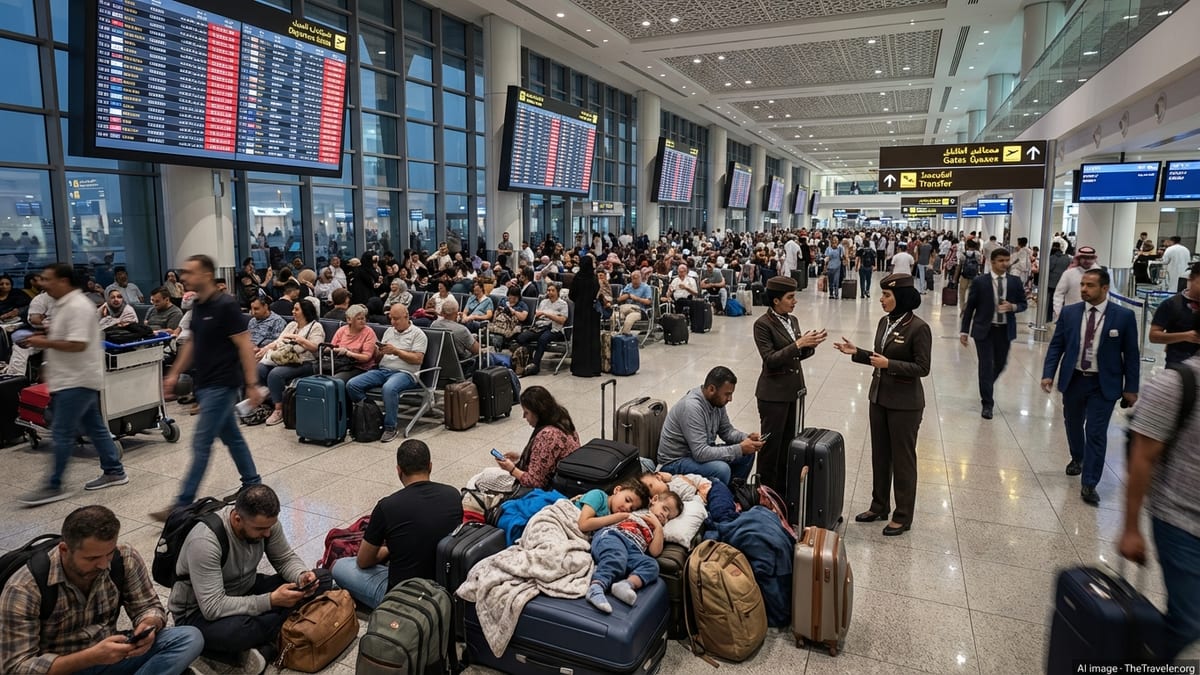
Conflict-Linked Airspace Closures Paralyse Key Hubs
Published reports indicate that escalating regional conflict involving Iran, Israel and the United States has led multiple Middle Eastern countries to restrict or close their airspace, turning the region’s busiest hubs into bottlenecks for global travel. Aviation tracking data cited in recent coverage shows thousands of flights scrapped across Saudi Arabia, the United Arab Emirates, Qatar, Bahrain, Israel and neighbouring states, with further disruptions expected as the situation continues.
Flight analytics cited by international media point to hundreds of cancellations and well over a thousand delays in a short window, including at least 246 flights fully cancelled and 1,475 delayed as airlines attempt to reroute aircraft or await clearance to operate. Many services that do depart are operating with extended flight times and significant diversions, placing further strain on crews, fleets and airport infrastructure.
The disruption is particularly acute because Gulf and Levant airports sit at the crossroads of routes linking Europe, Asia, Africa and Oceania. With sections of airspace over and around the Gulf temporarily restricted, long-haul carriers are being forced into longer southern or western corridors, while some services are being terminated short of their planned destinations.
Publicly available information shows that the rolling operational decisions are being driven by both direct security concerns around missile and drone activity and by precautionary restrictions imposed while risk assessments are carried out. This combination has produced a patchwork of closures and partial resumptions that is difficult for travellers to predict.
Jeddah, Dubai, Riyadh and Cairo Hit by Wave of Disruptions
Major hubs including Jeddah, Dubai, Riyadh and Cairo have seen some of the heaviest disruption, with terminal departure boards showing long stretches of red as cancellations and extensive delays accumulate. Reports from regional media and passenger accounts describe crowded terminals, long queues at airline desks and ad hoc overnight stays as travellers wait for scarce outbound seats.
In Saudi Arabia, services through Jeddah and Riyadh have been repeatedly adjusted as airspace restrictions shift and airlines reposition aircraft. Some domestic operations have continued, allowing a fraction of passengers to reach alternative gateways within the kingdom, but international connectivity remains seriously constrained.
Dubai, normally one of the world’s most reliable long-haul transit hubs, has been operating on a sharply reduced schedule as conflict-related strikes and airspace closures ripple across the region. Available coverage indicates that a combination of suspended arrivals, outbound cancellations and diversions to other airports has left many travellers stuck in the emirate or unable to reach it for onward connections.
Cairo, a critical junction for traffic between Africa, the Gulf and Europe, has also been drawn into the disruption. Egypt’s flag carrier has suspended or adjusted multiple services to Gulf destinations and Israel, further complicating travel plans for passengers who depend on Cairo as a regional transfer point.
Major Carriers Scramble to Rebook and Repatriate
Flag carriers and regional airlines are now working on what amounts to a rolling contingency plan for stranded customers. Public statements and network updates from airlines such as Emirates, Saudia, Gulf Air, EgyptAir, Qatar Airways and others show a mix of cancellations, limited repatriation flights and selective resumptions on routes judged to be safe and operationally viable.
Emirates and other UAE-based carriers have introduced reduced schedules, with a focus on key trunk routes and relief flights to move passengers caught in transit. Some flights are being routed via alternative airports or air corridors, often adding several hours to journey times. Gulf Air has steered passengers towards departures from Saudi gateways when Bahrain’s airspace has been more heavily restricted.
Saudi Arabia’s Saudia has similarly reshaped its network, prioritising services through less-affected airports and coordinating with partners where codeshare arrangements allow for onward connections. EgyptAir and other North African airlines are adjusting timetables to reflect the closure of airspace over parts of the Levant and Gulf, limiting flights into and across the most affected zones.
According to aviation data cited in recent analyses, the disruption is also squeezing aircraft and crew availability worldwide. Aircraft that cannot overfly key Middle Eastern corridors are arriving out of sequence or not at all, forcing carriers across Europe, Asia and Africa to thin their schedules or cancel rotations even on routes far from the conflict area.
Stranded Travellers Face Long Waits and Complex Rerouting
For passengers on the ground, the operational complexity translates into hours or days of uncertainty. Accounts compiled by regional and international outlets describe travellers sleeping in airport terminals, shuttling between hotels and check-in counters, and repeatedly rebooking as flights are rescheduled, then cancelled again at short notice.
Many travellers flying between Europe and Asia via the Gulf have been left in limbo after their connecting flights were removed from schedules while they were already en route. Some have been offered rerouting via longer southern paths through Saudi Arabia, Oman or North Africa where airspace remains open, though such options are limited by capacity and crew duty-time constraints.
Travel advisories from governments and airlines urge passengers to monitor their flight status closely and to avoid going to the airport unless a confirmed departure is listed. Publicly available guidance from consumer bodies also recommends keeping boarding passes, receipts and written communication from airlines to support later claims for refunds or reimbursements where applicable.
Insurance coverage has emerged as another point of uncertainty. Policy wording around conflict and war-related disruption varies widely, and travellers are being asked to review their documents carefully and contact providers directly to clarify whether their circumstances qualify for compensation or alternative arrangements.
Global Ripple Effects on Routes Far Beyond the Region
The shutdown across segments of Middle Eastern airspace is generating consequences far beyond the immediate conflict zone. Airlines in Asia, Europe and Africa that rely on overflight rights across the Gulf and Levant are reporting longer routing times, higher fuel consumption and schedule knock-on effects that extend to secondary and tertiary destinations.
Europe-bound flights from South and Southeast Asia, for example, are being rerouted via more southerly tracks over the Arabian Sea, the Red Sea or parts of North and East Africa, lengthening journeys and narrowing the margins that airlines typically build into their timetables. This, in turn, increases the likelihood of missed onward connections and missed aircraft rotations in distant markets.
Carriers that do not normally serve the Gulf are also affected when aircraft and crews become stranded or delayed at partner hubs such as Dubai, Doha, Jeddah or Cairo. According to industry analysis published in recent days, these network-wide disruptions can take weeks to unwind, even after airspace begins to reopen, as airlines work through backlogs and reposition aircraft.
Industry observers note that the current wave of disruption once again underlines the centrality of Middle Eastern hubs to modern global aviation. With a relatively small number of airports handling an outsized share of east west long-haul traffic, any prolonged closure or restriction in the region quickly reverberates through booking systems, schedules and, ultimately, travellers’ lives on a global scale.