

More news on this day
Thousands of travellers have been stranded at airports across the Middle East after a cascading wave of airspace closures and security restrictions forced airlines in the UAE, Turkey, Bahrain, Oman, Saudi Arabia and beyond to ground or delay hundreds of flights, disrupting key global routes that link Europe, Asia and Africa.
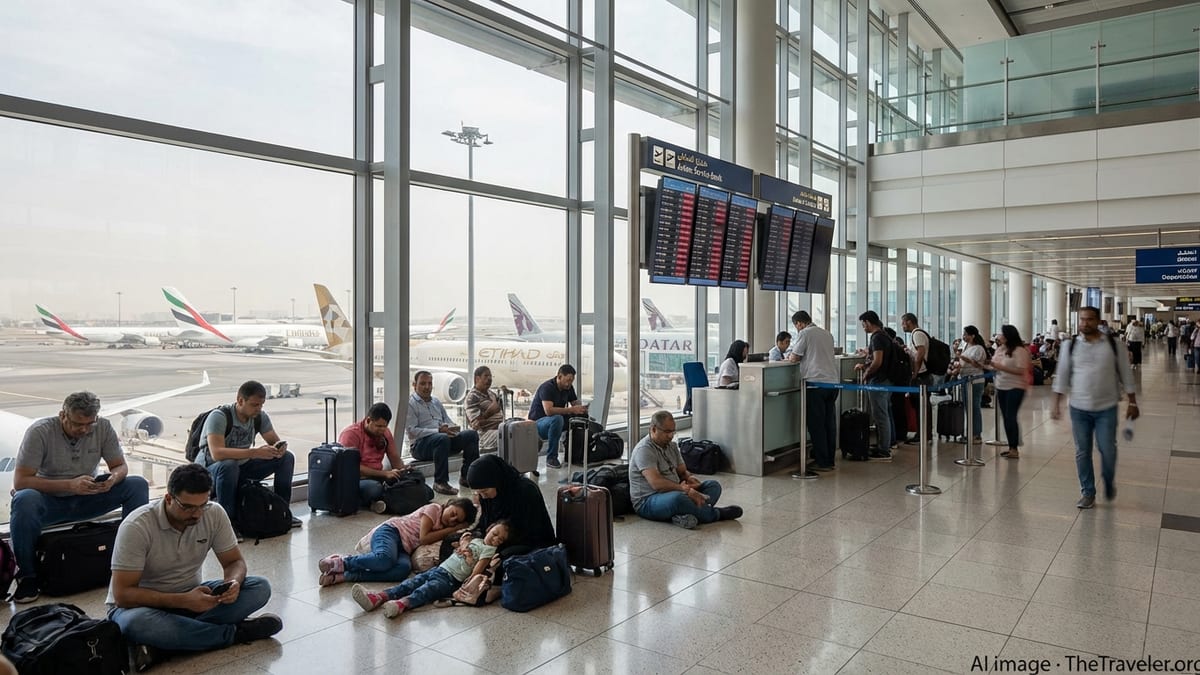
Regional Airspace Shutdown Ripples Across Key Hubs
Authorities across the Gulf and wider Middle East moved swiftly to restrict or close sections of their airspace on Saturday, prompting a rapid series of cancellations, diversions and long delays on one of the world’s busiest aviation corridors. Flight tracking data showed skies over Iran and parts of neighboring countries largely empty as carriers rerouted or halted services to avoid emerging conflict zones and potential missile trajectories.
Preliminary figures from regional aviation sources indicated at least 346 flights were grounded outright and more than 500 delayed across major hubs including Dubai, Abu Dhabi, Doha, Jeddah, Muscat, Istanbul and Bahrain, with disruption spreading along long-haul routes connecting Europe and North America with South and Southeast Asia. Aviation analysts warned that those tallies were likely to climb through the day as airlines updated schedules and repositioned aircraft and crews.
With Russian and Ukrainian airspace already off limits to many international carriers, the sudden squeeze on Middle East skies has created a fresh bottleneck on the vital Europe Asia corridor. Airlines that normally rely on direct overflight of Iran, Iraq and surrounding states have been forced into longer, more southerly routings, increasing fuel burn, flight times and crew duty limits while complicating already tight global schedules.
Regional regulators stressed that the measures were precautionary and driven by safety considerations, but the combined effect has been an abrupt shock to both point to point regional traffic and long haul transfer flows that funnel through Gulf and Turkish hubs. Travel industry executives said the disruption was among the most significant the region has seen since earlier rounds of tensions triggered airspace closures in 2025.
Emirates, Etihad and Gulf Carriers Forced to Ground Services
Dubai based Emirates and Abu Dhabi based Etihad were among the first major Gulf airlines to confirm significant operational disruption, as flights to several regional destinations were cancelled and others subjected to rolling delays and reroutes. Airport operators in Dubai reported multiple Emirates departures to nearby Middle East cities scrubbed from departure boards as the carrier worked with regulators to adjust routing and timing.
In statements, both Emirates and Etihad reiterated that safety of passengers and crew remained their highest priority and said they were actively monitoring the evolving security situation while coordinating with national and international aviation authorities. The airlines said affected customers were being offered rebooking, refunds or alternative travel options where available, although limited spare capacity across the network made same day solutions difficult in many cases.
Qatar Airways, Gulf Air, flydubai and Air Arabia also faced mounting disruption as airspace closures and restrictions extended across parts of the Gulf and Levant. Bahrain’s Gulf Air reported cancellations and delays on services touching Iran, Iraq and the eastern Mediterranean, while low cost and regional carriers warned of further last minute adjustments as new air traffic guidance was issued.
Industry observers noted that Gulf mega hubs such as Dubai, Abu Dhabi and Doha are uniquely exposed when regional skies constrict, because a large share of their traffic consists of transfer passengers whose itineraries depend on tightly timed connections. When one segment of a journey is cancelled or significantly delayed, onward sectors can quickly unravel, leaving aircraft and crews out of position and stranding passengers far from their final destinations.
Travellers Stranded From Dubai to Istanbul and Jeddah
Inside terminals from Dubai International to Istanbul Airport and Jeddah’s King Abdulaziz International, long queues formed at airline service desks as passengers sought information, hotel vouchers and rebookings. Many travellers learned of cancellations only after arriving at the airport, as airlines raced to update schedules and push notifications in line with fast changing regulatory advisories.
In Dubai, departure boards showed clusters of cancelled and delayed flights to Gulf, Levant and South Asian destinations, with some services marked as indefinitely delayed while carriers waited for revised routing clearances. Travellers described scenes of confusion around transfer zones, where hundreds of connecting passengers were left in limbo as their onward flights disappeared from the screens or were pushed back by several hours.
At Istanbul, a crucial bridge between Europe and the Middle East, Turkish Airlines and other carriers were forced to trim or retime services to conflict exposed airspace, complicating plans for holidaymakers heading to Gulf beach resorts, business travellers bound for Dubai and Doha, and migrant workers returning to jobs in Saudi Arabia and the UAE. Similar reports emerged from Jeddah, Riyadh and Muscat, where large numbers of labour and pilgrimage travellers were caught up in the disruption.
Airports activated contingency plans that included distributing water and meal vouchers, opening overflow seating areas and coordinating with local hotels as it became clear that many passengers would be forced to spend at least one extra night in transit. Ground staff urged travellers to remain patient and to rely on official airline communications rather than social media rumours as the situation evolved.
Global Carriers Adjust Routes as Delays Mount
The turmoil was not confined to Middle East based airlines. European and Asian carriers including Lufthansa, Air France KLM, Japan Airlines and several low cost operators announced suspensions or diversions of flights to destinations such as Tel Aviv, Beirut, Muscat, Dubai and Doha as they moved to avoid the most affected airspace corridors. Some long haul flights between Europe and Asia were forced to turn back mid route or divert to alternative airports for refuelling and crew changes.
Flight tracking platforms showed extended routings on services linking cities like London, Frankfurt and Paris with hubs in India and Southeast Asia, with some flights adding several hundred nautical miles to circumvent no fly zones. That translated into longer flight times, missed connections and additional strain on aircraft utilisation at a time when many airlines are already operating near capacity.
Analysts said the combined effect of several hundred cancellations and widespread delays could take days to fully unwind, particularly if airspace restrictions remain in place or are expanded. Airlines may be forced to temporarily trim schedules, substitute larger aircraft on key routes to clear backlogs, or prioritise repatriation of stranded passengers over new bookings until operations stabilise.
Travel agents in Europe and Asia reported a surge in inquiries from customers worried about upcoming trips through Gulf hubs, with some seeking to reroute via alternative pathways that avoid the region entirely. However, with many major global carriers also impacted and alternative corridors already congested, the scope for completely bypassing the Middle East in the short term appears limited.
What Travellers Can Expect in the Coming Days
Aviation experts and industry bodies have urged travellers with itineraries touching the Middle East over the next week to prepare for continued disruption, even if security conditions begin to ease. They advise passengers to assume that departure and arrival times may shift at short notice, to monitor airline apps and airport notifications closely, and to build generous buffers into any critical onward plans.
Airlines are expected to publish rolling waivers allowing customers to rebook or defer travel without change fees, particularly on routes most exposed to restricted airspace. However, limited seat availability during the busy late winter and early spring travel period means that securing alternative dates in the same cabin class may prove challenging, especially for large families or groups.
Travel insurance providers said policyholders should read the fine print on coverage related to war, civil unrest and government mandated airspace closures, as not all plans treat such events in the same way. In many cases, airlines will be responsible for care and assistance such as meals and accommodation during extended delays, but compensation for missed holidays or business opportunities may be more difficult to claim.
For now, airports and airlines across Dubai, Abu Dhabi, Doha, Jeddah, Istanbul, Muscat, Bahrain and other key hubs are focused on stabilising operations and gradually clearing backlogs as conditions and regulations allow. Until then, thousands of passengers remain in an uneasy holding pattern, watching departure boards and phone screens for any sign that their journeys across the Middle East’s vital air corridor can safely resume.