

More news on this day
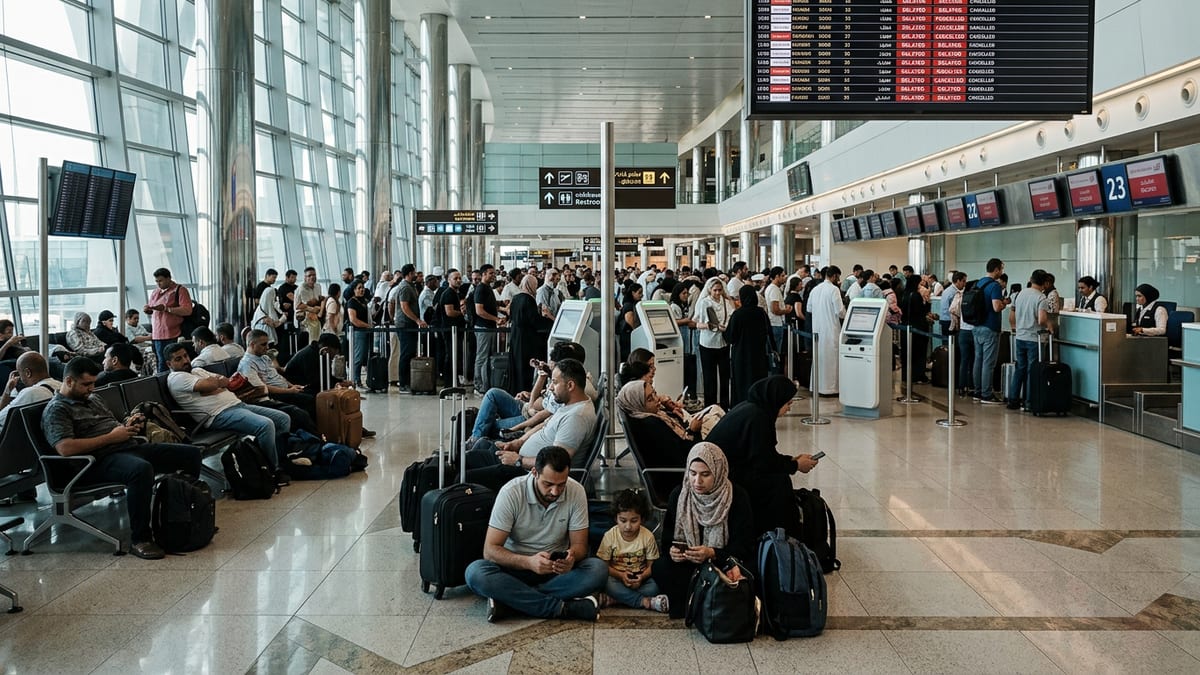
Thousands of airline passengers have been left stranded across the Middle East as carriers scrub at least 233 flights and delay more than 1,100 others, with cascading disruptions paralyzing major hubs in Doha, Dubai, Cairo, Jeddah and beyond amid a rapidly escalating regional security crisis.
Get the latest news straight to your inbox!
Regional Airspace Closures Ripple Across Key Hubs
Publicly available flight-tracking data and industry advisories show that a patchwork of airspace restrictions across Saudi Arabia, the United Arab Emirates, Qatar, Israel, Bahrain and neighboring states has translated into a sharp reduction in scheduled commercial traffic. As airports and airlines adjust to shifting no-fly zones and route bans, passengers have borne the brunt in the form of mass cancellations, rolling delays and forced diversions.
In Doha, operations at Hamad International Airport have been repeatedly disrupted by the closure of Qatari airspace on security grounds, leading to grounded Qatar-bound services and diversions to alternate airports in the region. In the Gulf’s busiest hub, Dubai International Airport, a combination of intercepted projectiles in nearby airspace and precautionary restrictions has periodically slowed movements to a fraction of normal daily volumes.
Similar patterns are visible in Cairo, Jeddah, Riyadh and other regional gateways, where national carriers have scaled back or temporarily suspended flights on routes crossing contested skies. The result is a fragmented network in which some city pairs remain accessible via lengthy detours, while others have effectively dropped off the map for days at a time.
Analysts note that while individual airports may technically remain open, the closure of surrounding airspace corridors has had a comparable effect to outright shutdowns. Aircraft that do depart are often forced to fly extended routing through remaining open corridors over Oman, parts of Saudi Arabia, or North Africa, increasing flight times and further straining airline schedules.
Major Carriers Slash Schedules and Suspend Routes
The unprecedented conditions have hit Gulf and regional airlines at the core of their networks. Emirates, based in Dubai, has cut hundreds of rotations serving the wider Middle East, Europe, Asia and Africa as it navigates airspace closures over the UAE and neighboring states. EgyptAir has suspended a range of services to and from Gulf destinations, including flights to Dubai, Abu Dhabi and Doha, according to published corporate updates and industry briefings.
Saudi flag carrier Saudia has also been forced to pare back operations, particularly on services touching affected airspace around Israel, Qatar and Bahrain. In Bahrain, Gulf Air has faced repeated disruptions as Bahrain’s skies are intermittently restricted, complicating its role as a transfer hub between Europe, Asia and the Indian subcontinent.
Low cost and regional operators have not been spared. Flights by Turkey’s Pegasus Airlines and various Middle Eastern budget carriers that typically connect secondary cities to the big hubs in Doha, Dubai, Cairo and Jeddah have seen widespread cancellations. For many travelers, these airlines provide the first or last leg of longer itineraries, meaning a single scrubbed sector can derail entire multi-stop journeys.
According to aggregated operational tallies reviewed by aviation analysts, the current wave of disruption has produced at least 233 outright cancellations and more than 1,100 delays across affected Middle Eastern airspace in a compressed period. Observers caution that these figures likely understate the true scale, as they do not fully capture last minute schedule changes, aircraft reassignments and rolling knock-on delays outside the region.
Passengers Face Overnight Stays, Rebookings and Uncertain Timelines
The operational turmoil has translated into often chaotic scenes for travelers on the ground. Reports from passengers, airport information boards and airline status feeds indicate that many travelers have been stranded for 24 hours or longer, sometimes sleeping in terminal seating or on the floor while they wait for rebooking options to materialize.
In Dubai and Doha in particular, where large numbers of long haul itineraries hinge on tightly timed connections, a canceled or heavily delayed inbound flight can mean missed onward links to Europe, North America, Africa or Asia. With hub banks disrupted and replacement services in short supply, some passengers have been rebooked days later or rerouted via circuitous paths through unaffected airports in Muscat, Istanbul or European gateways.
Travel advisories issued by corporate travel managers and security consultancies emphasize the importance of checking flight status repeatedly rather than relying on initial booking confirmations. Public guidance urges passengers to anticipate extended processing times at check in and security, carry essential medications and valuables in hand luggage, and be prepared for unplanned overnight stays should conditions deteriorate while they are in transit.
Travel insurance providers are also beginning to flag complex coverage questions, as some policies treat airspace closures linked to armed conflict differently from routine weather or technical delays. Consumer advocates suggest that travelers review the fine print of disruption and trip interruption clauses and document all expenses incurred while stranded.
Economic Shock for Aviation and Tourism
Beyond immediate traveler inconvenience, the grounded fleet poses a significant economic blow to airlines and the wider tourism ecosystem. Industry analyses connect the current upheaval to the broader conflict dynamic in the region, noting that airspace closures over multiple Gulf and Levant states have eroded confidence in itineraries that rely on Middle Eastern hubs for seamless east west connectivity.
With hundreds of aircraft either parked or flying less efficient routes, fuel and crew costs have climbed while revenue has fallen. Hotel occupancy patterns in hub cities are skewed as transit passengers are forced into unplanned overnight stays, while new tourist arrivals decline. Downstream sectors such as airport retail, ride hailing services and tour operators are already reporting weaker activity compared with pre crisis projections.
Trade and cargo flows have similarly been affected. Freighter aircraft and belly hold cargo on passenger jets are key components of just in time supply chains linking Asia, Europe and Africa. Prolonged disruptions in Middle Eastern airspace have led to delays in high value shipments, from electronics and fashion to pharmaceuticals, prompting some companies to consider alternative routings or modes of transport where feasible.
Economists warn that if restrictions and security concerns persist, airlines may need to realign networks more fundamentally, reducing reliance on certain hubs and favoring alternate corridors through South Asia, Central Asia or southern Mediterranean states. Such shifts would reshape long established travel patterns and could permanently diminish the role of some Gulf gateways in global aviation.
Uncertain Outlook as Security Situation Evolves
As of late March 2026, the trajectory of air travel in the region remains tightly bound to the wider security environment. Government communiques, military advisories and commercial intelligence updates indicate that further missile or drone activity cannot be ruled out, which in turn keeps pressure on civil aviation regulators to maintain conservative safety margins in any decision to reopen affected airspace.
Some carriers have tentatively reinstated limited services on selected routes, often using longer, less direct flight paths to avoid sensitive zones. However, schedules remain highly fluid, with airlines issuing rolling operational updates as conditions shift. For now, the operating assumption across much of the industry is that disruptions will continue intermittently, even if the most severe closures are eventually eased.
Travel planners, corporations and individual passengers are beginning to adapt by building in wider connection windows, avoiding non essential trips through the most impacted hubs, and keeping alternative itineraries in reserve. Industry observers note that the Middle East has weathered previous episodes of airspace tension, but the present combination of simultaneous closures, elevated security risk and global economic uncertainty marks one of the most challenging environments regional aviation has faced in years.
Until regional skies stabilize, airlines serving Doha, Dubai, Cairo, Jeddah and other key cities are expected to operate with a heightened degree of caution, and travelers transiting through these hubs may continue to encounter cancellations, delays and last minute reroutings on a scale rarely seen in peacetime commercial aviation.